Jibang Consulting: Demand growth at home and abroad was limited in October, and the price of the PV industry chain was operating under pressure
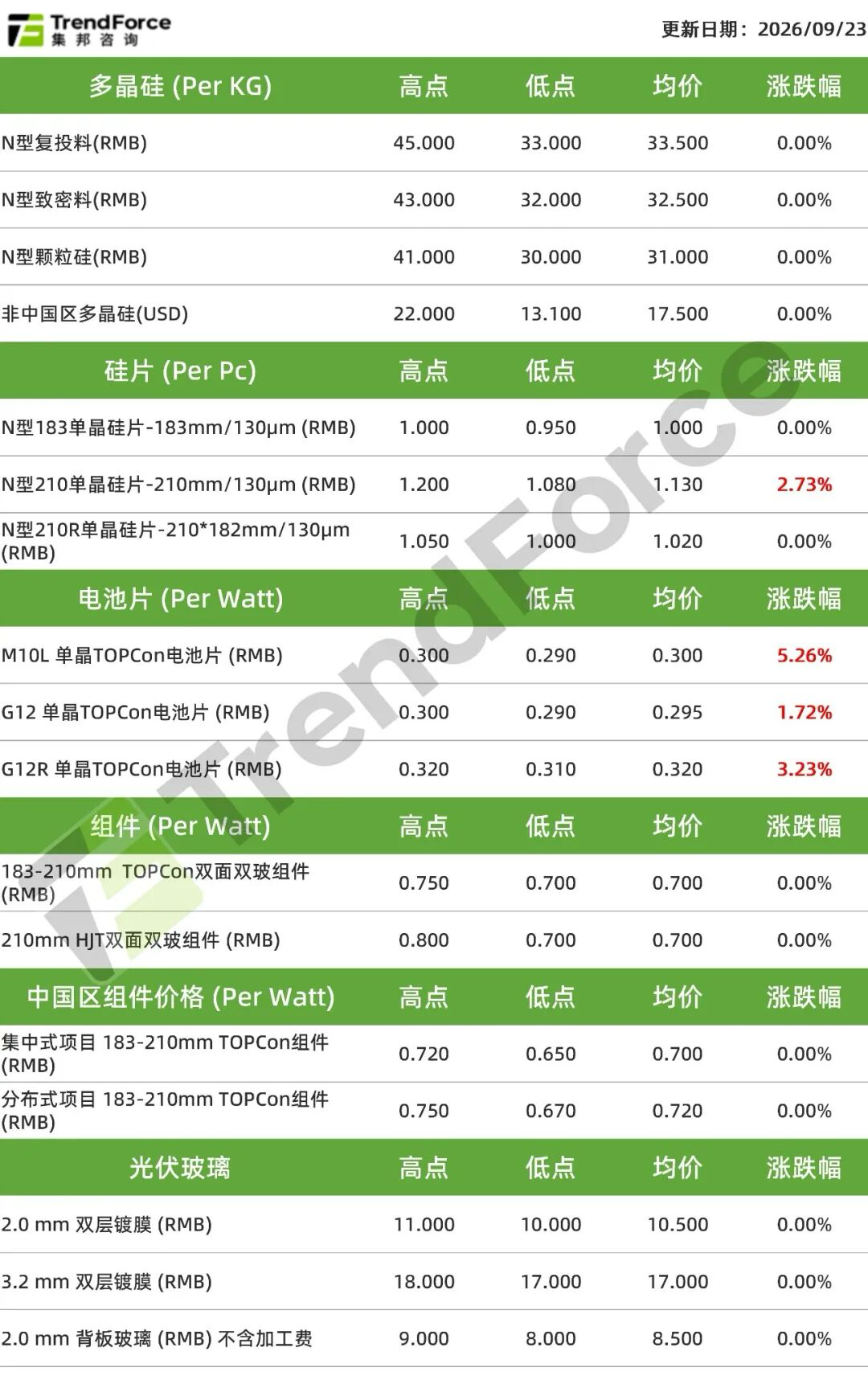
The Zhitong Finance App learned that on September 24, TrendForce Jibang Consulting released a monthly report on price trends in the global PV industry chain. In terms of silicon materials, the silicon side continued to accumulate stocks this week. Inventories rose to more than 550,000 tons, and excessive pressure on supply and demand in the market continued to increase. However, supported by strong policy expectations, the price of polysilicon remains above 40 yuan/kg. The market is in a game between weak fundamentals and policy expectations, and the overall wait-and-see sentiment is strong. Currently, actual transactions are mainly based on small orders, specific channels, and futures transactions. The market's acceptance of the high price system is still limited, and overall trading is weak.
Expectations of a sharp reduction in silicon production in October continued to increase, and leading companies are more willing to raise prices. Currently, major companies are still sticking to cost line quotes. The market has yet to actively cut prices or sell goods at low prices, and the silicon inventory of the crystal factory continues to be consumed, and the probability of price stabilization is gradually increasing.
Whether the subsequent price system can be re-established still depends on the implementation of policies and implementation of production cuts. If actual production cuts fall short of expectations, there is still a risk that silicon prices will fall back.
silicon wafer
Currently, the silicon wafer inventory remains around 26GW. Inventory changes are relatively limited, and prices are gradually stabilizing. The price of upstream silicon has stabilized for the time being, providing some support for the price of silicon wafers, but the overall inventory of silicon wafers is still relatively high. Combined with the market's expectations that some silicon wafers that have been slow to sell overseas will return, prices are still under some pressure.
Currently, the mainstream transaction prices for 183, 210R, and 210 are 1.00 yuan/piece, 1.02 yuan/piece, and 1.13 yuan/piece. Low-cost supplies have decreased, and prices are gradually stabilizing. With the rise in downstream battery prices, the stabilization of silicon prices, and the release of demand for stocking before the National Day, silicon wafer price support has increased. In the future, we will focus on changes in silicon prices and the elimination of silicon wafer inventories.
Cell
Currently, battery stocks have been in stock for about 7 days, showing a slight downward trend. Shipping pressure has eased somewhat, prices have gradually stabilized, and the focus of transactions has moved upward.
Recently, battery prices have generally risen slightly, mainly affected by improvements in supply and demand and cost-side support. On the one hand, some professional battery manufacturers have reduced the output of 183 cells, market supply has shrunk, and other companies are more willing to raise prices; on the other hand, demand for high-efficiency batteries has increased in the Middle East and India markets, especially strong demand for 210R batteries.
At the same time, domestic centralized projects released demand for 210 cells in the fourth quarter. Combined with downstream preparations before the National Day, phased demand improved. Furthermore, the rebound in silver prices and the stabilization of silicon wafers also provided some support for battery prices.
However, the current demand improvement is still mainly phased. As some overseas market orders are gradually coming to an end and external trade policies are affected, new overseas demand is expected to flatten in October, and there is still room for a decline in the operating rate of battery manufacturers in the future. Short-term battery prices are supported, but the continued rise still requires observation of terminal demand and supply adjustments.
photovoltaic module
Demand on the component side has improved compared to the previous period, but the overall demand is still weak. As we approach the fourth quarter, the commencement of domestic centralized projects has improved, and the delivery of orders for large components has increased; overseas orders from the Middle East have also entered the delivery stage, compounding the impulse demand of some companies at the end of the year. Overall component demand has improved compared to the previous period, and some companies' production schedules have increased.
The overall demand in domestic centralized and overseas markets is expected to remain lackluster in October. As orders from the Indian market are expected to end around the end of October and changes in external trade policies, the subsequent increase in overseas demand may be limited; the increase in domestic centralized projects in October is also quite limited.
In terms of price, the domestic component market is still low. Leading companies, TopCon, offer prices of about 0.70-0.72 yuan/W, while second-tier companies mostly quote less than 0.68 yuan/W, and actual transactions are limited. Since domestic terminal projects are less receptive to price increases, there are still many low-cost components in circulation in the market.
As downstream phased demand improves and battery prices rebound, module price support has increased in the short term. However, with a limited increase in overall demand in October, it is still difficult for prices to rebound. The follow-up focus will be on the implementation of anti-domestic roll policies and changes in domestic and foreign terminal demand.