
Kansai Paint (TSE:4613) Faces A Valuation Test As Short Term Momentum Cools
Kansai Paint (TSE:4613) has drawn fresh attention after a recent stretch of mixed share performance, with the stock down over the past month but higher across the past 3 months.
Recent trading suggests momentum in Kansai Paint is cooling in the very near term, with the share price down over the past week and month. However, the 90 day share price return of 7.12% and year to date gain of 14.72% indicate a still positive trend alongside a 1 year total shareholder return of 19.93%.
Scan beyond Kansai Paint and compare its recent run to a hand picked group of 17 high quality undervalued stocks that currently combine stronger balance sheets with appealing valuations.
Bulls point to Kansai Paint’s solid recent shareholder returns and a stated discount to intrinsic value, while bears focus on the cooling short term trend. Which side does the valuation arithmetic support next?
Preferred P/E of 16.8x for Kansai Paint: Is it justified?
Kansai Paint shares last closed at ¥2,836.5, and on a P/E of 16.8x they trade slightly above both the firm’s own estimated fair P/E of 16.1x and the peer averages flagged in the data. That points to a valuation that leans on the richer side compared with similar businesses in the JP Chemicals space.
The P/E ratio compares the current share price with earnings per share, so a higher multiple often reflects stronger profit expectations or a perceived quality premium. For Kansai Paint, the data shows earnings are forecast to grow 11.6% per year, faster than the broader JP market at 8.9% per year. This can help explain why investors are willing to pay more for each unit of profit.
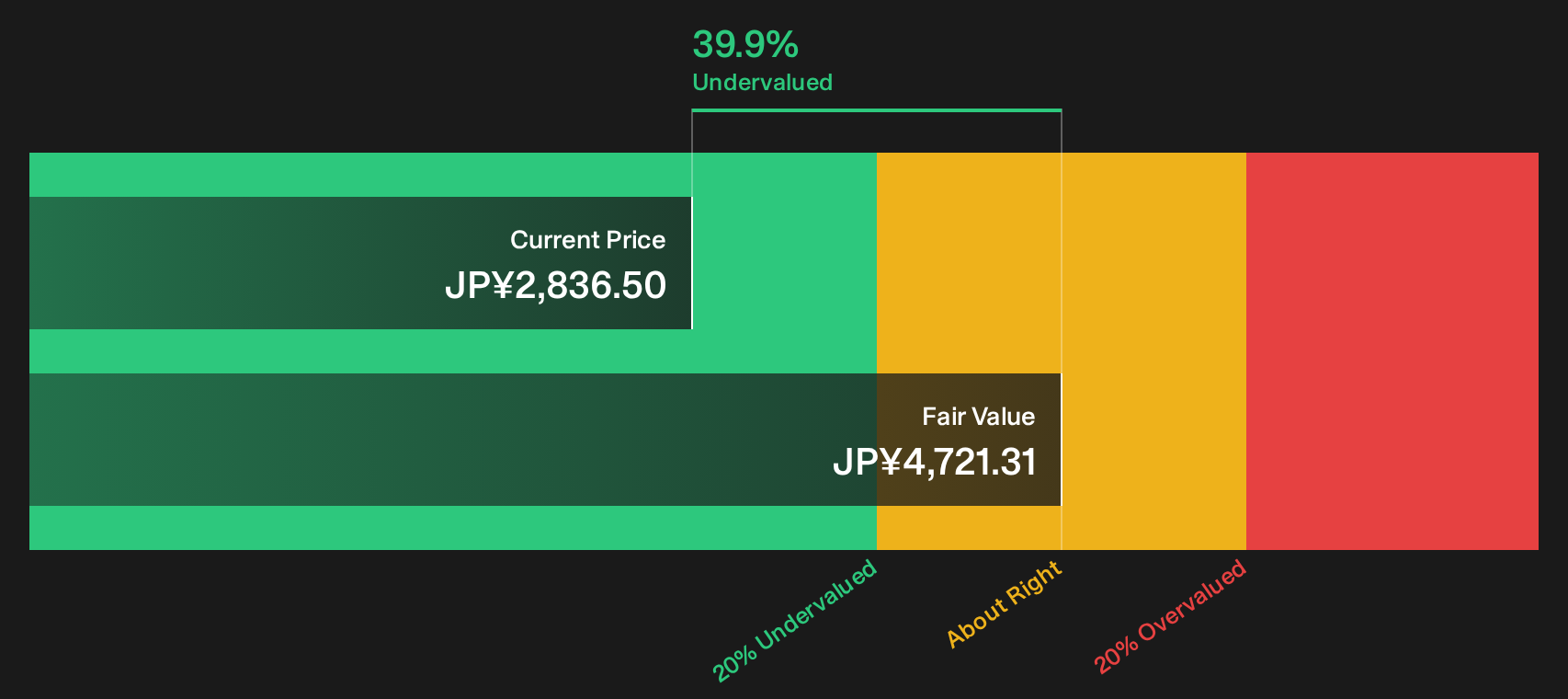
There is a tension in the numbers. The stock is described as trading 39.9% below an internal fair value estimate of ¥4,721.31 based on the SWS DCF model, yet the same dataset labels Kansai Paint as expensive relative to its fair P/E of 16.1x and to sector comparisons at 16.5x for peers and 12.9% for the wider JP Chemicals group. That mix suggests the market is pricing Kansai Paint on the higher side of earnings-based benchmarks even while some cash flow models see more upside. Investors may therefore be paying up today for the earnings growth that is expected rather than what has just been delivered.
Explore the SWS fair ratio for Kansai Paint.
Result: Price-to-earnings of 16.8x (OVERVALUED).
Still, the rich P/E on Kansai Paint could come under pressure if earnings growth underwhelms or if broader materials sector sentiment turns against cyclicals.
Find out about the key risks to this Kansai Paint narrative.
Another View on Kansai Paint’s Value
On earnings, Kansai Paint screens a little expensive. On cash flows, the story flips. The SWS DCF model points to a fair value of ¥4,721.31 per share, which is well above the current ¥2,836.5 level and implies the stock trades at a discount using that lens.
This kind of gap between a P/E premium and a DCF discount can point to either an opportunity or a value trap. It depends on how much confidence you place in long term cash flow forecasts versus near term profit metrics. Which lens do you trust more for Kansai Paint right now?
Look into how the SWS DCF model arrives at its fair value.
Simply Wall St performs a discounted cash flow (DCF) on every stock in the world every day (check out Kansai Paint for example). We show the entire calculation in full. You can track the result in your watchlist or portfolio and be alerted when this changes, or use our stock screener to discover 17 high quality undervalued stocks. If you save a screener we even alert you when new companies match - so you never miss a potential opportunity.
Next Steps
Mixed signals around Kansai Paint’s valuation and recent performance can feel messy, so move quickly, weigh the upside and downside data, and pressure test it yourself against the 2 key rewards and 1 important warning sign.
Looking for more Kansai Paint sized opportunities?
If Kansai Paint has you thinking more broadly about where to put fresh capital, use this moment to widen your watchlist before the next leg of the market moves.
- Target potential mispricings by scanning companies that combine quality fundamentals with attractive valuations through the 17 high quality undervalued stocks.
- Strengthen your income stream by focusing on resilient payers with higher yields via the 14 dividend fortresses.
- Protect your downside by filtering for businesses with sturdier finances using the list of solid balance sheet and fundamentals (21 results).
This article by Simply Wall St is general in nature. We provide commentary based on historical data and analyst forecasts only using an unbiased methodology and our articles are not intended to be financial advice. It does not constitute a recommendation to buy or sell any stock, and does not take account of your objectives, or your financial situation. We aim to bring you long-term focused analysis driven by fundamental data. Note that our analysis may not factor in the latest price-sensitive company announcements or qualitative material. Simply Wall St has no position in any stocks mentioned.
Have feedback on this article? Concerned about the content? Get in touch with us directly. Alternatively, email editorial-team@simplywallst.com