
How Chairman Change Will Impact Berkshire Hathaway Stock Investors
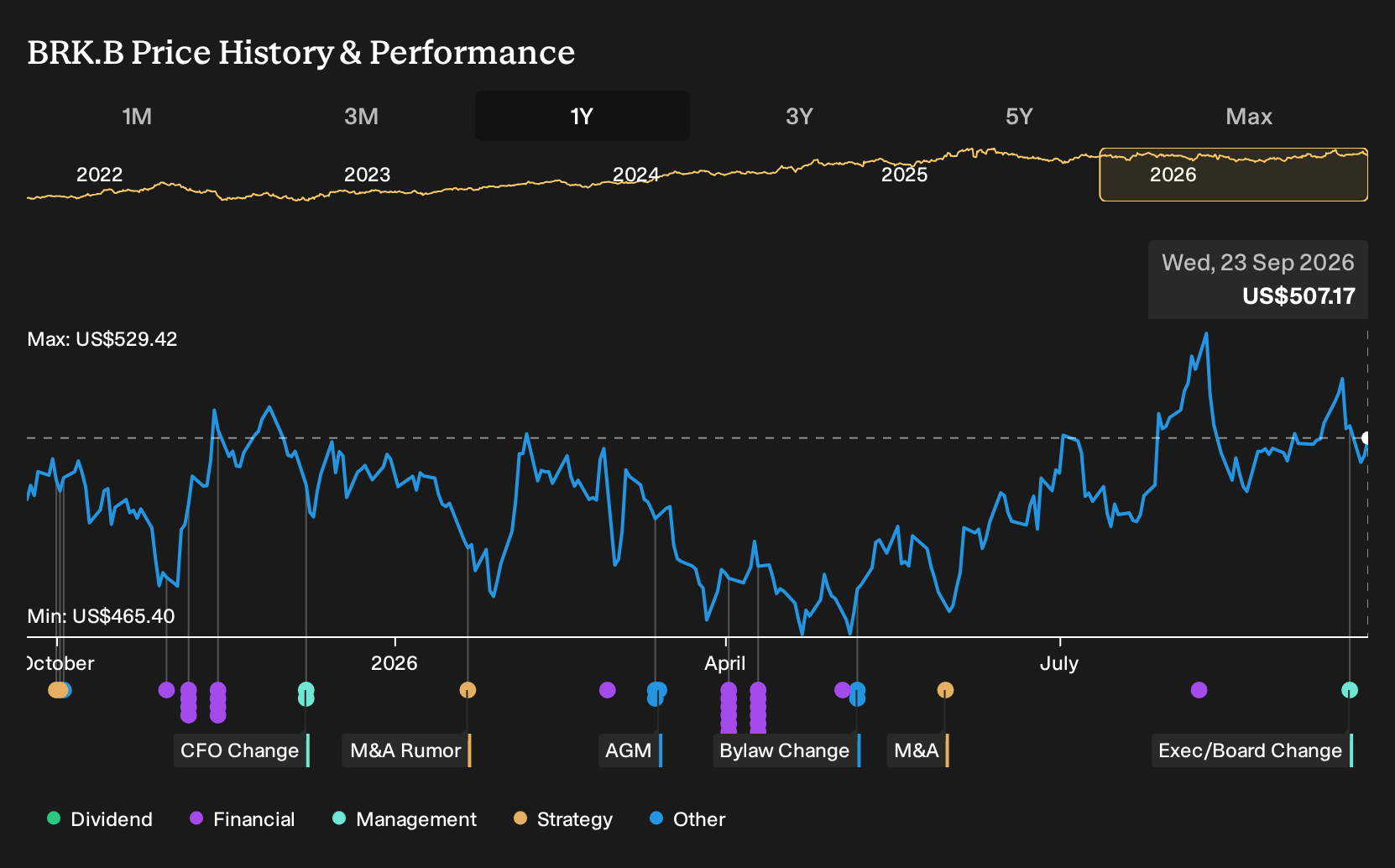
- Berkshire Hathaway reported that Warren Buffett stepped down as chairman on September 18, 2026, becoming chairman emeritus while remaining on the board, with Howard Buffett elected chairman and Greg Abel already serving as CEO.
- The handover concentrates board leadership and capital allocation oversight in Howard Buffett and Greg Abel. This combination directly affects how Berkshire Hathaway deploys its large insurance float, utility spending and equity portfolio.
- We will examine how Berkshire Hathaway's investment narrative is shaped by Greg Abel's leadership as CEO and Howard Buffett's appointment as chairman.
Berkshire Hathaway Investment Narrative Recap
To own Berkshire Hathaway, you need to be comfortable with a sprawling operating mix, from insurance and rail to utilities and housing, and with earnings that analysts expect to decline 7.2% per year over the next 3 years. The big near term swing factor sits in how effectively Greg Abel and Howard Buffett keep that machine disciplined while absorbing higher capital needs in power, housing and data infrastructure.
The biggest short term catalyst remains how Berkshire deploys cash across utilities, housing and its equity book, especially as AI related power demand and US housing exposure evolve. The key risk right now is not operational strain in a single segment but any slip in confidence around the new leadership’s capital allocation judgment after Warren Buffett’s step back.
The most relevant recent development is Warren Buffett’s move to chairman emeritus and Howard Buffett’s election as chairman, on top of Greg Abel already running Berkshire Hathaway as CEO. This formalizes a succession plan that investors had expected, but now concentrates oversight of a US$1t plus group and its sizeable cash and investment pool in a refreshed leadership pairing.
That matters for every major catalyst on the table. Decisions on utility build out for AI driven data centers, further expansion in specialty insurance and housing exposures such as Taylor Morrison or Lennar all run through this leadership framework. Execution quality, board oversight through Susan Decker as lead independent director, and consistent communication will shape how much weight investors put on the current risks around earnings forecasts and return on equity.
What The Current Forecasts Assume For Berkshire Hathaway
Berkshire Hathaway's current analyst narrative rests on a fairly specific earnings path. Consensus assumptions point to revenue growth of 5.3% a year over the next three years, shrinking profit margins and a material reset in reported profit levels by the end of the decade.
On these numbers, the business is expected to move from US$85.8b of earnings today to US$53.1b by 2029. That is a decline of about US$32.7b in annual profit, even as analysts project revenues of US$448.5b in the same year.
Those forecasts also imply a different capital markets profile for Berkshire Hathaway. Analysts are baking in a higher P/E multiple of 26.1x on the 2029 earnings, relative to 12.7x today and above the 17.2x level cited for the US diversified financials group, and a modest 0.77% yearly reduction in share count as buybacks continue.
Putting it together, the fair value work in the consensus view links a US$799,502.75 price target to that 2029 revenue and earnings path, a 7.5% discount rate and the assumption that investors will still accept a premium valuation multiple for the stock compared with sector averages.
Berkshire Hathaway's narrative projects US$448.5b revenue and US$53.1b earnings by 2029. This rests on 5.3% yearly revenue growth and an earnings decline of about US$32.7b from US$85.8b today.
Uncover why Berkshire Hathaway's fair value indicates a 5% potential upside to its current price, which could narrow quickly.
Exploring Other Perspectives
Four fair value estimates from the Simply Wall St Community cluster between about US$799,503 and US$1,188,422 per Berkshire Hathaway share, with the upper end implying a far richer appraisal than the lower band. Those private investors are not factoring in the recent leadership shift, so you need to weigh succession risks, AI driven power demand and expanded housing exposure when comparing their views. Use these differing opinions as a prompt to explore several alternative angles before setting your own expectations.
Explore 3 other Berkshire Hathaway fair value estimates, including one that suggests it could be worth just $799,503.
The Verdict Is Yours
Disagree with existing narratives? Extraordinary investment returns rarely come from following the herd, so go with your instincts.
- A great starting point for your Berkshire Hathaway research is our analysis highlighting 3 key rewards and 1 important warning sign that could impact your investment decision.
- See our latest analysis for Berkshire Hathaway. The report includes a comprehensive fundamental analysis summarized in a single visual, the Snowflake, making it easy to evaluate Berkshire Hathaway's overall financial health at a glance.
Looking for more Berkshire Hathaway style ideas?
If Berkshire Hathaway's mix of resilient cash generation and long term compounding appeals to you, it can help to widen the search across other high quality businesses. The Simply Wall St Screener lets you filter for the traits you care about most, so you can build a watchlist that fits your own risk and return preferences.
- If capital preservation is your priority, start with steady operators that screen as resilient using our 31 resilient stocks with low risk scores.
- For investors who care most about balance sheet strength and underlying fundamentals, narrow the field with a focused list of solid balance sheet and fundamentals (23 results).
- If you want to spot underfollowed opportunities with room for a fuller market appraisal, sort through a curated pool of 16 high quality undiscovered gems.
This article by Simply Wall St is general in nature. We provide commentary based on historical data and analyst forecasts only using an unbiased methodology and our articles are not intended to be financial advice. It does not constitute a recommendation to buy or sell any stock, and does not take account of your objectives, or your financial situation. We aim to bring you long-term focused analysis driven by fundamental data. Note that our analysis may not factor in the latest price-sensitive company announcements or qualitative material. Simply Wall St has no position in any stocks mentioned.
Have feedback on this article? Concerned about the content? Get in touch with us directly. Alternatively, email editorial-team@simplywallst.com