
US mortgage rates hit a two-year high! The US property market is facing a 7% interest rate barrier, and real estate recovery transactions are under pressure
The Zhitong Finance App learned that US mortgage interest rates have risen sharply to the highest level in more than two years, further hampering the US housing market, which has been suppressed by high housing prices and weak sales in recent years. According to data released by the American Mortgage Bankers Association on Wednesday, contract interest rates for 30-year fixed-rate mortgages rose sharply by 15 basis points to 7.12% in the week ending September 18, the highest level since May 2024. However, interest rates on adjustable-rate mortgages with fixed interest rates unexpectedly fell 13 basis points to 6.1% in the first five years.
The US 30-year fixed mortgage interest rate can be roughly split into 10-year US bond yield+mortgage backed securities (MBS) interest spreads compared to treasury bonds+cost and profit increases for loan issuance, services, guarantees, etc. The principal amount of the mortgage is gradually repaid, and the borrower may also repay or refinance early, so the interest rate risk period is not the same as the 30-year term of the contract. The market usually uses 10-year US bond yields rather than longer-term risk-free returns or short-term borrowing costs as an important pricing benchmark; MBS interest spreads will also change with factors such as the risk of early repayment.
As interest rates on 30-year fixed mortgages rose to 7.12%, home purchase loan applications and refinancing applications fell by 0.8% and 2.6%, respectively, highlighting the increase in long-term financing costs further reducing the purchasing power of housing. At the same time, as some high-income and middle-class relocation needs such as marriage and job changes still provide some support, economists have different judgments about the room for further decline in the housing market.
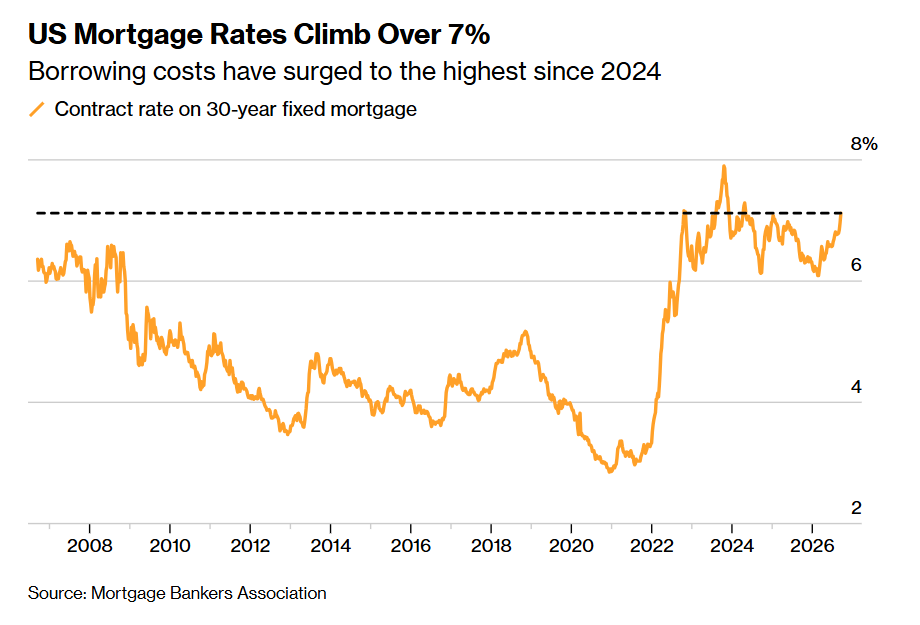
As shown in the chart above, US mortgage interest rates rose above 7% — home borrowing costs soared to their highest level since 2024. Source: American Mortgage Bankers Association.
US mortgage interest rates soared above 7%, hitting a new high of more than two years
Mortgage interest rates have been on an upward trend since February. At that time, the war in Iran broke out, driving up energy prices, which once again raised concerns about inflation. The Federal Reserve raised its benchmark interest rate for the first time since 2023 last week to contain pressure on prices.
As borrowing costs have climbed, fewer Americans are applying for housing finance. The American Mortgage Bankers Association Home Buying Index, which measures home loan applications, fell 0.8% to a four-week low. The Association's refinancing index fell 2.6% to its lowest level since February 2025.
Breaking through the 7% mark could further dampen demand. “The reason 7% is important is simply because when people see interest rate numbers starting with '7', it has a psychological impact,” said Darryl Fairweather, Redfin's chief economist.
Veteran economist Fairwether predicts that higher interest rates will limit the rise in housing prices, but sales will remain sluggish.
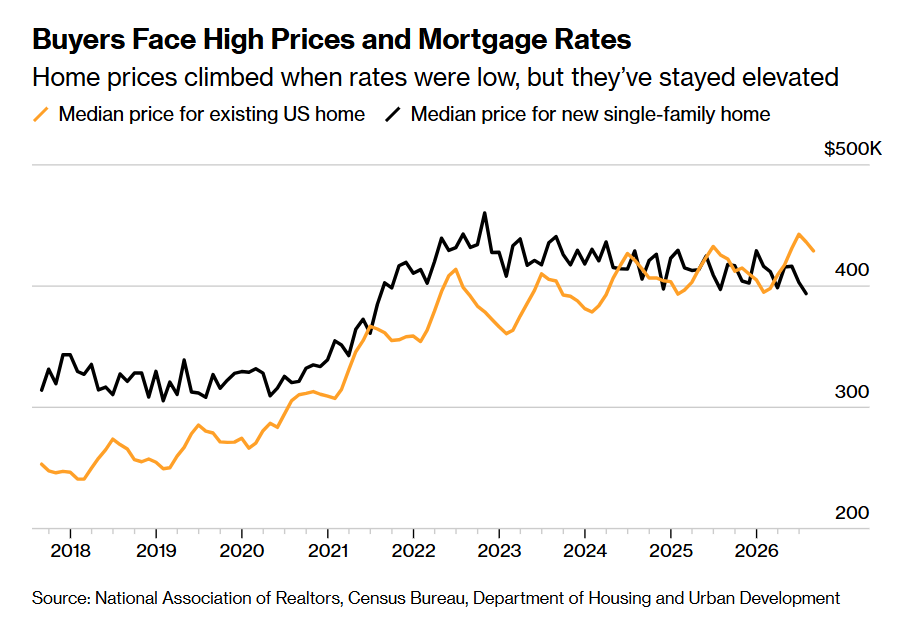
As shown in the chart above, buyers have faced high housing prices and high mortgage interest rates in recent years — housing prices rose during a period of low interest rates, and since then have remained high in the context of the Federal Reserve's interest rate hikes and interest rate cuts. Source: National Association of Realtors, US Census Bureau, US Department of Housing and Urban Development.
Existing home sales fell to their lowest level in more than a year in August. Homebuilders' confidence was at its lowest level since late 2022 this month, as higher interest rates discouraged potential buyers, while rising prices for building materials and fuel drove up costs.
Home builders have also been laying off workers — the number of people employed in the residential construction industry peaked in September 2024 and has generally been declining since then.
“The housing market itself has clearly fallen into recession, but this recession may not be deep enough or last long enough to drag the rest of the economy back into recession,” said Ben Ayers, senior economist at Nationwide.
Borrowing costs are likely to remain high. Mortgage interest rates closely follow the 10-year US Treasury yield, which is hovering close to the highest level in nearly 20 years. Nationwide expects mortgage interest rates to remain around 7% until at least the end of this year.
Even so, there is probably not much room for the housing market to decline further.
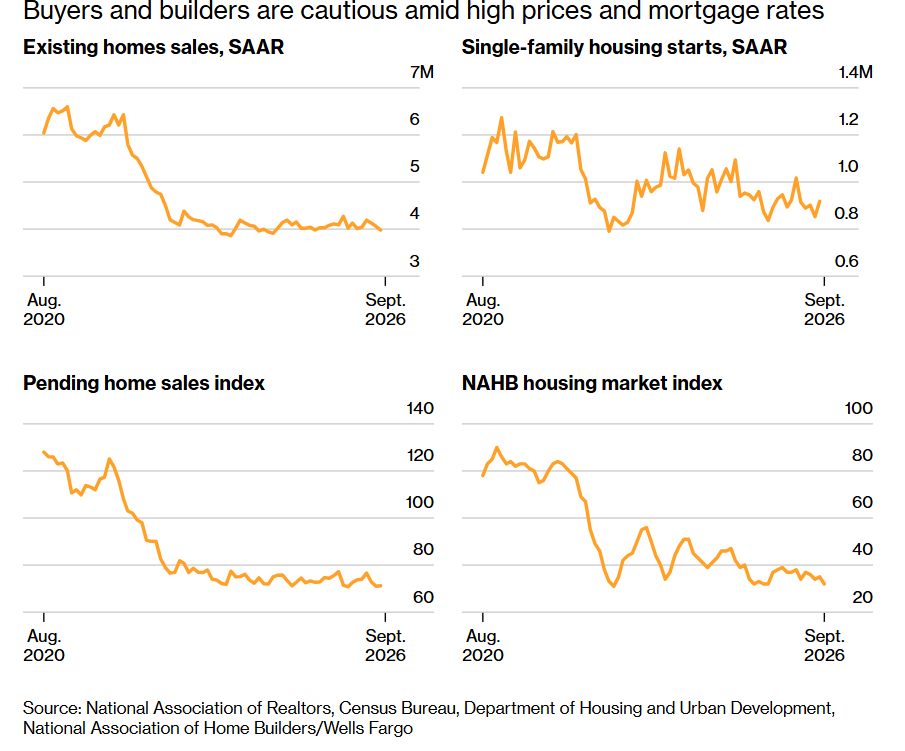
As shown in the chart above, home sales and new home construction are at a low level — high housing prices and high mortgage interest rates keep buyers and builders cautious. Source: National Association of Realtors, US Census Bureau, US Department of Housing and Urban Development, National Association of Home Builders/Wells Fargo.
“Right now, we're very close to the bottom,” said Hannah Jones, senior economist at Realtor.com. “Touching the 7% figure does have a psychological impact, but I don't think there will be a cliff-style drop in demand.”
Jones said that although no one will move just to seize favorable market opportunities, marriage, divorce, and job changes will still support the housing market.
The American Mortgage Bankers Association has conducted this survey weekly since 1990, using feedback from mortgage banks, commercial banks, and savings agencies. The relevant data covers more than 75% of retail residential mortgage applications in the US.
Behind the continued high yield on US bonds with a term of 10 years or more: inflationary pressure compounded demand for AI financing
US bond yields have continued to be high recently, reflecting the market's repricing of future policy interest rates, energy inflation due to the worsening geopolitical situation in the Middle East, and risk compensation required to hold long-term bonds. The Federal Reserve raised interest rates by 25 basis points on September 16, 2026, raising the federal funds rate target range to 3.75% — 4.00%; the median official interest rate forecast announced during the same period suggests that interest rates may be raised by another 25 basis points during the year.
On September 18, which corresponds to the mortgage survey, the 10-year and 30-year US Treasury yields were 5.01% and 5.34%, respectively; although they fell back to 4.96% and 5.29% on September 21, they were still high. The inflationary pressure brought about by energy prices and expectations of subsequent austerity are being transmitted through the long-term financing market to corporate investment and residents' housing purchase costs.
The expansion of AI infrastructure has increased the need for long-term financing. Assets such as large AI data center parks and electricity support require long-term financial support. Technology companies issuing long-term bonds will increase the interest rate risk that investors need to accept; project operators may also lock in financing costs through “floating interest rate borrowing+payment of fixed interest rate swaps” and transfer additional long-term interest rate risks to the long-term US bond yield pricing market.
As for the yield curve of long-term US bonds of 10 years or more, the more critical structural force comes from the “fiscal deficit+AI debt issuance” competition for the global long-term bond pool: the balance of US treasury bonds broke through the 40 trillion US dollar supermark with an unprecedented record, and the deficit for the 2026 fiscal year is expected to be about 1.9 trillion to 2.1 trillion US dollars; at the same time, AI-related debt is close to 15% of this year's investment-grade bond issuance volume. Goldman Sachs claims that Google's parent company Alphabet and Amazon (Amazon) global hyperscale cloud computing service providers (that is, AI) Hyperscalers) has issued approximately US$194 billion in bonds and anticipates that its direct financing supply may reach approximately US$250 billion in 2026.
Looking more broadly, AI hyperscalers such as Alphabet, Amazon, and Meta have issued nearly 220 billion US dollars in bonds since this year, which is more than double the full year of 2025 of 108 billion US dollars. Judging from current comparable data, it can be called “a record high for the same period or a record issuance pace during the same period.”
Dallas Federal Reserve researchers point out that these financing channels may affect long-term yields and term premiums. The core transmission mechanism behind this is an increase in long-term capital demand and long-term risk supply. When other conditions remain unchanged, additional upward pressure is placed on the interest/yield curve mechanism for a period of 10 years or more.