
US stock earnings forecast to turn negative for the first time in 23 weeks! Analysts are wary of inflation and high interest rates eroding corporate profits
The Zhitong Finance App notes that stock analysts' views on the profit prospects of US companies have turned net negative, for the first time in months, reflecting market concerns that rising inflation and interest rates are eroding corporate profits.
A Citigroup index shows that for the first time in 23 weeks, the number of analysts who lowered their profit expectations surpassed those who raised them, ending the longest upward cycle since September 2021.
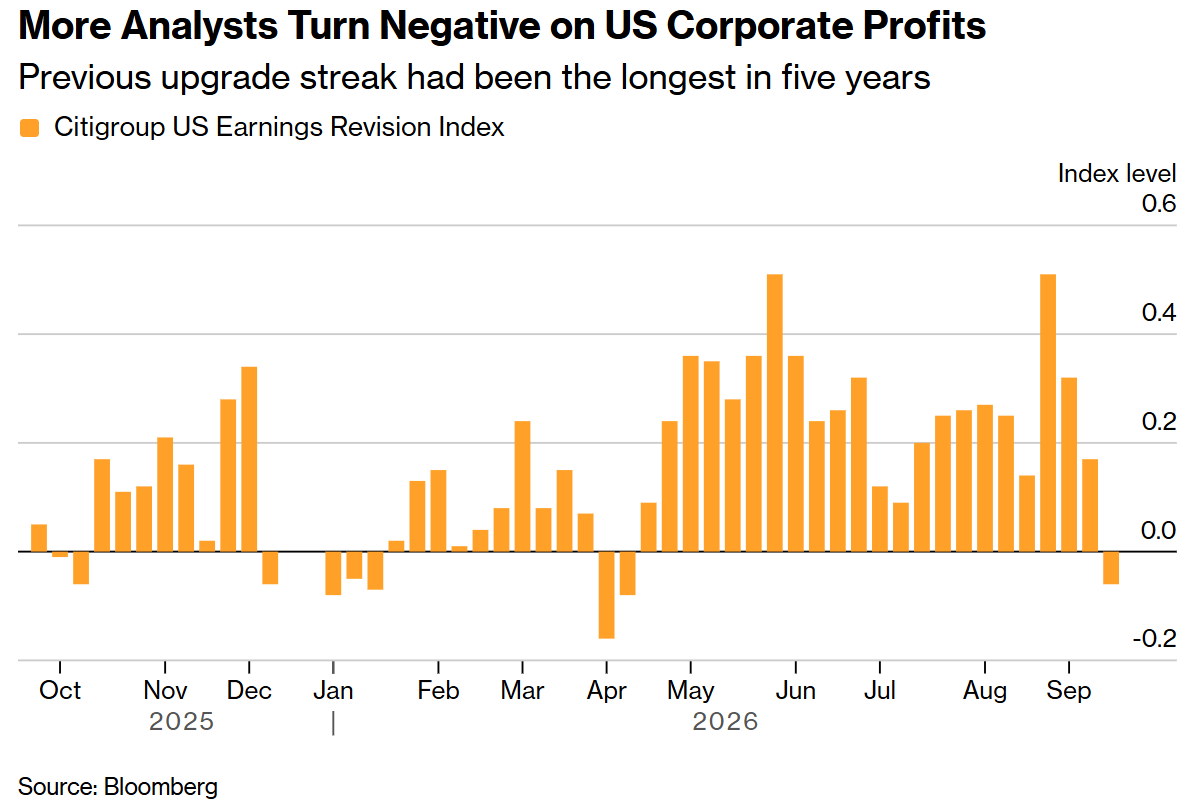
More analysts are pessimistic about US corporate profits
Stefan Kemper, chief investment officer of BNP Paribas Wealth Management Germany, said: “The main driver of this round of weakness is the consumer sector, which includes both essential and non-essential consumer goods, as well as raw materials and finance.” “I think these (profit expectations) downgrades can be directly attributed to the combined effects of rising living costs and rising energy prices.”
Although Wall Street analysts are generally confident that US companies will usher in a profitable harvest year, some have raised concerns about the short-term outlook for the stock market.
This judgment is being echoed by more and more institutions. Helen Jewell, the international chief investment officer for fundamental stocks at BlackRock, the world's largest asset management company, recently said that the market's forecast for US companies' profits this year “is still in a fairly high double-digit range — 15%, 16%, 17%, 18%,” so there is considerable room for reduction.
In particular, she pointed out that considering the level of interest rates and the impact of inflation brought about by the situation in the Middle East, the market's forecast for stable profits in the consumer sector is “difficult to hold.” In her view, the benefits of improved earnings in energy stocks and materials stocks will be offset by downgrades in aviation and other sectors, and the overall profit growth rate may eventually “remain roughly flat.”
In addition to declining profits, valuation risks have also alerted strategists. Michael Wilson, chief US stock strategist at Morgan Stanley, warned that if stock valuations continue to fall recently and energy prices rise further to force monetary policy tightening, the S&P 500 index faces up to 7% downside. Since then, the team further suggested that interest rate sensitivity in the current market has risen to the highest level in recent years. The 10-year US Treasury yield is approaching the 4.5% key threshold, and interest rate hikes are still the core risk variable hanging over the stock market.
It is also difficult to find room for relaxation at the macro level. The Organization for Economic Cooperation and Development (OECD) expects global inflation in 2027 to be faster than previously predicted, and monetary policy needs to be further tightened; the Federal Reserve raised interest rates for the first time in three years earlier this month to respond to price pressure. The combination of high inflation and high interest rates means that corporate profit margins and stock valuations will be under pressure at the same time.