
The service industry works hand in hand with Germany and France! Eurozone PMI unexpectedly soared to a three-year high in September, and the market is betting that the ECB will raise interest rates again in October
The Zhitong Finance App learned that business activity in the Eurozone unexpectedly accelerated in September, the initial value of the comprehensive PMI rose to the highest level in more than three years, the service sector improved beyond expectations, and the two major economies of Germany and France were both better than expected. As new orders grew at the fastest rate in more than four years, and investment costs jumped again due to high energy prices, the market's bets on further ECB rate hikes have clearly heated up.
According to data released by S&P Global on Wednesday, the Eurozone's initial composite PMI for September rose from 52.0 in August to 53.1, far above the 50 boom and bust dividing line, and higher than analysts' expectations of 51.7.
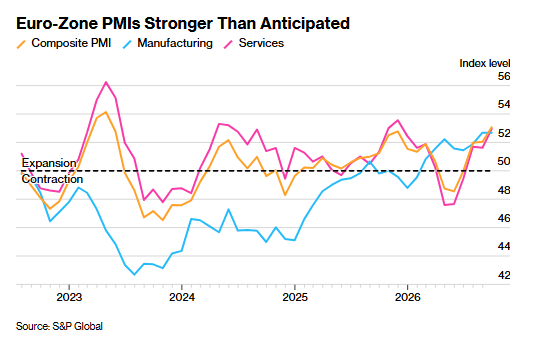
Looking at each item, the service industry was the biggest surprise. The Eurozone service sector PMI rebounded to 53.0 from 51.6 in August to a new high of nearly a year, but the market had expected it to fall to 51.5. The manufacturing PMI remained flat at 52.7 in August, but the output measurement index rose slightly from 53.3 to 53.4, and continued to support the overall PMI. Overall new orders surged at the fastest rate in more than four years, and exports rose further, including trade within the Eurozone.
The recovery in demand has led companies to increase recruitment, but at the same time, companies are facing a sharp rise in investment costs. Due to the Middle East conflict and the war between the US and Iran driving up energy prices, corporate operating costs have clearly jumped, and part of the costs can be passed on to customers.
Chris Williamson, chief commercial economist at S&P Global Markets Finance, said that it was not surprising that inflationary pressure rose again in September because the ongoing conflict in the Middle East drove up energy prices; however, in this context, economic growth is still showing resilience, which is even more encouraging.
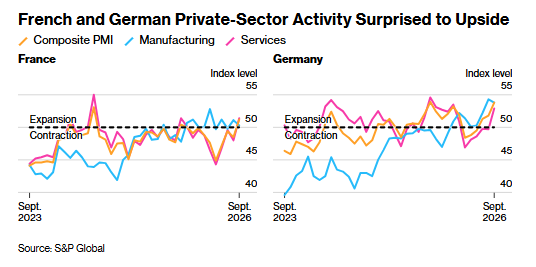
At the country level, the two largest economies in the Eurozone both surpassed expectations. German business activity grew at the fastest rate since October 2025, while France unexpectedly expanded, and the growth rate was the fastest in more than two years. Williamson pointed out that the manufacturing industry, led by Germany, is enjoying the best growth period in more than four years, and rising spending on artificial intelligence and defense has become an important driving force; at the same time, growth in the service sector is also picking up, indicating that the economic growth story is showing broad improvements.
Williamson also said that order book growth in the manufacturing and service sectors in September both further gathered momentum, suggesting that the economy is expected to maintain its momentum after entering the fourth quarter. However, he also warned that a strong economy is driving up consumer prices.
Although the Eurozone economy has shown more resilience than expected to the Middle East conflict and rising energy costs, it is uncertain how long this resilience will last. Inflation in the Eurozone is currently at its highest level in nearly three years, and borrowing costs are rising. Earlier this month, the ECB raised interest rates for the second time this year, and the second since the war began in Iran, to curb energy-driven inflation and warned that price pressures might prove to be continuous. Officials are relieved by the steady performance of the economy and have raised this year's economic growth forecast to 0.9%.
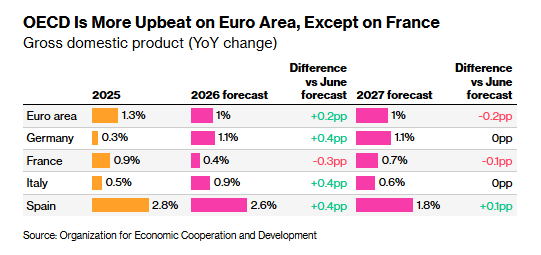
The OECD also announced a more positive outlook for the Eurozone, raising its 2026 growth forecast by 0.2 percentage points to 1% on Wednesday, while also raising forecasts for Germany, Italy, and Spain. In contrast, the organization drastically lowered its forecast for France, which currently expects the second-largest economy in the Eurozone to grow by only 0.4%.
Current market pricing shows that the ECB will raise interest rates three times before the end of June next year. Williamson believes that in the context of geopolitical headwinds and rising prices, the resilience of economic growth may encourage the ECB to raise interest rates again before the end of the year and increase reasons to act as soon as possible, making it “very likely” to raise interest rates in October. The ECB is likely to take action again as early as October.
The reason PMI is closely watched by the market is that it is released at the beginning of each month, which can reveal economic trends and turning points earlier. As an indicator to measure the extent of changes in output rather than depth, it is sometimes difficult for business surveys to directly map quarterly GDP performance, but their latest readings have strengthened the market's focus on economic resilience and inflationary pressure in the Eurozone.