
Learn Why The Bull Case For CSX Stock Could Change Following Worker Furloughs
- CSX has moved to furlough around 1,100 workers and permanently cut 165 maintenance of way roles, with unions warning that reduced engineering and track staff could increase maintenance backlogs and safety risks for crews and communities.
- The workforce cuts highlight a core trade off at CSX between lowering operating costs and sustaining the labor intensive inspection and repair work that underpins safe, reliable rail service.
- This article examines how CSX's investment narrative is affected by these large scale maintenance furloughs and the safety concerns they raise.
Compare CSX's labor and safety story with freight rail peers by scanning our hand picked 30 resilient stocks with low risk scores that aim to balance operational efficiency with lower operational risk profiles.
CSX Investment Narrative Recap
For CSX, the basic belief is that a high fixed cost rail network can support modest revenue growth while productivity work and corridor projects gradually lift earnings. The furlough of roughly 1,100 workers, including many tied to inspections and maintenance, now sits uncomfortably against that thesis because service reliability and safety metrics are already central to the story.
In the near term, the key catalyst is how well CSX handles new intermodal corridors and the industrial project pipeline without tripping service issues. The biggest risk is that thinner engineering staffing leads to delays, backlogs or regulatory responses that offset cost savings and make it harder to capture that incremental volume efficiently.
The furlough plan and permanent loss of 165 maintenance of way positions line up directly with those execution risks. Unions are already flagging safety concerns and talking to regulators, which could add scrutiny at the same time CSX is trying to prove that productivity initiatives and infrastructure work can support higher volumes and margins.
Emergency track work at Cross Hill after a defect was found shows how dependent CSX is on timely inspections and repairs to keep dwell times, trip plan performance and accident rates under control. If maintenance backlogs grow or public incidents rise, service quality could come under pressure just as new routes, industrial projects and truck to rail conversions are meant to act as the main earnings drivers.
How CSX's Cuts Line Up With Analyst Assumptions
Analyst models for CSX still lean on a fairly clean financial story. They build on revenue rising by 5.2% a year over the next three years and margins stepping up from 22.2% today to 26.5% by 2029. That picture assumes the railroad can push productivity and capital efficiency while keeping its network reliable enough for customers and regulators to stay onside.
The same forecasts call for earnings to move from about US$3.2b today to a consensus of US$4.5b by around 2029, with the most optimistic views closer to US$4.9b. Those figures sit alongside expectations that share count edges down roughly 0.52% a year, which lifts earnings per share on top of the underlying profit expansion. It is a carefully balanced equation where cost cuts are expected to boost profitability without materially undercutting safety or service.
CSX's workforce reductions sit right in the middle of this framework. Furloughs and permanent maintenance cuts lower operating expense today. At the same time, the assumptions behind the current models imply that inspection and repair work still happens at a level that supports higher volumes, better trip plan performance and a tighter accident record. If backlogs widen or regulators react to union warnings, the margin uplift built into these numbers could be harder to achieve.
Analysts also tie their view of CSX to a specific valuation bridge. Their consensus implies a future P/E of 27.7x on those 2029 earnings, compared with about 26.4x at the moment, and below the US Transportation sector at roughly 32.6x. That multiple rests on the idea that the railroad can keep pushing structural productivity, including headcount and non fuel spending, while still convincing customers and policy makers that it is running a safer, more resilient operation despite leaner staffing on the ground.
CSX's narrative projects US$16.9b revenue and US$4.5b earnings by 2029. This assumes 5.2% yearly revenue growth and an earnings increase of about US$1.3b from US$3.2b today.
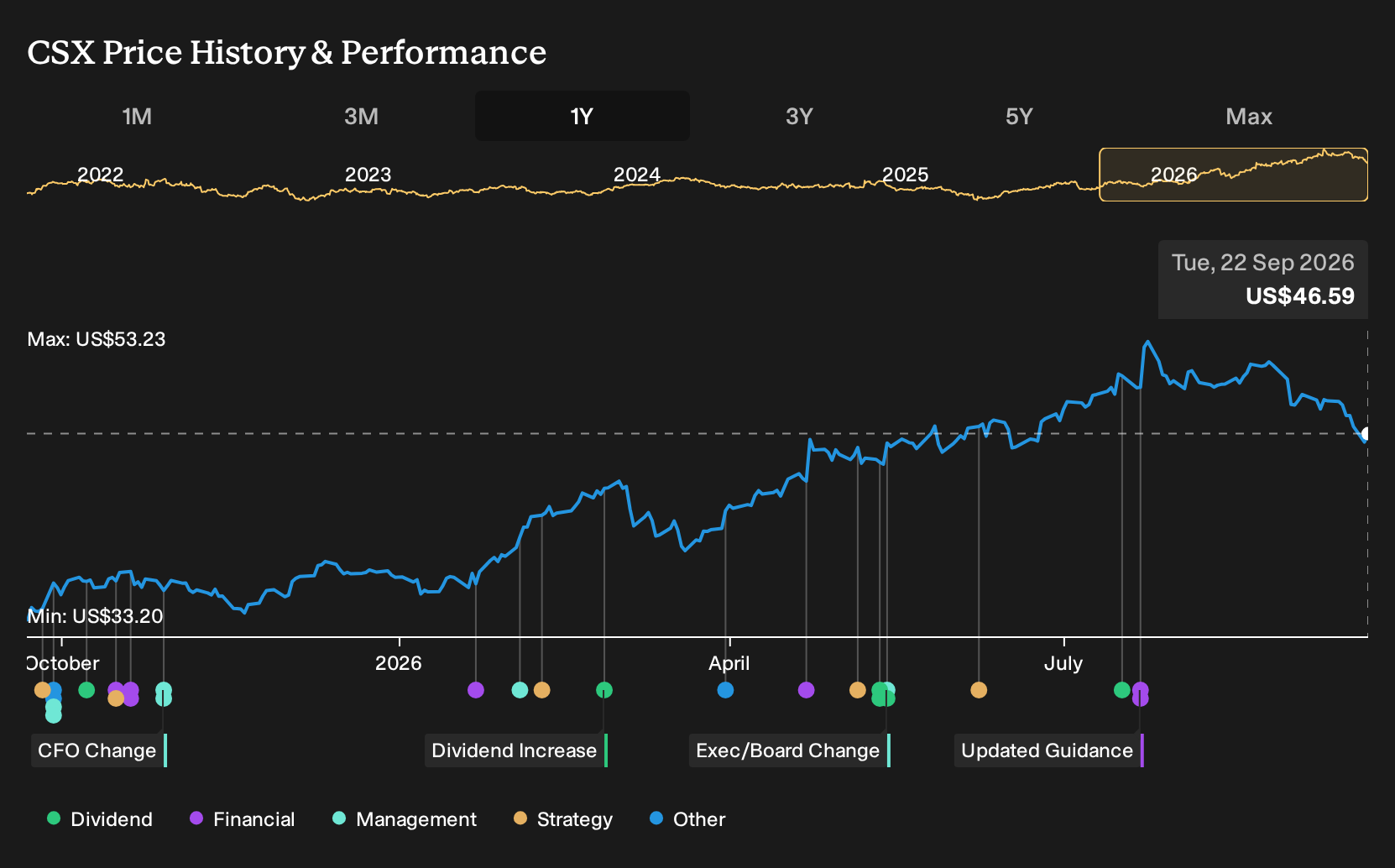
Uncover how CSX's fair value indicates a 14% potential upside to its current price, before that discount to CSX closes.
Exploring Other Perspectives
Some of the most optimistic analysts were treating CSX’s cost program itself as a major catalyst, expecting revenue to reach about US$17.6b and earnings near US$4.8b by 2029. You may now see those same cuts very differently. Opinions clearly span a wide range, so it makes sense to compare several viewpoints before deciding how this news might reshape your own thesis.
Explore 3 other CSX fair value estimates, including one that suggests as much as 14% upside from the current price.
Decide For Yourself
Don't just follow the ticker; dig into the data and build a conviction that's truly your own.
- A great starting point for your CSX research is our analysis highlighting 3 key rewards and 2 important warning signs that could impact your investment decision.
- See our latest analysis for CSX. The report includes a comprehensive fundamental analysis summarized in a single visual, the Snowflake, making it easy to evaluate CSX's overall financial health at a glance.
Looking For More Ideas Beyond CSX?
If this CSX story has you rethinking risk, return and resilience, it can help to widen the lens and compare it with other businesses that fit different profiles on quality, income and balance sheet strength.
- If you want potential mispricing paired with stronger fundamentals, scan a curated set of 16 high quality undiscovered gems that might not yet be on every investor's radar.
- If income is a priority, focus on cash return potential by reviewing a selection of 7 dividend fortresses that aim to pair higher yields with sturdier payout profiles.
- If capital preservation comes first, concentrate on financial resilience by working through a list of solid balance sheet and fundamentals (23 results) that filters for stronger balance sheets and steadier fundamentals.
This article by Simply Wall St is general in nature. We provide commentary based on historical data and analyst forecasts only using an unbiased methodology and our articles are not intended to be financial advice. It does not constitute a recommendation to buy or sell any stock, and does not take account of your objectives, or your financial situation. We aim to bring you long-term focused analysis driven by fundamental data. Note that our analysis may not factor in the latest price-sensitive company announcements or qualitative material. Simply Wall St has no position in any stocks mentioned.
Have feedback on this article? Concerned about the content? Get in touch with us directly. Alternatively, email editorial-team@simplywallst.com