
AI Partnerships Might Change The Case For Investing In Intel Stock (INTC)
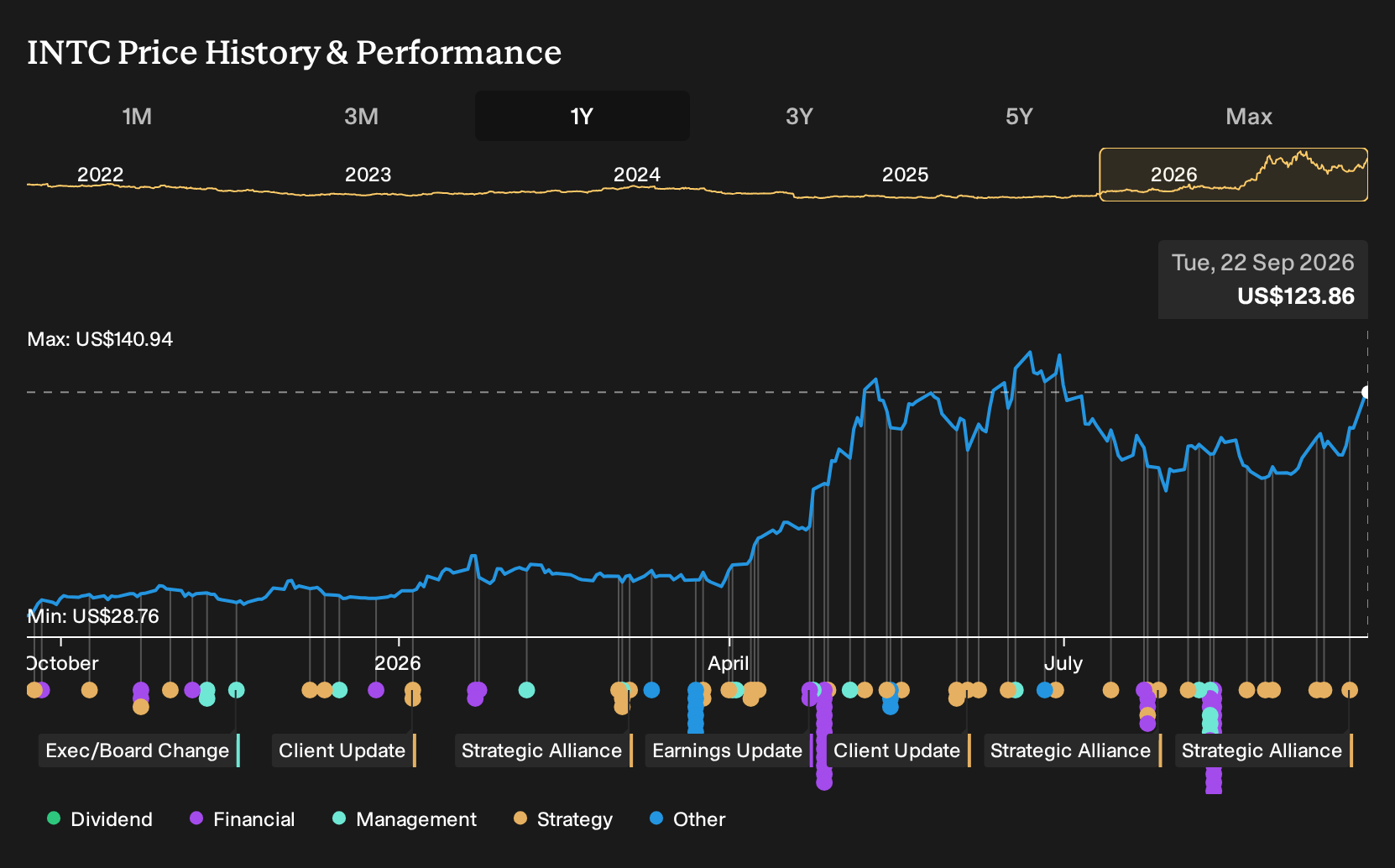
- Advantech expanded its WEDA powered Edge AI ecosystem with Intel, Qualcomm and AMD, aiming to simplify edge workload development, deployment and lifecycle management through standardized hardware, software and containerized tools across industrial and enterprise settings.
- Intel also worked with Atsign to pair its hardware rooted security features with Atsign’s encrypted agent to agent architecture, targeting secure autonomous Edge AI in smart transportation where performance, privacy and trust are critical for real world deployment.
- We will look at how Intel's investment narrative aligns with these AI centric alliances, particularly the push into secure, standardized edge infrastructure.
Scan beyond Intel to see which peers are also gearing up for secure AI at the edge with our hand picked 86 AI infrastructure stocks in focus.
Intel Investment Narrative Recap
To own Intel, you need to believe its push into AI centric compute, edge deployments and foundry services can turn a currently loss making, capital heavy business into a more efficient, higher margin platform. The core near term swing factor is still execution on product roadmaps and manufacturing efficiency rather than any single stock move.
Recent alliances with Advantech, Qualcomm, AMD and Atsign support that operating story by making Intel architectures easier to deploy at the edge and more secure for agentic AI. These partnerships look additive but not transformational to the immediate risk picture. The risk picture remains centered on organizational complexity, high OpEx and CapEx, and capacity constraints.
The Atsign collaboration around encrypted agent to agent communication is the most relevant to this secure edge AI theme. It links Intel’s hardware rooted security, such as hardware backed key management and trusted compute, with a software architecture built for identity, privacy and auditability in smart transportation and other distributed systems.
For you as a shareholder, that solution brief matters because it turns Intel’s security features into a concrete workload with measurable performance uplift and pre validated deployment paths via the Industrial Builders program. The opportunity is that secure, high throughput agentic AI becomes a repeatable use case on Intel. The risk is that slow internal execution or macro driven demand weakness means competitors seize that workload first.
What Analysts Are Baking Into The Intel AI Story
Intel's current AI and edge push sits on top of some punchy analyst expectations. The consensus view ties the secure edge narrative to a recovery in profitability and a sizable shift in the earnings base over the next several years.
Intel's narrative projects US$92.4b revenue and US$21.7b earnings by 2029. This assumes 17.4% yearly revenue growth and an earnings increase of roughly US$33b from a loss of US$11.3b today.
Uncover why Intel's fair value indicates a 7% potential downside to its current price. This reflects a valuation premium that leaves little room for error.
Exploring Other Perspectives
One alternate Intel story puts execution risk front and center. In that view, restructuring and foundry shifts bite harder, with bearish analysts only penciling in about US$75.8b of revenue and US$6.9b of earnings by 2029. Those estimates came before today’s secure edge AI alliances, which could eventually push forecasts in either direction.
Explore 16 other Intel fair value estimates, including one that suggests as much as 65% downside from the current price.
Decide For Yourself
Don't just follow the ticker; dig into the data and build a conviction that's truly your own.
- A great starting point for your Intel research is our analysis highlighting 1 key reward and 1 important warning sign that could impact your investment decision.
- See our latest analysis for Intel. The report includes a comprehensive fundamental analysis summarized in a single visual, the Snowflake, making it easy to evaluate Intel's overall financial health at a glance.
Looking For More Investment Ideas Beyond Intel?
If the Intel story leaves you wanting a broader watchlist, the Simply Wall St Screener can help you line up other potential candidates that match your risk tolerance and income goals.
- For investors focused on quality at a reasonable entry point, review our hand picked set of 29 high quality undervalued stocks that combine fundamentals with more modest pricing.
- If capital preservation and steadier profiles matter most to you, filter for companies in the 30 resilient stocks with low risk scores that score well on resilience.
- Those who want robust financial footing and cleaner balance sheets can scan the list of solid balance sheet and fundamentals (23 results) to spot businesses with stronger foundations.
This article by Simply Wall St is general in nature. We provide commentary based on historical data and analyst forecasts only using an unbiased methodology and our articles are not intended to be financial advice. It does not constitute a recommendation to buy or sell any stock, and does not take account of your objectives, or your financial situation. We aim to bring you long-term focused analysis driven by fundamental data. Note that our analysis may not factor in the latest price-sensitive company announcements or qualitative material. Simply Wall St has no position in any stocks mentioned.
Have feedback on this article? Concerned about the content? Get in touch with us directly. Alternatively, email editorial-team@simplywallst.com