
Traders increase hedging and bet that the Fed's interest rate hike cycle may be shallower than market expectations
The Zhitong Finance App learned that traders are seeking protection for one possibility — the Fed's interest rate hike may be lower than the current market pricing. Interest rate swaps currently reflect the expectation that the Federal Reserve will raise interest rates 3 times by 25 basis points each by June next year. This view was further strengthened after Federal Reserve policymakers voted last week to raise the federal funds rate target range by 25 basis points and sent a signal that further rate hikes were needed to curb inflation.
At the same time, this hawkish consensus is prompting some traders to use options tied to policy-sensitive secured overnight financing rates (SOFR) to hedge risks. Demand for call options associated with March SOFR futures has continued to rise over the past week, indicating that the market's interest in preventing the Federal Reserve from taking a less aggressive policy path is rising.
Christian Hoffmann, head of fixed income at Thornburg Investment Management, said, “The market is currently pricing interest rates three times from now on. I would choose to bet in the opposite direction.” “Raising interest rates four times in a year is a very aggressive response to the current economic context, and it will have a substantial knock-on impact on the macroeconomy.”
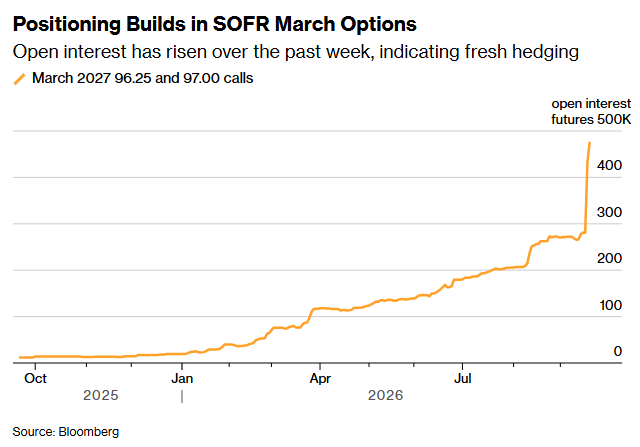
The number of open contracts has risen over the past week, indicating that new hedging positions are being established
Oil prices remain a key variable and continue to have a significant impact on the Fed's policy path and market outlook. Due to the rise in crude oil prices driven by factors related to the Middle East War, the yield on 10-year US Treasury bonds recently soared to more than 5%.
On Tuesday, US Treasury bond prices fluctuated along with oil prices as Saudi Arabia sought to resume crude oil transportation through an important pipeline and investors focused their attention on the annual meeting of diplomats held at the UN headquarters in New York, hoping to find clues about the progress of the reopening of the Strait of Hormuz.
George Bory, chief fixed income investment strategist at Allspring Global Investments, said that the recent market environment has prompted him to increase his bullish positions on the bond market. And he's not the only one doing it. According to J.P. Morgan's latest investor survey, direct investor long positions have increased, reaching the highest level since November last year.
George Bory said, “Higher yields, higher current monetary policy interest rates, and higher oil prices are all essentially equivalent to taxing economic growth.” “As a result, some of this pressure may eventually begin to show in the fourth quarter and may even continue into next year.” He added that the economic slowdown, the easing of the tense situation in the Middle East, and the cooling of artificial intelligence (AI) spending may all lead to a decrease in the number of interest rate hikes by the Federal Reserve.
As of Monday's close, there were approximately 2.7 million open SOFR call option contracts — that is, additional risk exposure — due in March 2027. This figure is about 1 million more put options for the same period, indicating that traders prefer to use hedging to bet that the Fed's policy path at that time will be more moderate than the current market pricing path.
Jeff Schuh, head of interest rate trading at Constitution Capital, said: “These capital flows may mean that the Fed still has one or two cautious interest rate hikes left, but after these rate hikes, the market may enter a period of relative range turbulence.”
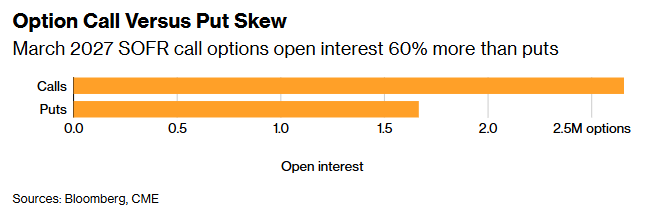
The number of open SOFR call options contracts in March 2027 was 60% higher than that of put options
Furthermore, in the March 2027 SOFR options, one prominent position target was an overnight interest rate close to 3%, far lower than the current federal funds effective interest rate of 3.88%. To achieve this goal, the Federal Reserve needs to quickly start a cycle of interest rate cuts in early 2027, and few people currently expect this to happen.
Here is an overview of the interest rate market position indicators for the past week:
According to the J.P. Morgan Chase US Treasury customer survey, direct investor long positions increased by 4 percentage points in the week ending September 21, to the highest level since November last year; at the same time, short positions decreased by 6 percentage points.
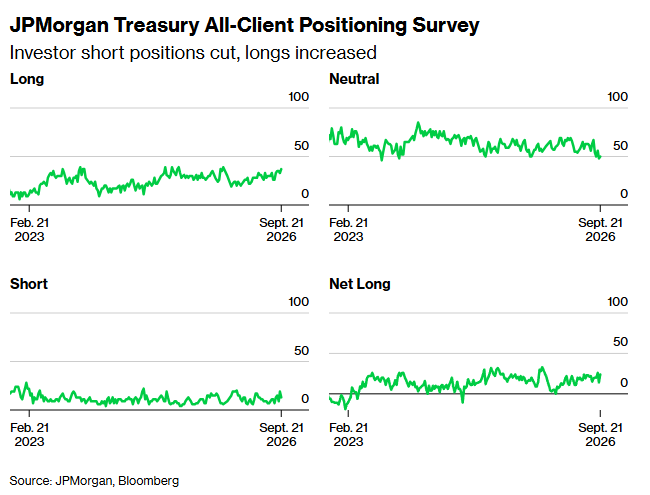
J.P. Morgan Chase US Treasury Bond All-Client Position Survey
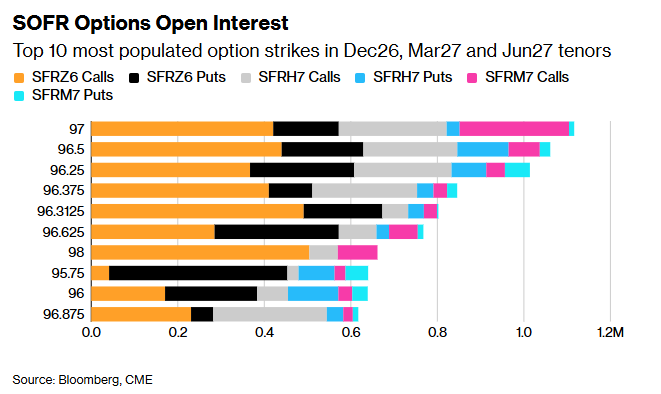
In terms of SOFR options positions, in SOFR 2026/12, 2027/3, and 2027/6 options, there were a large number of new risk exposures in the past week of multiple exercise prices for bullish options in March 2027, including 97.00 shares (increase of 94,262 shares) and 96.25 shares (increase of 102,713 shares). This was mainly due to large purchases of SFRH7 96.25/97.00 double buy three (2x3) bullish spread options. The market is also generating demand for a similar structure through SOFR March 2027 96.75/97.75 double buy three (2x3) bullish spread options.
However, the most active trading in the past week was the 95.4375 exercise price, mainly due to the surge in the number of put options in December 2026. The capital flow included buying the SFRZ6 95.9375/95.8125/95.4375/95.3125 bearish butterfly combination (put condors).
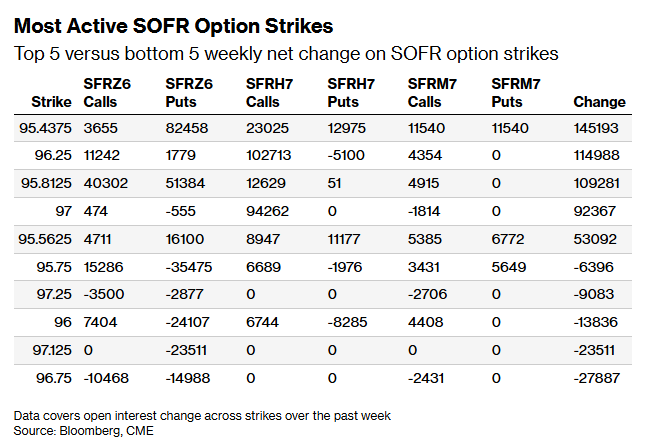
The most active SOFR option exercise price
SOFR Options Open Positions
Due to the huge volume of SOFR call options trading at 97.00 March 2027 in the past week, the 97.00 exercise price has now become the most traded price for unclosed contracts in the various periods of December 2026, March 2027, and June 2027. The number of open positions with an exercise price of 96.50 is also still high. Among them, there are still a large number of bullish option positions in December 2026.
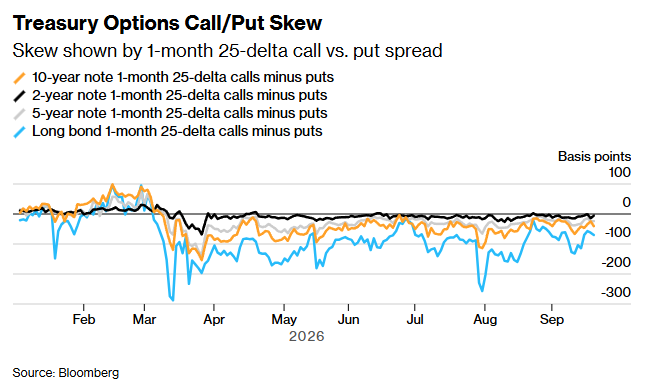
In long-term treasury contracts, option premiums paid to hedge against the risk of US Treasury futures are still biased towards put options, but they are closer to neutral compared to a few weeks ago. This indicates that the premium paid by traders to hedge against a sell-off in the long-term yield curve is falling. The skew from front-end to mid-tier terms has remained close to neutral over the past week.
US Treasury options bully/bearish bias