
At a time when AI is igniting a frenzy to expand semiconductor production, is Europe, which has a giant lithography machine, seriously left behind? Asmack: European sales in the second quarter were zero
The Zhitong Finance App learned that an executive of Asmat, the company with the highest market capitalization in Europe, said that the company currently does not sell any chip manufacturing equipment in Europe, and that as the US, China, and India invest heavily in developing their respective local semiconductor manufacturing and advanced packaging industry chains, Europe faces serious backward industrial chain risks.
The executive spoke at a time when products such as Meta Muse and OpenAI Astra are expanding the scope of tasks that can be completed independently, driving a new round of gains in the semiconductor sector in the global stock market. For Asmack, this means that manufacturing demand for advanced logic chips and advanced memory chips is expected to grow at the same time. Its position as the sole supplier of extreme ultraviolet lithography equipment (i.e. EUV) makes it the most critical upstream bottleneck in the AI computing power investment frenzy. Benefiting from the extremely strong AI semiconductor production capacity expansion trend brought about by the AI infrastructure frenzy that is in full swing around the world, ASML.US (ASML.US) trading prices have risen sharply by 60% since this year. The stock price increases of the other two major semiconductor equipment giants in the US — LRCX.US (LRCX.US) and Applied Materials (AMAT.US) — have been even stronger, with increases close to 80% during the year so far
“We can't sell anything in Europe. This is because there is no investment in Europe, and because no chip factory is being built there,” Asmack's executive vice president for global public affairs Frank Heemskerk said at an event in Amsterdam late Monday.
Europe has the world's leading semiconductor equipment companies, yet it lacks local chip manufacturing investment to match it. Europe's contribution to Asmack's net system sales in the second quarter was zero; 1% for comparison in 2025 corresponds to the combined net system sales of the three regions of Europe, the Middle East, and Africa. This set of data reveals the gap between European equipment technology advantages and local fab investment, and also explains why executives are asking Europe to act faster.
Wells Fargo and Citi, another Wall Street financial giant, recently upgraded global fab manufacturing equipment (Wafer Fab Equipment, WFE) spending expectations, highlighting that the global wave of AI computing power infrastructure construction is in full swing and in the macro context of the “memory chip supercycle”, semiconductor equipment manufacturers are also ushering in a super-growth cycle. They will be the core beneficiaries of the rapid expansion of AI chip production capacity (covering AI GPU/AI ASIC/TPU) and DRAM/NAND memory chips.
Semiconductor equipment giants such as Asmack, Fanlin, and Applied Materials have also recently followed the strong rise in the semiconductor sector, and the increase was significantly stronger than the semiconductor ETF benchmark trend. Applied materials can be described as ubiquitous in chip factories. Unlike Asmack, which has always focused on the field of lithography, Lam Research (Fanglin) focuses more on etching, cleaning, graphics and key film manufacturing processes, particularly on high depth to width ratio (HAR) etching/deposition and related process capabilities required for 3D NAND storage. The high-end equipment provided by applied materials plays an important role in almost every step of chip manufacturing. Its products cover atomic layer deposition (ALD), chemical vapor deposition (CVD), physical vapor deposition (PVD), rapid heat treatment (RTP), CMP, wafer engraving, ion implantation, Other important core building steps.
The world is scrambling to expand semiconductor production, but mainland Europe is getting cold?
An executive of Asmat, the company with the highest market capitalization in Europe, said that the company currently does not sell any chip manufacturing equipment in Europe; as the US, China, and India invest heavily in developing their respective local semiconductor industries, Europe faces the risk of falling behind.
Asmack is a key pillar in the semiconductor supply chain because it is the only manufacturer of the precision lithography equipment necessary to produce cutting-edge chips. Customers, including TSMC and Samsung Electronics, use their devices to print complex transistor patterns on silicon wafers, and these devices are also key to driving the global AI boom.
The EU is comprehensively revising its Chip Act. The bill, which came into effect in 2023, aims to address the shortage of semiconductors during the COVID-19 pandemic and increase Europe's share of global chip production. However, the law has largely failed to effectively stimulate investment in new chip factories. EU auditors said last year that the EU is unlikely to achieve its goal of doubling its market share by 2030.
Asmat and the European Commission have been seeking ways to enhance the EU's technological competitiveness, strengthen the supply chain, and create demand for chips. Meanwhile, other countries are investing government funds and adopting other incentives to boost local semiconductor production.
According to Heimskerk, the US, China, and India are also actively seeking this chip equipment manufacturer to expand its business layout in the region.
“We need to scale up production, and this isn't just going to happen in the Netherlands,” he said. “All parties are competing fiercely to allow us to expand production elsewhere. What is important to Asmer is that Europe can act actively.”
Heimskerk said that China and India “laid out the most grand red carpet for me and said, 'Invest here too, build your factory here. '” “We do a quarter of our R&D work in the US, and they ask, 'Can't we increase it to half? '”
In the second quarter, the contribution value of a single European market to Asmack's net sales was zero, and EMEA (Europe, Middle East, and Africa Market) statistics have not been accurately summarized. By comparison, Europe, Middle East, and Africa together accounted for 1% of net sales of their systems in 2025.
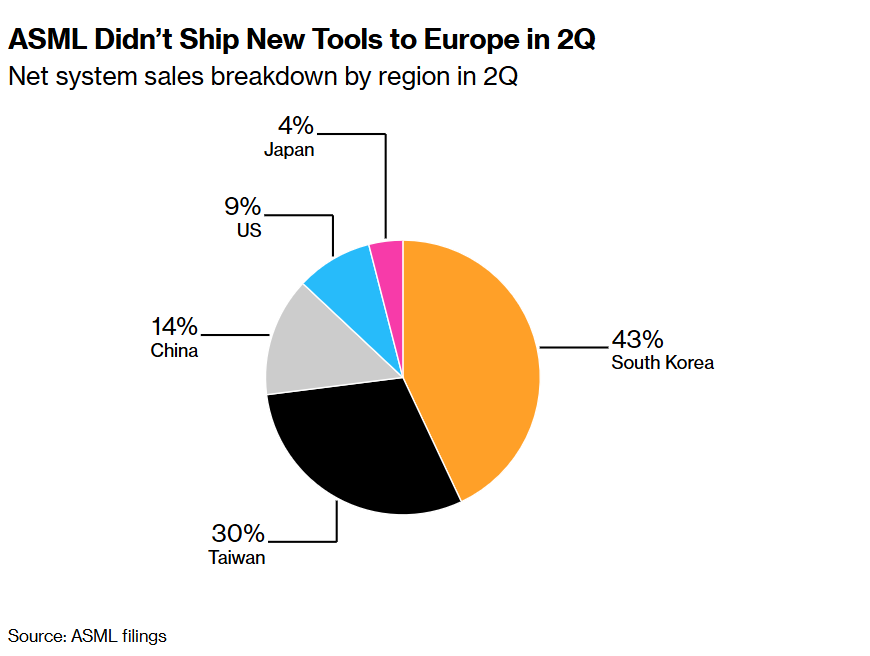
The above chart shows that Asmack did not deliver new equipment to Europe in the second quarter — net system sales for the second quarter were broken down by region. Source: Asmat disclosure documents.
In the first half of the year, South Korea was Asmack's largest lithography machine market, especially the largest EUV lithography equipment market (HBM and advanced DRAM capacity expansion in data centers require EUV equipment), followed by the Chinese market. Notably, in May of this year, Asmat and Tata Electronics Private Limited signed a cooperation agreement aimed at enhancing India's local chip manufacturing capabilities.
From the AI agent frenzy to the expansion of fab production capacity: the dual driving force of the semiconductor equipment supercycle
Looking at global business, Asmack's growth base has been supported by the company's guidance and production expansion plans. When the company announced its second-quarter results in July, it raised its net sales guideline for the full year of 2026 to 43 billion euros, clearly indicating that AI is driving demand for advanced logic and storage, and customers are accelerating the expansion of production capacity. The company plans to increase the annual production capacity of about 65 low-numerical aperture EUV units and about 130 submersible DUV units in 2026, respectively, by about 30% in 2027, and is studying further expansion of production in 2028.
Therefore, the investment significance of recent active iterative progress in AI smart device technology is to significantly and comprehensively strengthen the long-term sustainability of the existing trend of expanding AI semiconductor production; the US, China, and India actively seeking investment from Asmack, as shown in the latest report, further reflect global competition in semiconductor manufacturing capabilities.
Looking at the underlying architecture, agents expand a question-and-answer session to a continuous work process of “understanding a task — planning — calling tools — executing — verifying”. Pre-filling requires processing the input context, decoding continues to generate results, the key-value cache expands with the length of the context and the scale of concurrency, and the browser, code execution, and external tools require CPU, memory, and storage.
Muse's proprietary virtual machine and Astra's multi-step computer operation capabilities reflect this change. Higher task success rates and lower completion costs can also attract more jobs into the AI system. The resulting industrial transmission is to expand the scope of application and scale of use, drive the growth of computing, storage and interconnection capacity, and gradually transform it into equipment demand through the expansion of production and process upgrades by chip manufacturers. These are semiconductor industry chain demand estimates based on AI inference system architectures.
Different equipment leaders undertake different manufacturing processes: Asma mainly benefits from advanced logic, the expansion of advanced DRAM wafer production capacity, and increased demand for critical lithography; Fanlin Group participates in the manufacture of 3D storage structures, silicon holes and advanced package interconnections through etching and deposition equipment; application materials support advanced transistors, HBM and heterogeneous integration through technology such as material deposition, flattening, metal interconnection, and wafer stress control. As chip structures become more three-dimensional, HBM stacking is more complex, and packaging integration is higher, equipment investment is simultaneously driven by “more wafers need to be manufactured” and “each wafer and package requires a more complex process”. The combined continuous rise of these two extremely explosive demand is the most supportive industrial logic of the “semiconductor equipment supercycle” in the global market.