
Muse and Astra set off a new wave of AI computing power! UBS has created four major investment lines, and storage and semiconductor equipment are on the cusp
The Zhitong Finance App learned that the latest Asia Pacific AI technology research report released by international financial giant UBS (UBS) shows that the AI agent workflow that has recently taken the B-side and C-side user groups by storm is accelerating the expansion of the scope of AI applications in various industries around the world, driving the full expansion of computing power requirements from Nvidia AI GPUs or Google TPU systems to storage chips, CPU supporting components, 2.5D CowOS/3D advanced packaging, high-performance Ethernet network facilities, AI data center high-speed optical interconnection transmission and uninterrupted high-efficiency power supply/distribution systems, and The boom in the computing power chain associated with the construction of AI computing power infrastructure, which is in full swing around the world, will be further extended until 2028.
The core change brought about by the recently popular Meta Muse AI agent and the OpenAI Astra large model/AI agent “comparable to AGI” is that a single user command can trigger continuous, multi-stage computational work. A research, programming, or office task may in turn include planning, retrieving, reading documents, calling tools, executing code, checking results, and fixing errors. Multiple steps require re-calling the model, and complex tasks may also use parallel exploration and verification. Such an almost endless and increasingly complex AI workload will accelerate the transmission of growth opportunities to a complete AI inference load computing power system beyond the GPU.
Based on the “Jevons Paradox” (Jevons Paradox), the overall demand for AI computing resources will continue to expand in the future due to declining computational power costs on the inference side. Recently discussed, the so-called Jevins effect, also known as the “Jevans Paradox,” is a counterintuitive economic theory: when current technological advances improve the efficiency of the use of certain resources (such as energy, raw materials, or AI computing power infrastructure resources), it will reduce the unit cost, thereby stimulating large-scale expansion of market demand, which ultimately causes the total consumption of all types of resources not to decrease but to increase. The concept was first proposed by the English economist William Stanley Jevons (William Stanley Jevons) in the book “The Coal Problem” in 1865.
From the perspective of AI inference system architecture, more complex AI tasks led by Meta Muse often include longer context, multiple rounds of model calls, tool execution, and result verification: prefill (prefill) requires processing input, decode (decode) continuously generates output, and key value cache (KV Cache) takes up more memory as context and concurrency scale expand, and computational throughput, memory bandwidth, and capacity need to be increased collaboratively. Therefore, as cutting-edge intelligence such as Meta Muse further detonates the demand for AI computing power, the core inference for the AI computing power industry is that GPUs and TPUs undertake model calculation, CPU undertaking tool execution and task orchestration, HBM, server DRAM, storage and high-performance network infrastructure, and data center optical interconnect devices to support efficient data transportation and state management; ultimately, a complete set of AI computing power server clusters will be needed to deliver sustainable operation services.
Meta's Muse and OpenAI's Astra have strengthened extremely professional computer operation, programming, and multi-step work capabilities. What can be deduced from this is that the accelerated expansion of AI applications is simultaneously increasing the infrastructure investment required for “model thinking” and “actual execution of work.” This is why, with the significant improvement of the AI commercialization process, UBS Group's senior analyst team drastically raised the 2027 operating cash flow forecast for global hyperscale cloud computing vendors and new cloud-type enterprises by 30%, and clearly ranked the investment preferences for the AI computing power theme as “memory chips > semiconductor equipment > multilayer ceramic capacitors (MLCC) > selected semiconductor industry in Taiwan, China”. They are particularly optimistic about the semiconductor sector in the Asia-Pacific region, and emphasized that most of the core participants in the AI computing power industry chain are located in the Asia-Pacific region.
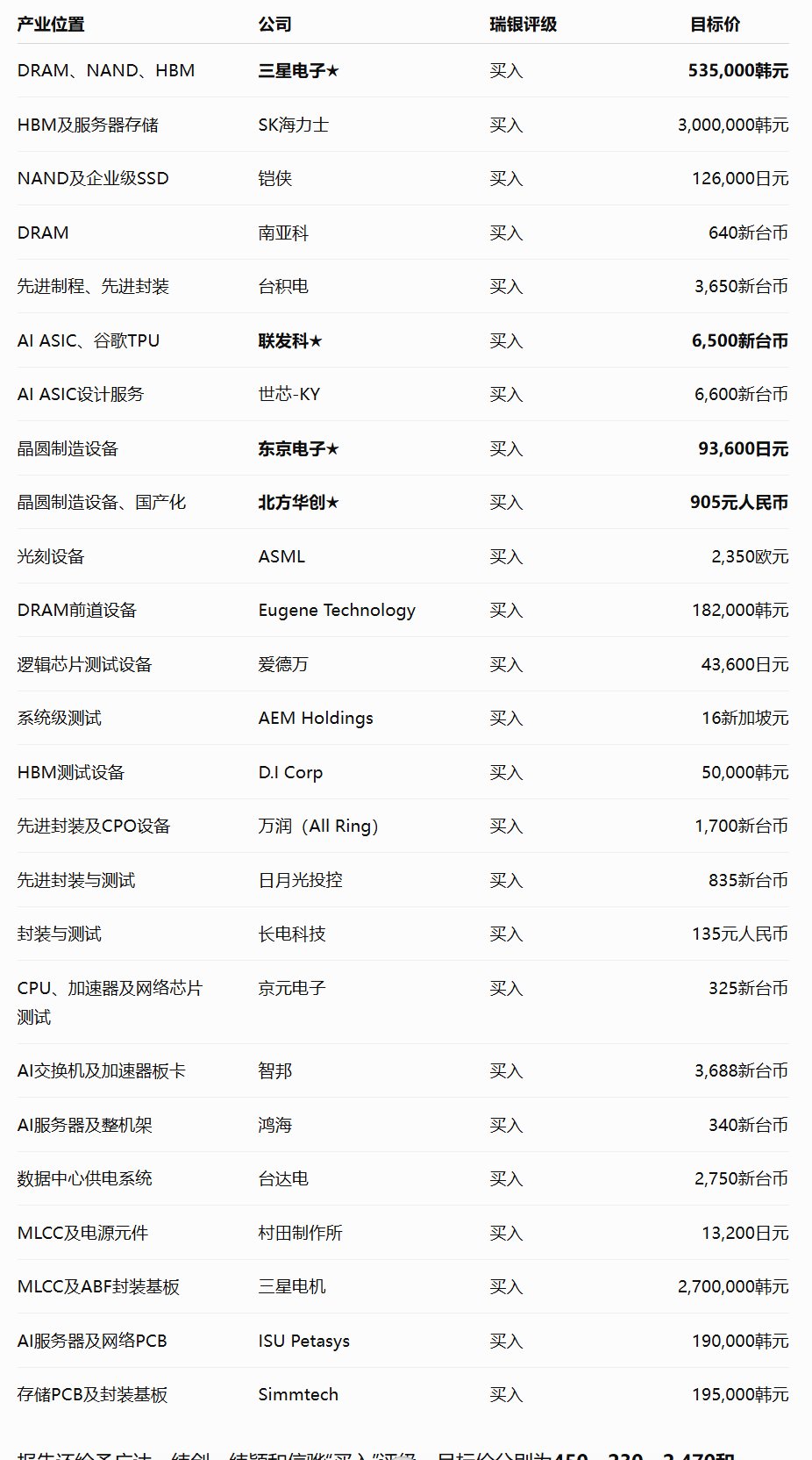
For the Asia-Pacific region, UBS focuses on recommending Samsung Electronics, MediaTek, Tokyo Electronics, and North China Chuang. It has also long been optimistic about the most core computing power suppliers in the AI computing power industry chain, such as TSMC, SK Hynix, Delta, Zhibang, and Sun Moon Light Semiconductors. The table below summarizes all 21 “favorite” companies of UBS analysts, and adds four directly related targets: ASML (ASML), Kioxia, South Asia Technology, and Shixin. The asterisk represents the four regionally preferred AI stocks named by UBS analysts; the target prices are all per share in the local currency of the corresponding listed stocks.
From trillion-dollar capital expenditure to sharp increases in storage prices: the six major logics behind UBS dismantling the AI computing power infrastructure investment frenzy
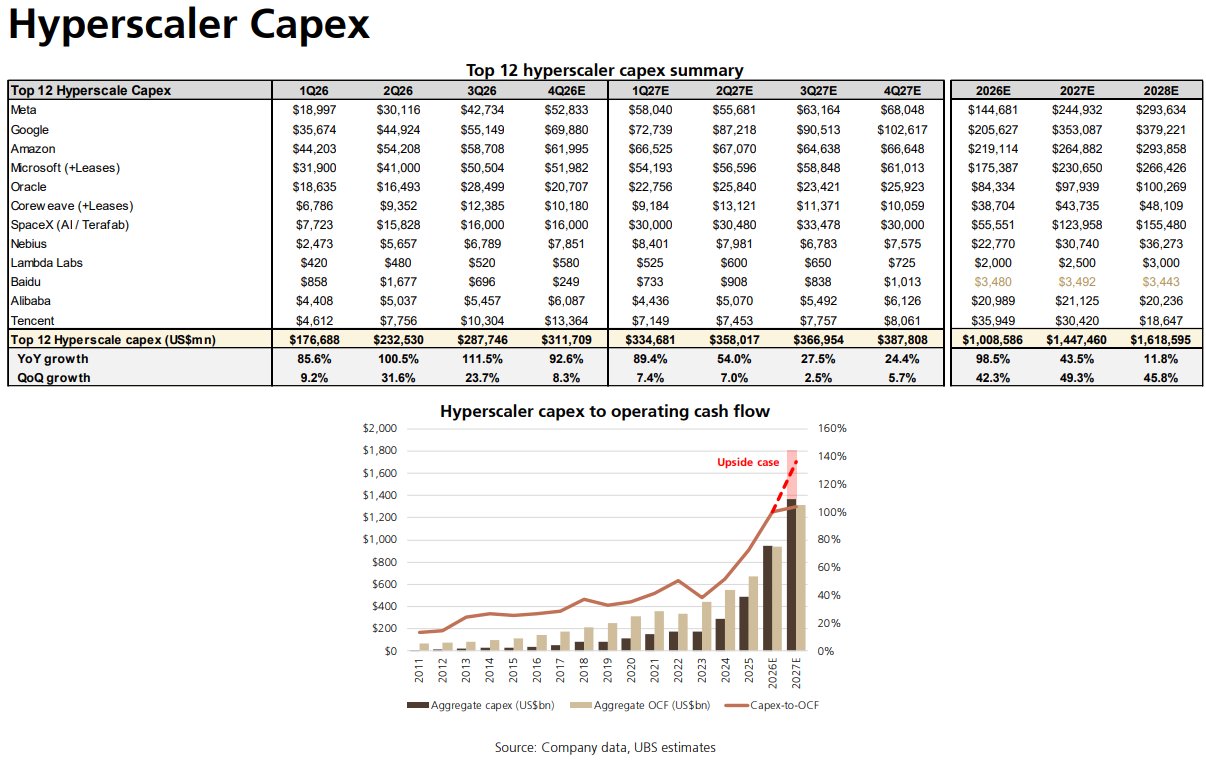
First, UBS is focusing on improving AI commercialization to provide cash flow support for capital expenditure that continues to expand. UBS expects the total capital expenditure of the 12 cloud computing and AI infrastructure companies covered by it from 2026 to 2028 will reach approximately $1.009 trillion, $1.447 trillion, and $1.619 trillion, respectively, with year-on-year increases of 98.5%, 43.5%, and 11.8%; the 2027 upward scenario will reach 1.8 trillion US dollars. Among them, the capital expenses of Google and Meta are estimated to be approximately US$353.1 billion and US$244.9 billion, respectively, in 2027.
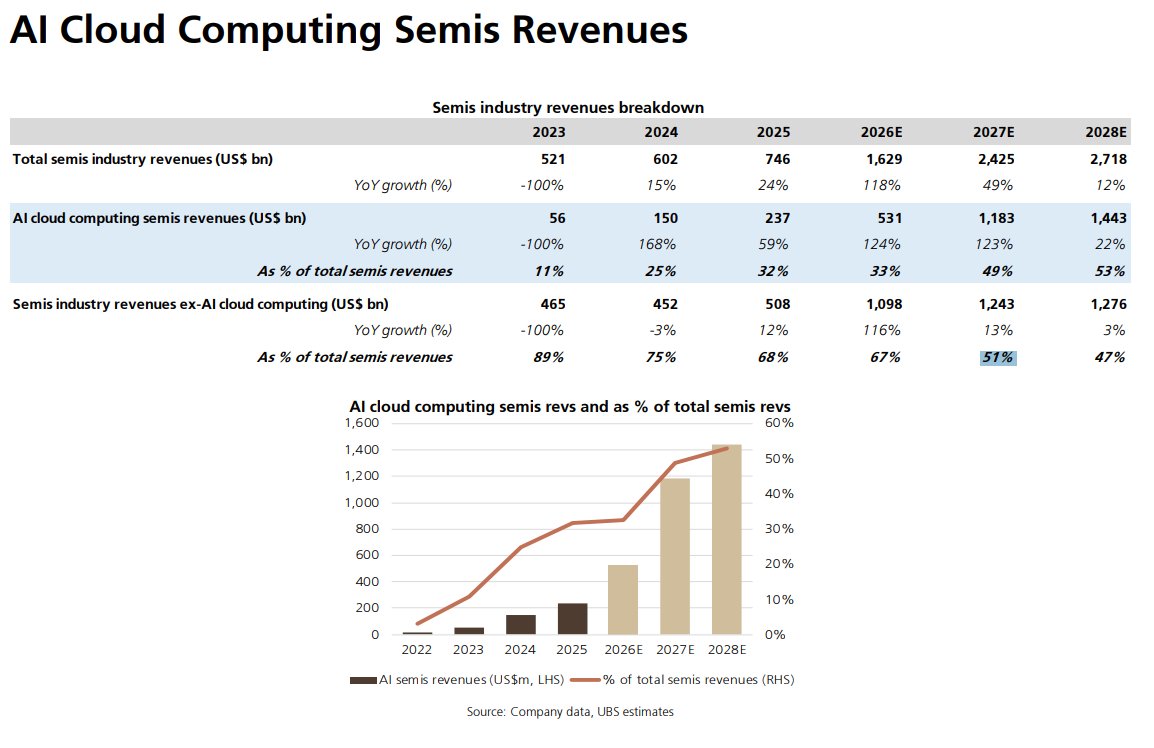
The key change here is that UBS raised its operating cash flow forecast at the same time, so that investment expansion can receive stronger commercial support; the report still lists the financing gap between capital expenditure and operating cash flow as the primary observation factor, but the judgment is generally manageable. The increase in demand is also reflected in the chip revenue structure: UBS predicts that AI cloud computing semiconductor revenue will increase from US$531 billion in 2026 to US$1.183 trillion in 2027, and further reach US$1.443 trillion in 2028, accounting for 53% of global semiconductor revenue. Note that these figures are all recent predictions from the UBS analyst team, and revenue growth includes contributions from product upgrades and storage price increases.
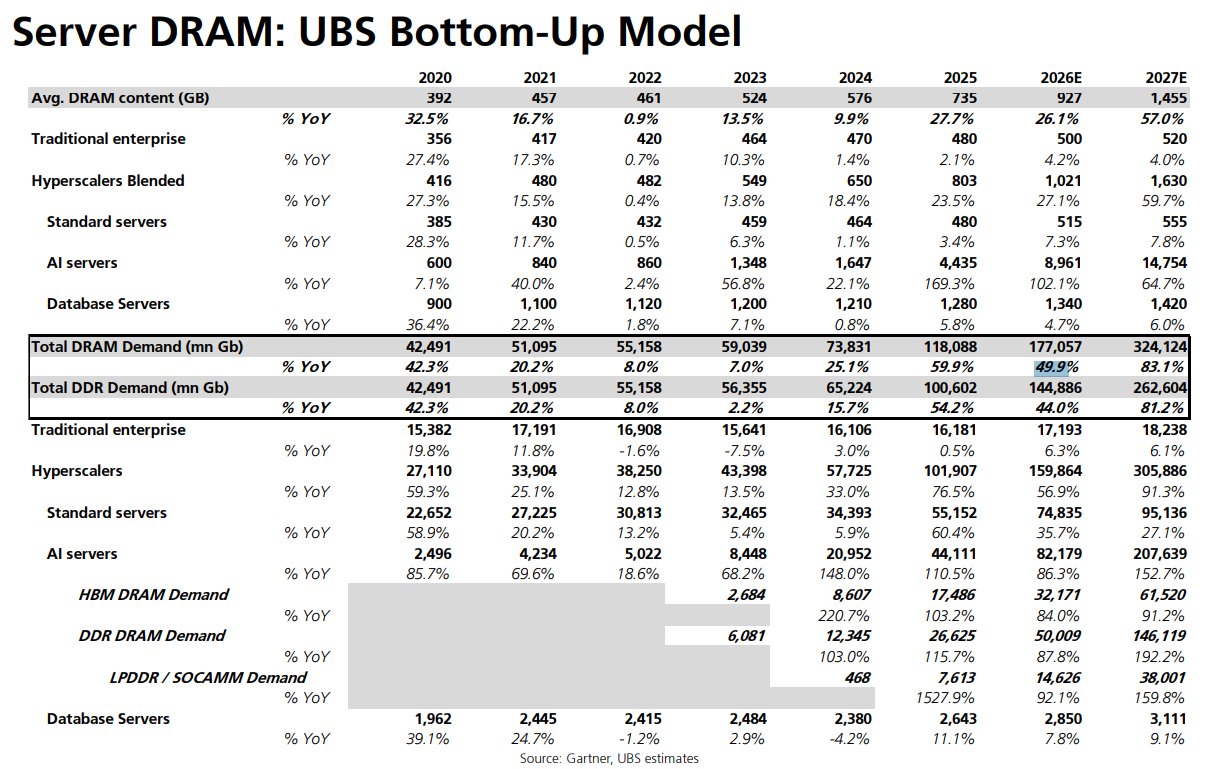
Second, the memory chip investment theme is the most prominent configuration main line in this report. The growth momentum covers HBM, server memory, and enterprise-grade SSDs. UBS expects the DRAM uplink cycle to continue until the second quarter of 2028, and NAND until the fourth quarter of 2027; server DRAM bit demand will increase by 49.9% in 2026 and further increase by 83.1% in 2027, and the average server DRAM capacity will increase from 927GB to 1,455GB. At the same time, demand for HBM terminals is expected to increase by about 91% in 2027, and demand for AI servers at the high performance DDR level will increase by about 192%.
UBS said that the production capacity of new DRAM wafers on the supply side is mainly going to HBM, and supply expansion of traditional DRAM and NAND is relatively limited; after accounting for inventory adjustments, the UBS model shows that the DRAM and NAND supply gaps in 2027 were about 4.9% and 1.4%, respectively, and the corresponding mixed average price increased by 44.1% and 34.6%, respectively.
UBS also expects the enhanced long-term supply agreement to cover more than 50% of the industry's shipments, with more than 40% using fixed quantity and fixed price terms to increase revenue visibility. In its forecast model, cloud vendor procurement expenses related to memory chips reached about US$933.2 billion in 2027, accounting for as much as 64% of the benchmark capital expenditure, far higher than UBS's estimate of 37% of storage expenses in 2030, so customer purchasing capacity has also become an important observation point in the report. At the individual stock level, Samsung benefits from HBM's ability to improve execution and expand production. UBS expects its HBM bit share to reach 41% in 2027; SK Hynix will continue to benefit from the profit expansion of HBM and other storage products. The stronger free cash flow and dividend and repurchase capabilities of the two companies is UBS's logic that the market will pay more attention to the value level of their shareholder returns.
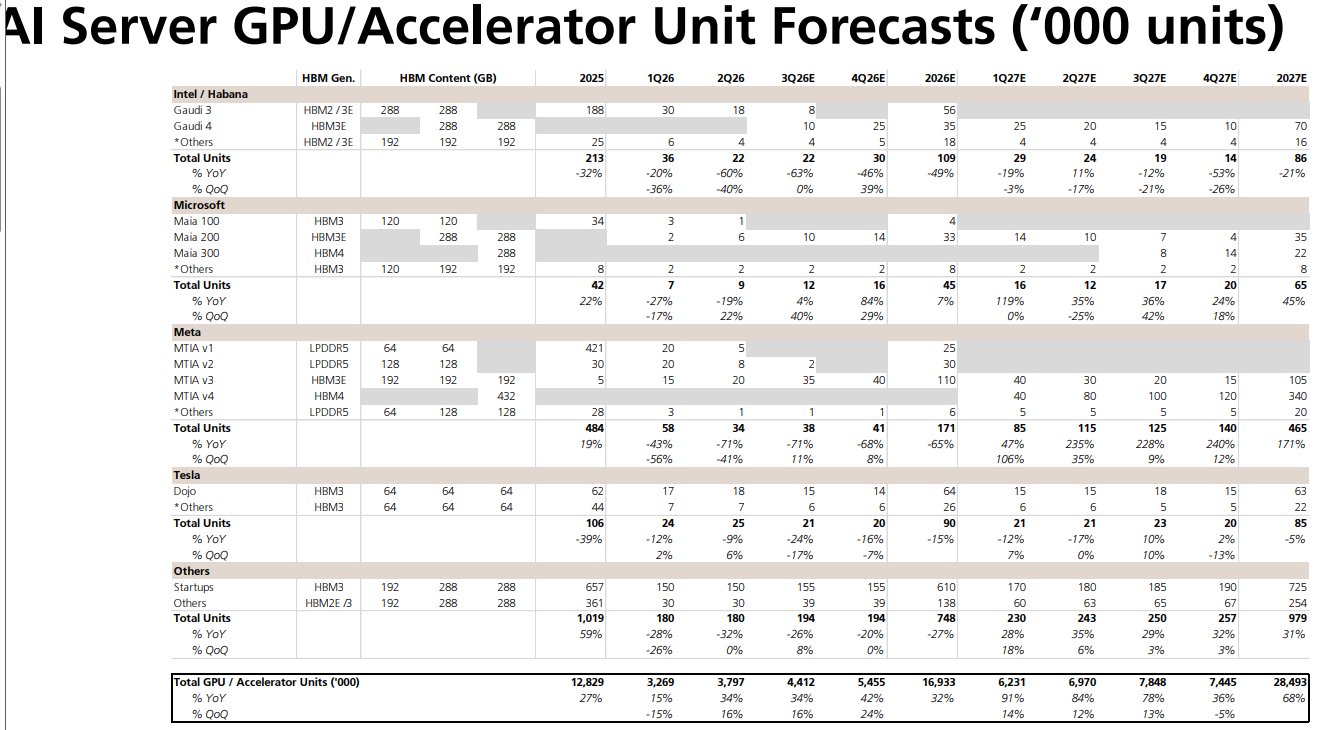
Third, GPU and ASIC, the two most core AI accelerator computing technology routes, are jointly accelerating the expansion, and server investment opportunities extend to various computing architectures and overall rack upgrades. According to the summary caliber of UBS's AI accelerators, UBS expects the number of GPUs and accelerators to be around 16.933 million in 2026, an increase of 32% year on year, and to 28.493 million in 2027, an increase of 68% year on year. Delivery of Nvidia racks is expected to rise from 80,090 units in 2026 to 95,098 units in 2027. Blackwell or Blackwell Ultra will accelerate the transition to Rubin during this period, so the reduction in old platform racks should be deduced and understood in conjunction with the large-scale deployment of the new platform.
In terms of AI ASIC/Google TPU supply and demand, MediaTek is the focus: the report explains that it raised its 2027 TPU sales target from 7 billion to 12 billion US dollars to 12 billion to 16 billion US dollars. UBS's own forecast is higher, reaching 18 billion US dollars, and further reaching 35 billion US dollars in 2028. The background is the expansion of the TPU market, increase in share, and progress of v9 projects.
The AI server/AI server integrates the entire cabinet supply chain. Hon Hai benefits from the higher selling price of Rubin racks, the integration of non-chip components, and added manufacturing value; Zhibang has benefited from the increased content of Trainium boards, 800G/1.6T switches, liquid cooling, and optical switching. CPU and storage packages have also been upgraded simultaneously. For example, UBS expects SimmTech's SoCAMM2 related revenue to rise from 224 billion won in 2026 to 453 billion won in 2027.
Fourth, advanced manufacturing processes, packaging complexity, and storage expansion are jointly driving equipment, materials, and testing requirements. UBS expects the global wafer manufacturing equipment (WFE) market to reach $158 billion, $226 billion, and $274.5 billion respectively from 2026 to 2028, with DRAM equipment spending increasing by about 60% in 2027. UBS said that the visibility of TSMC's AI/high-performance computing demand extends from 2029 to 2030, and UBS expects capital expenditure to be 63 billion, 80 billion, and 95 billion US dollars respectively from 2026 to 2028; the monthly production capacity of 2.5D grade CowOS advanced packaging at the industry level will increase from 160,000 pieces at the end of 2026 to 270,000 pieces at the end of 2027.
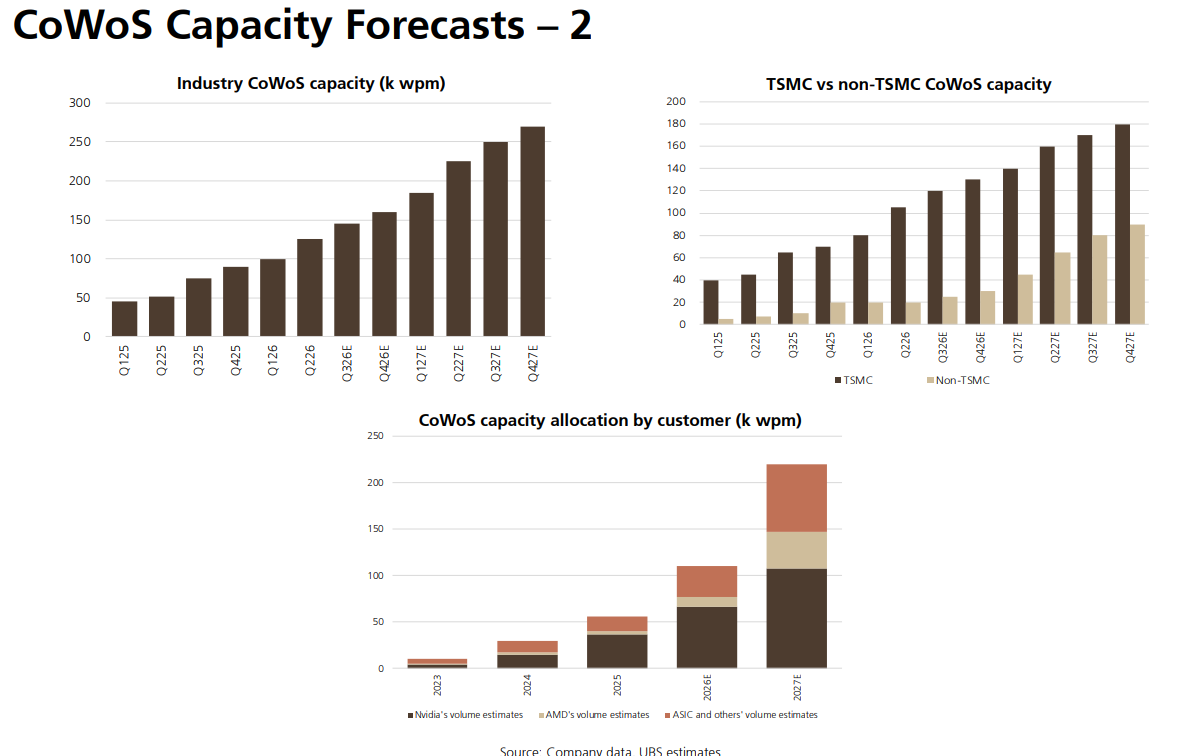
UBS emphasized that the global 2.5D/3D advanced packaging expansion will accelerate further transmission to Sun Moon Light, Wanrun and test manufacturers: Sun Moon Light's 2027 LEAP advanced packaging testing business revenue guidelines will be raised to more than 7 billion US dollars, and UBS predicts 7.5 billion US dollars; Chiplet, multi-chip integration and complex packaging will increase test steps and test time to support Edwin, AEM, Jingyuan Electronics and HBM test equipment companies. Longer term HBM4/HBM4E, 4f² vertical channel DRAM and COPOS routes also increase requirements for deposition, etching, lithography, bonding and inspection. Corresponding to individual stocks, Tokyo Electronics benefited from DRAM equipment exposure and product price increases, while North China Huachuang benefited from the expansion of storage production and equipment localization in China, while the Netherlands-based lithography giant ASML (ASML) benefited from increased lithography demand from advanced logic and DRAM.
Fifth, the growth of data center optical interconnection, power supply/distribution, and MLCC is due to the simultaneous increase in data center bandwidth and power density. UBS's benchmark forecast for the optical transceiver serviceable market is that it will increase from US$12 billion in 2025 to US$32.3 billion in 2030, of which CPO contributed US$6.5 billion, accounting for 20%; in an upward scenario, the total market reached US$55.2 billion, of which CPO contributed US$13.8 billion, accounting for 25%.
UBS's predictions mean that both pluggable optical modules and CPO have room for growth, with incremental value covering optical chips, lasers, optical fibers, switching ASICs, packaging and test equipment. In terms of power supply, UBS expects the AI server power supply market to grow by about 69% from 2025 to 2030, reaching US$91.1 billion by 2030; Delta Power benefits from its product portfolio from the grid side to the chip side, and the 400V/800V power supply architecture is expected to become a greater growth driver from 2028 to 2029.
In terms of MLCCs, AI servers require more high-specification decoupling and filtering components, while production cycles and yield limits supply expansion for high-end products: UBS expects Samsung Electric's AI server MLCC revenue to compound by about 80% from 2025 to 2030; Murata has raised its data center revenue guidance for the fiscal year ending March 2027 to 370.6 billion yen, an increase of 110% over the previous year. Together, these opportunities point to an increase in the value of electronic components within a single frame.
Sixth, UBS's configuration emphasizes industry differentiation, and combines valuation, positions, and profit cashing to select the company's targets. In terms of regional configuration, UBS's research report is overequipped with semiconductors from South Korea and Taiwan, with a neutral configuration of Japan; the industry configuration exceeds that of advanced manufacturing processes, storage, packaging and testing, server ODM, and wafer equipment. Although MLCC is high in its ranking of preferences, the official industry weight is still neutral, and recommendations are mainly reflected in specific corporate targets with excess alpha value.
In terms of consumer electronics, UBS expects global PC shipments to drop 11% in 2026 and about 4% in 2027; smartphone shipments will drop 10%, drop 3%, and increase 2% from 2026 to 2028, respectively. Increased storage prices, terminal purchasing capacity, and switching intentions are an important basis for it to carefully view related sectors. In addition, UBS said that individual stock choices are also differentiated: South and American semiconductors maintain sales, with a target price of NT$170,000, and Daliguang's target price is NT$5,000, due to competition, valuation, and certification progress; Asus, Renbao, and Heshuo received neutral ratings even after expanding the AI server business; it can be seen from this that the UBS analyst team seems to pay more attention to the ability of demand to ultimately transform into profit, free cash flow, and shareholder returns.
AI has begun to work efficiently for people. Why does the world need to accelerate the upgrading and construction of AI data centers?
The core change and AI application trend brought about by the rapid explosion of Muse and Astra is that a single user instruction can trigger continuous, multi-stage computational work. A research, programming, or office task may in turn include planning, retrieving, reading documents, calling tools, executing code, checking results, and fixing errors. Multiple steps require re-calling the model, and complex tasks may also use parallel exploration and verification.
Muse's cloud-based virtual machine and back-office execution mechanism, as well as Astra's computer operation capabilities, expand the range of tasks that can be handed over to AI. Looking at the demand model, the total amount of computation is determined by the number of active users, the frequency of tasks, and the inference workload for each task, while peak concurrency and response time requirements determine how much capacity the infrastructure needs to allocate.
Stronger models can also attract more jobs into the AI system by increasing the success rate and reducing the cost of completing tasks. Meta revealed that in its engineer comparison tests, Muse Spark 1.3 reduced tool calls and token usage by about 20% and 25%, respectively (compared to Muse Spark 1.2's internal engineering comparison results); this efficiency was greatly improved, making more tasks that were originally too expensive or not reliable enough commercially viable, thereby creating favorable conditions for the accelerated penetration of overall AI applications and exponential growth in user token input/usage consumption through the expansion of user scale and task volume.
This is why, according to the UBS analyst team, these near-heavy-scale and extremely complex AI inference workloads will transfer growth opportunities to complete computing systems beyond GPUs. GPUs and ASICs are responsible for neural network computing, while AMD, Intel, and ARM architecture CPUs can handle virtual machines, browsers, code execution, task scheduling and data processing; model weights, long context, and KV caches increase HBM and system memory capacity and bandwidth requirements; long-term memory, file and appropriate cache layers increase enterprise-level SSD requirements; distributed inference, multi-node data exchange and storage access further drive high-speed networks and optical interconnections.
OpenAI revealed on September 11 that its Habitat online storage platform has processed more than 70 million storage requests per second, managed more than 500 PB of record milestone data, and clearly listed CPU-intensive tasks such as routing, compression, encryption, and verification. This provides an actual engineering basis for “the growth of AI applications while driving AI semiconductors such as CPU and storage as well as optical interconnection transmission in data centers.” As more tasks enter the production environment, additional servers and higher rack power densities are added, and demand is transferred to power supply, liquid cooling, and grid access. Therefore, from an engineering and investment perspective, the popularity of intelligent devices represented by Muse and Astra is expected to simultaneously expand strong demand for AI computing capacity, storage, high-speed optical interconnection in data centers, and energy systems. This also echoes UBS's bottlenecks in memory chips, semiconductor equipment supporting large-scale expansion of AI semiconductor production, and the key layout of the AI data center infrastructure core supply chain.