
Will Commission Free Trading Change BMO Stock's Narrative
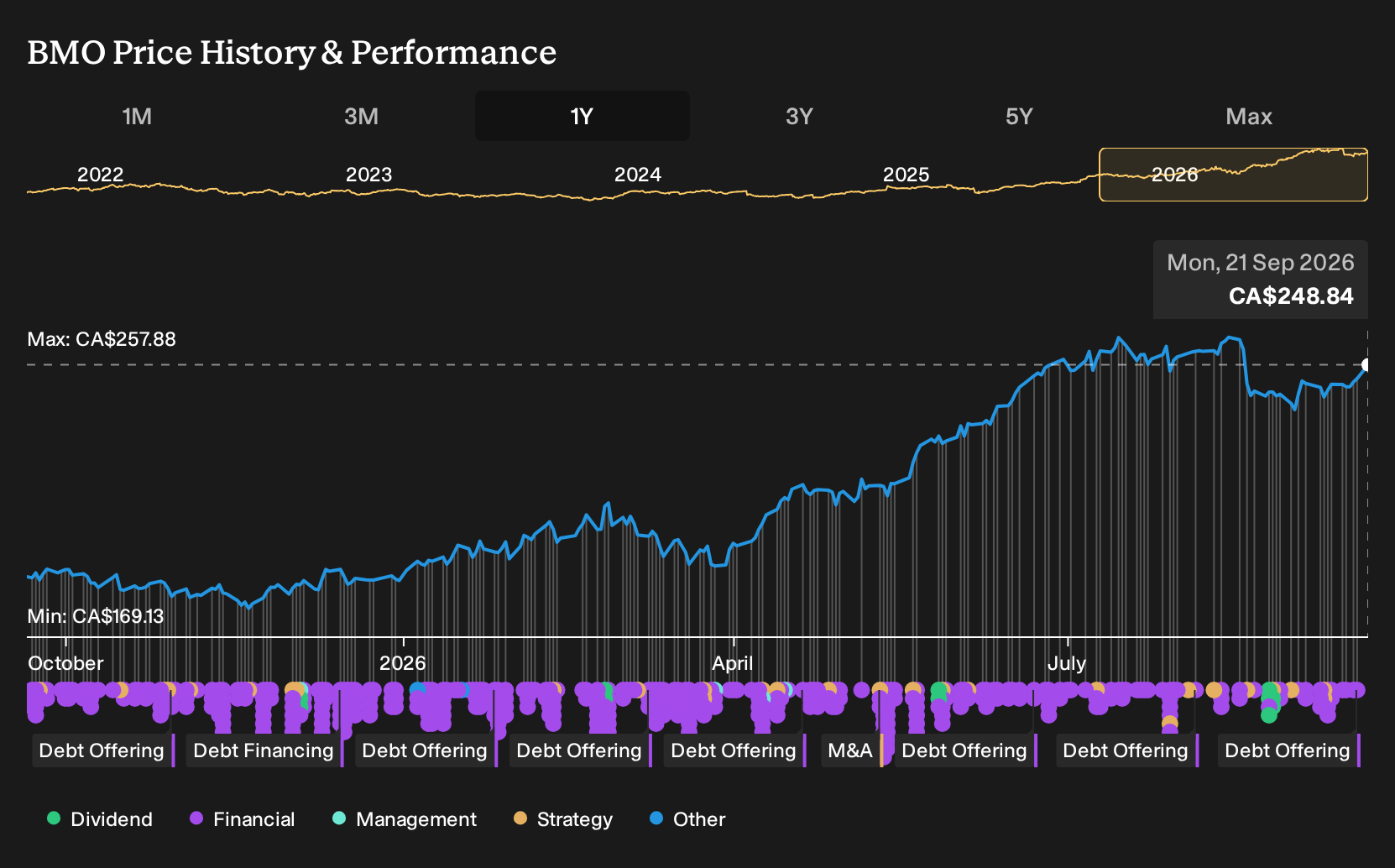
- Bank of Montreal expanded its capital markets footprint in early September 2026, pairing a series of fixed income offerings and AT1 LRCNs with the launch of commission-free trading on BMO InvestorLine and new leveraged and inverse ETNs for sector traders.
- The move shifts BMO’s economics toward fee and trading activity, as the bank trades commission revenue for higher platform usage, deeper client relationships and a broader menu of structured products aimed at sophisticated users.
- We will now explore how Bank of Montreal's commission free BMO InvestorLine model may reshape its broader investment narrative for investors.
Bank of Montreal Investment Narrative Recap
To own Bank of Montreal, you need to be comfortable with a large North American lender leaning on fee income, digital platforms and capital markets alongside traditional lending. The latest wave of fixed income deals and AT1 LRCNs points to active balance sheet management rather than a major shift in the story. For now, the central near term swing factor still looks like credit quality and loan demand in Canada and the U.S.
The biggest risk remains a weaker economic backdrop pressuring credit, especially in unsecured retail and commercial real estate, while higher technology and people costs squeeze operating leverage. Recent issuance increases funding flexibility but does not fundamentally change that trade off. If economic trends or expense pressures worsen, that risk case moves closer to the foreground.
The launch of commission free BMO InvestorLine pricing sits closest to the current equity narrative. It speaks directly to BMO’s push into digital and AI powered banking, which analysts already highlight as a key driver of efficiency and customer engagement. For you as a shareholder, the question is whether higher platform activity and data rich relationships can offset the loss of trading commissions.
This shift links tightly to near term catalysts around fee based revenue and cost control. If the platform attracts more active and adviceDirect users, that can support wealth and capital markets cross sell. The flip side is that technology and service investment must stay disciplined, or expense growth could outpace the incremental income. That execution balance between growth and cost is where the stock narrative feels most exposed right now.
Bank of Montreal's current analyst narrative points to CA$43.3b in revenue and CA$11.6b in earnings by 2029. That profile reflects revenue growing 6.7% per year and an earnings increase of about CA$2.9b from CA$8.7b today.
Uncover why Bank of Montreal's fair value indicates a 3% potential upside to its current price before the market closes that discount.
Exploring Other Perspectives
The Simply Wall St Community only contributes two fair value views on Bank of Montreal, yet the gap already runs from about CA$255 to CA$309 per share. Those private estimates sit alongside bond issuance, AT1 LRCNs and new leveraged ETNs that could reshape funding costs and fee income. Opinions are likely to differ, so explore them.
Explore another Bank of Montreal fair value estimate, including one that suggests as much as 24% upside from the current price.
Reach Your Own Conclusion
Don't just follow the ticker. Dig into the data and build a conviction that's truly your own.
- A great starting point for your Bank of Montreal research is our analysis highlighting 3 key rewards and 1 important warning sign that could impact your investment decision.
- See our latest analysis for Bank of Montreal. The report includes a comprehensive fundamental analysis summarized in a single visual, the Snowflake, making it easy to evaluate Bank of Montreal's overall financial health at a glance.
Looking for more Bank of Montreal style ideas?
If the Bank of Montreal story has sharpened your thinking, use that same lens across the market. A focused stock screener helps you quickly filter for traits that fit your own risk tolerance, income needs and growth preferences.
- For investors hunting for strong businesses that the market may be overlooking, run your filters through 9 high quality undiscovered gems and see which companies match your criteria.
- If capital preservation and steadier profiles matter most to you, start with a pool of 8 resilient stocks with low risk scores and compare their fundamentals side by side.
- Income focused portfolios can begin with a universe of 1 dividend fortresses and then zero in on payout histories, coverage and balance sheet strength.
This article by Simply Wall St is general in nature. We provide commentary based on historical data and analyst forecasts only using an unbiased methodology and our articles are not intended to be financial advice. It does not constitute a recommendation to buy or sell any stock, and does not take account of your objectives, or your financial situation. We aim to bring you long-term focused analysis driven by fundamental data. Note that our analysis may not factor in the latest price-sensitive company announcements or qualitative material. Simply Wall St has no position in any stocks mentioned.
Have feedback on this article? Concerned about the content? Get in touch with us directly. Alternatively, email editorial-team@simplywallst.com