
How AI Cloud Expansion At Microsoft (MSFT) Has Changed Its Investment Story
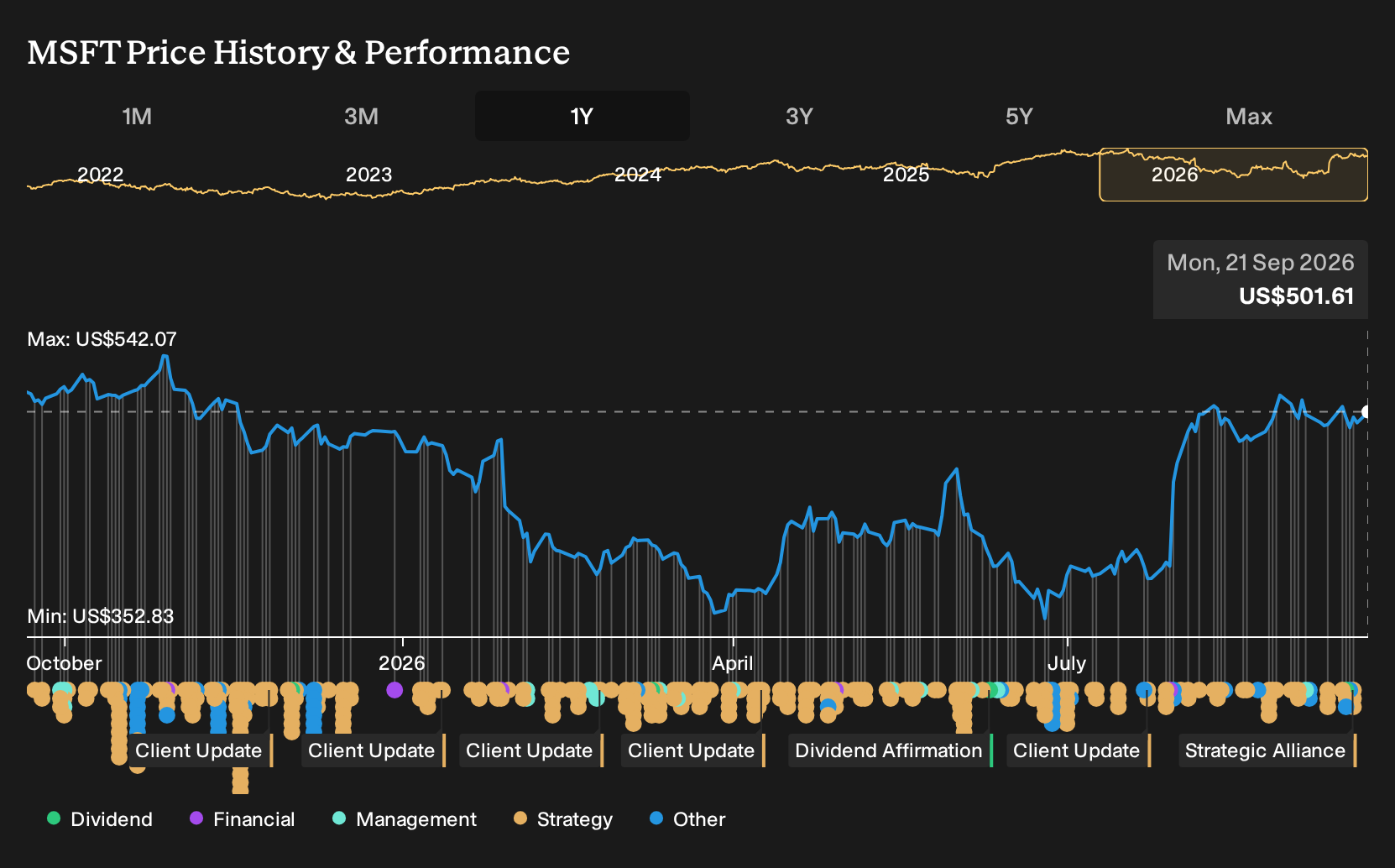
- Microsoft expanded its AI-heavy cloud footprint through new Azure partnerships in payments, telecoms and scientific research, while its board approved a quarterly dividend of US$0.98 per share for payment on 10 December 2026 after an 8% increase announced on 15 September 2026.
- These moves combine aggressive AI and infrastructure deployment with a longer dividend growth record, indicating management’s focus on both enterprise demand and ongoing cash returns to shareholders.
- Next, the focus turns to how Microsoft’s AI-centric cloud deals and fresh dividend increase contribute to the broader investment narrative.
Microsoft Investment Narrative Recap
To own Microsoft, you need to believe its heavy AI and cloud buildout can keep pulling more workloads into Azure and Copilot without eroding profitability too far through higher CapEx and lower mix margins. The biggest near term swing factor remains how quickly these AI services translate into durable consumption, especially as large AI customers carry concentration risk.
The latest Azure Payment HSM v2 launch and Nokia and Causaly partnerships reinforce that thesis but do not materially change the main near term catalyst, which is sustained enterprise AI usage flowing through upcoming quarters. They mainly sharpen the existing risk reward profile around infrastructure spend, execution on large contracts and regulatory and legal outcomes in AI.
The Marvell and Utimaco backed Azure Payment HSM v2 preview looks most relevant here because it sits directly in high value, compliance heavy payment flows. If adoption builds across banks and processors, this kind of workload can support Microsoft’s aim of deepening mission critical use of Azure, where switching costs and contract duration tend to be higher.
For investors tracking catalysts, this payments HSM service speaks to whether Microsoft can convert AI heavy infrastructure into differentiated offerings that justify ongoing CapEx and margin pressure. Execution risk is real, since payment networks demand strict uptime, security and auditability, and any misstep or slower than expected ramp would feed into the broader concerns about hyperscaler AI spending efficiency.
Microsoft Long Range AI And Cloud Assumptions
Microsoft's narrative projects US$567.2b revenue and US$212.2b earnings by 2029. This rests on analysts assuming 19.6% yearly revenue growth and about a 59% earnings increase from US$133.7b today.
Uncover why Microsoft's fair value indicates a 14% potential upside to its current price, which could narrow quickly.
Exploring Other Perspectives
One alternate view leans into upside from Microsoft’s sheer AI spend rather than worrying most about margin squeeze. Those bullish analysts were already modeling revenue climbing toward US$633.1b and earnings near US$244.7b by 2029, ahead of consensus. Your job is to ask whether today’s Azure Payment HSM v2 and agentic deals push expectations even higher or force a rethink.
Explore 61 other Microsoft fair value estimates, including one that suggests potential upside of up to 25% from the current price.
The Verdict Is Yours
Disagree with existing narratives? Extraordinary investment returns rarely come from following the herd, so go with your instincts.
- A great starting point for your Microsoft research is our analysis highlighting 3 key rewards and 1 important warning sign that could impact your investment decision.
- See our latest analysis for Microsoft. The report includes a comprehensive fundamental analysis summarized in a single visual, the Snowflake, making it easy to evaluate Microsoft's overall financial health at a glance.
Looking For More Ideas Beyond Microsoft?
If the Microsoft story has sharpened your thinking about AI, cash returns and balance sheet strength, it can help to line it up against a broader watchlist. The Simply Wall St Screener lets you filter for companies that fit very specific checklists, so you can compare how other businesses stack up on quality, income and risk.
- If resilience matters most, start with companies that show lower risk characteristics and see which ones surface in the 30 resilient stocks with low risk scores.
- For investors focused on value and quality together, compare Microsoft with a 30 high quality undervalued stocks that pair solid fundamentals with more modest valuation multiples.
- If you care most about financial strength, look for companies with robust balance sheets using the list of solid balance sheet and fundamentals (23 results).
This article by Simply Wall St is general in nature. We provide commentary based on historical data and analyst forecasts only using an unbiased methodology and our articles are not intended to be financial advice. It does not constitute a recommendation to buy or sell any stock, and does not take account of your objectives, or your financial situation. We aim to bring you long-term focused analysis driven by fundamental data. Note that our analysis may not factor in the latest price-sensitive company announcements or qualitative material. Simply Wall St has no position in any stocks mentioned.
Have feedback on this article? Concerned about the content? Get in touch with us directly. Alternatively, email editorial-team@simplywallst.com