
How to price AI pharmaceuticals after the “15th Five-Year Plan”: speed, depth and modal options
The Zhitong Finance App learned that on September 18, 10 departments including the Ministry of Industry and Information Technology issued the “15th Five-Year Plan” for the Development of the Pharmaceutical Industry. Technologies such as artificial intelligence, quantum computing, precise molecular delivery, cell programming, and gene editing were incorporated into the policy framework at the same time, and the market immediately reacted: Jingtai Technology (02228) closed up 16.32% on the same day to HK$8.02, with a turnover of HK$1,251 billion; Insilicon Smart rose 13.12%, and Jettech rose 12.04%. Jingtai eventually led the three AI pharmaceutical companies, reflecting that the capital focus has expanded from a single algorithm to computational, experimental, delivery, and cutting-edge system integration capabilities.
Policies act as catalysts, and industry trends determine the upper limit of valuation. Today, the core question of measuring AI pharmaceutical companies has become: who can continuously produce differentiated assets, whose technology can be reused across projects, and who can select drug models with a higher probability of success among different targets.
Clinically leading gold content, to be confirmed by subsequent data
First-generation AI pharmaceutical companies have experienced a round of clinical elimination and industry integration. Recursion disclosed more than 10 clinical and pre-clinical projects when it acquired Exscientia; after a few months, the company reduced the key portfolio to 5 or more, and suspended or abandoned 3 clinical lines and 1 preclinical pipeline. Among them, REC-2282 and REC-994 all stopped development due to insufficient clinical data.
This history shows the full meaning of “move fast, fail fast”: rapid entry into clinical practice can be falsified as early as possible, and may also bring issues of target selection, patient stratification, and molecular quality to a higher cost stage. After this round of reshuffle, the three listed domestic AI pharmaceutical companies have formed three more clear ways to lead the way.
Jietai Technology is moving the fastest in the registration process. MTS-004 has completed phase III clinical trials, and authorized parties are proceeding with production verification and NDA declaration preparation; MTS-201 has completed Phase I Part B; MTS-105 has entered liver cancer IIT dose escalation, and MTS-109 has obtained early human data and is preparing for IND between China and the US. The core barrier lies in organ-targeted LNP, RNA sequence design and in vivo expression, improving drug production efficiency by simultaneously designing “load” and “delivery methods”.
Moderna's mresvia was first administered to elderly subjects in January 2021 to receiving FDA approval in May 2024. The complete cycle is about 3 years and 4 months. This time scale shows that after mature mRNA platforms complete process and regulatory verification, subsequent products have the opportunity to reuse the development foundation. If Jetai establishes advantages based on targeted organ delivery, orphan drug qualification, and early human data, the MTS-105 has the potential to accelerate development, and the actual registration time still depends on clinical results.
Insili Intelligence has turned the small molecule route into a large-scale matrix: the official website revealed more than 40 projects, 13 were approved by IND, and the core pipeline Rentosertib has already started IPF phase III. The study plans to recruit 320 people at 47 centers in China and continue to administer medication for 52 weeks. The registration was completed in October 2029; recruitment, follow-up of final patients, and data clean-up explained the “one-year administration, three-year completion” time difference.
Phase III usually requires hundreds to thousands of subjects, and the cycle is calculated on an annual basis. According to BIO statistics, the success rate of cross-disease programs entering NDA/BLA from phase III is about 57.8%. IPF particularly tested patient heterogeneity, background medication use, and long-term pulmonary function endpoints: ziritaxestat and pamrevlumab all sent positive signals in phase II, then terminated in phase III due to risk of benefits and major endpoint issues, respectively. If Rentosertib can pass this major test, it will become an important verification for the entire AI pharmaceutical industry; the recruitment efficiency of Chinese clinical centers is expected to improve time costs.
Jingtai Technology showed a third kind of leadership: the final shape of the pipeline covered small molecules, antibodies, molecular gels, peptides, small nucleic acids, and cell therapy. The 2026 interim report revealed 3 clinical pipelines, more than 10 IND approval or preparation phase pipelines, nearly 10 PCC pipelines, and more than 20 discovery phase projects; by 2027, the target is more than 10 clinical, 10 IND stages, and about 20 PCC, that is, more than 40 pipelines have reached PCC or more mature stage, forming the most extensive drug modal pipeline in the world.
The advanced nature of the platform is that these pipelines have already been distributed at key value nodes in different modes: SIGX1094, RTX-117, and PEP08 have entered clinical trials in the small molecule field, and SIGX2649 has been approved by the US IND; 3 wholly-owned pipelines are scheduled to enter clinical trials in 2027; more than half of the 6 siRNA pipelines have completed in-vivo pharmacodynamics evaluation, and the fastest project has reached PCC; the molecular gel project has obtained pmol-level degradation molecules within a quarter; brain delivery peptides and oral cyclic peptides are being promoted to PCC; incubated cells The treatment program has obtained a number of IND licenses in China and the US.
Steadily advancing the six major drug modes to a high level of maturity on the same technical foundation is almost unimaginable in the history of traditional Biotech development. In the past, it was limited by the bottleneck of a single technology platform; now, the market favors platforms with “system-level options”, and more AI companies even prefer biomedical modes such as antibodies and small nucleic acids — they allow drug modes to actively adapt to biology and accurately match the most effective weapons for specific diseases. It is in line with this “right to choose” logic. If we then examine the final pipeline form announced by each company, we will find that the division of labor and barriers in the industry has clearly divided.
The table below only counts the final drug modals that have been disclosed. Simply having an algorithm or service capability does not count as an official pipeline; △ indicates that the platform or ability to cooperate has been disclosed, but no clear named assets have been announced.
Modal comparison of AI pharmaceutical companies' official advertising pipelines
Disclosure of information as of September 2026. The table shows the self-research, cooperation, or incubation pipelines that have been officially announced by the company. The stage information is based on the company's latest public standards.
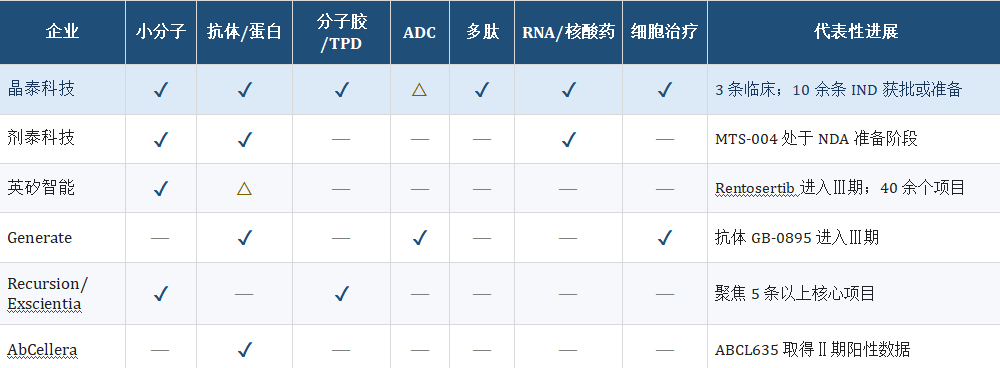
 The table indicates that ✓ there are clear assets or pipelines; △ platforms or cooperation capabilities have been disclosed, and assets have not been clearly named; — No official announcement pipeline.
Source: Company announcements, official website and public clinical progress. The compilation date is September 21, 2026.
The table reveals a clear division of labor in the industry: Jietai leads the registration process and delivery technology; Insili leads the number and advanced verification of small molecule pipelines; ABCellera, Absci, and Generate focus on proteins and antibodies; Jingtai has the widest range of disclosed modal combinations.
Multi-modality is becoming a common choice for large manufacturers to enter AI pharmaceuticals
Google DeepMind expands AlphaFold to protein, DNA, RNA, ligands, and antibody complexes; NVIDIA BioNEMO focuses on advancing protein conjugate design; OpenAI collaborates with Retro Biosciences to develop protein engineering models. After entering drug development, large manufacturers generally switch from macromolecules and new modes, because data in these fields are scarce, the structural space is more complex, and it also reflects the value of a closed loop of computation and testing.
Different targets correspond to different optimal solutions: intracellular pockets are suitable for small molecules, cell surface signals can be blocked by antibodies, pathogenic proteins can be degraded through molecular gum, gene expression can be silenced by siRNA, and immune resetting can invoke TCE or CAR-T. The multi-modal platform obtained the right to choose “target first, modal placement”.
Historical data is also provided for reference. Among the probability of approval from phase I of BIO statistics, small molecules are about 7.5%, monoclonal antibodies are about 12.1%, RNAi is about 13.5%, and CAR-T is about 17.3%. These cross-period data cannot directly predict a single pipeline, but it shows that the drug modality itself is a risk allocation tool.
The breadth of Jingtai comes from horizontal multiplexing of the same set of bases
The reason why Jingtai's various modes can achieve the widest layout is because they share models based on shared quantum mechanics and physical modeling, AI generation and prediction, automated synthesis and experimental verification, and then standardized data flow back. The R&D workflow is common to the bottom layer of “wet and dry” AI pharmaceutical practice experience, and the expansion rate is driven by the platform reuse rate.
The current small molecule clinical combination includes SIGX1094, RTX-117, and PEP08; SIGX2649 has been approved by the US IND and submitted to the Chinese IND. Self-developed TRK/RET intestinal restriction small molecule XTN004 has completed the submission of US pre-IND materials. The interim report is for the second half of 2026. According to the company's recent communication, the project plans to submit an IND this week, and in the end, the official announcement shall prevail.
Macromolecules and new modes have also blossomed a lot. ALX001, ALX002, and ALX005 of Jingtai's subsidiary AILux are scheduled to enter clinical trials in 2027; Kodexia has laid out 6 siRNA pipelines, and more than half have completed in-vivo efficacy evaluations. Among them, the IgA nephropathy project has obtained non-human primate data in about 7 months; the molecular gum project has obtained pmole-grade degradable molecules within a quarter; brain delivery of the peptide platform and oral cyclic peptide projects have been promoted separately to PCC; incubator LEYMAN Biotech's META 10-19 has obtained multiple IND licenses from China and the US.
SIGX1094 provides a sample to observe the conversion efficiency of the platform. For diffuse gastric cancer, the project observed initial safety and anti-tumor signals in phase I, and obtained FDA orphan drug and fast track qualification; phase II/III applications in combination with Cinda KRAS-G12C inhibitors have been accepted by the CDE. The fast track can improve the efficiency of regulatory communication and rolling review. The follow-up registration path depends on phase II design and efficacy intensity. The pipeline is expected to be exempted from phase III clinical trials for rare diseases, and the marketing process will begin as early as 2027 after completing phase II clinical trials. Higer Biotech is responsible for clinical promotion, and Jingtai retains revenue share for subsequent commercialization, so that the platform value can continue to be realized as assets mature.
In the first half of 2026, Jingtai's AI4S business revenue increased by 136.4% year-on-year to 193.5 million yuan. The increase in the number of pipelines and the simultaneous crossing of PCC and IND nodes in multiple modes indicate that base reuse has begun to transform into asset density.
Ailux and DoveTree: Platforms Begin Actively Seizing Pipeline Revenue
Ailux, a subsidiary of Jingtai, can be seen as a pioneer in the evolution of its business model. The company has successively authorized structural forecasting platforms to Johnson & Johnson and UCB, and then reached a dual cooperation of up to US$345 million with Eli Lilly. The contract includes platform licensing options, cooperative R&D, and milestone benefits; it is now further concentrating resources on three wholly-owned self-exempt pipelines.
This change quickly completed the value transition path of “platform licensing - cooperative development and division - self-operated pipeline”. ATLAx's proprietary data base contains billions of protein sequences, approximately 140,000 antigen-antibody sequence pairs, and approximately 30 million synthetic structural data, forming a solid feedback loop with a 30,000 square foot wet laboratory. While Anthropic is still completing experiments through acquisitions of self-built biological laboratories, Ailux has accumulated real-world data that can directly service model training.
Maria Belvisi, who joined Ailux in April this year, was AstraZeneca's senior vice president of respiratory and immune research and development, managing around 500 scientists and advancing Tozorakimab from pre-clinical to phase III. Her addition points to a clear goal: to upgrade the AI antibody platform to Biotech with global clinical development capabilities.
As a reference for the primary market valuation, Anew Labs recently completed financing of US$290 million with a post-investment valuation of approximately US$1.5 billion, and its fastest public pipeline is still pre-clinical. On the other hand, Ailux already has multinational pharmaceutical customers, proprietary data, wet laboratories, and three clear self-operated pipelines, and the asset maturity level is significantly higher.
The DoveTree partnership shows that Jingtai began introducing external leverage into clinical and commercial capabilities earlier. Jingtai has received an initial payment of 51 million US dollars and a second payment of 19 million US dollars, with a cumulative total of 70 million US dollars; the most recent payments under the original agreement are still up to 30 million US dollars, and the total potential amount is up to 5.99 billion US dollars. The first tumor asset has entered the IND-enabling stage.
Dovetree founder Gregory Verdine has co-founded more than 10 biotech companies, of which more than 5 have entered the capital market; Fog Pharma changed its name, Parabilis went public in June of this year. At the time of signing the contract, Jingtai revealed that it had jointly developed 3 FDA-approved drugs; daraxonrasib, a quasi-blockbuster drug for pancreatic cancer approved this year, absorbed the early work of Verdine and Warp Drive, further increasing the number of approved drugs in this technology spectrum to 4.
In this complementarity, Jingtai requires Verdine's old judgment on targets and commercialization paths, and Verdine values Jingtai's hard-core ability to integrate AI, physical intelligence, and automated experiments into the same platform. This combined effort is turning the number of pipelines on paper into a high-value asset for real money.
The key to valuation: transforming technical breadth into a continuous value node
In terms of speed, Jietai is closest to product registration. Insilicon has the AI Native Small Molecule Phase III benchmark; in terms of modality and breadth of business models, Jingtai is in a scarce position among AI pharmaceutical companies listed globally.
This breadth can bring investors three real layers of defensive and offensive value:
1. Decentralized pipeline risk: More independent clinical and BD events reduce the extent to which the success or failure of a single pipeline dominates the company's overall valuation.
2. Biologically-oriented “modal options”: Comparing different modes around the same target, so that drug forms actually serve biological problems rather than being limited by technical limitations.
3. Multi-level revenue structure: Platform service revenue, milestones, sales shares, self-operated pipelines, and incubation of ecological equity have built a rich profit pool.
Traditional biotech valuations are often hijacked by one or two core assets; Jingtai is closer to the composite valuation model of “R&D infrastructure revenue + risk adjustment value + cooperative pipeline sharing + Ailux and incubation ecological options + new material platform”. Currently, the market already has a preliminary pricing for its service revenue, but the pricing of multi-modal pipelines and huge ecological rights is still in the very early stages.
The next value delivery point is clear: XTN004 was officially submitted to IND, SIGX1094 entered the next clinical stage, three ALX antibodies entered clinical trials in 2027, and small nucleic acid and peptide projects continued to reach PCC.
Policies have boosted the industry's risk appetite, but only the scarcity of underlying technology determines how far the premium can go. If investors in the secondary market are betting — AI pharmaceuticals are being upgraded from a “single-point blind box tool” to an “industrialized system that can repeatedly produce major drugs,” then Jingtai Technology, which has the “widest layout”, undoubtedly has the most complete value mapping in the current market.