
2Y US Treasury yields show that there are still three interest rate hikes. Bulls are betting on excessive pricing: rushing to raise short-term bonds
The Zhitong Finance App learned that investors in the US Treasury bond market are turning their attention to holding government bonds with a shorter term — a deal that is betting that the Federal Reserve will eventually win in the fight against inflation. In the few days since the Federal Reserve raised interest rates for the first time since 2023 last week, the two-year US Treasury yield has soared to a multi-year high of about 4.75%. This is the latest step in the sell-off of the underlying bond. Futures market pricing shows that monetary policy will be tightened by 80 basis points in the coming year, which shows that Chairman Kevin Warsh's pledge to go all out in the fight against inflation is winning the trust of traders.
Bullish investors believe that the two-year US bond price, which has already been severely depressed, has taken into account these interest rate hikes. If inflation improves or the Fed's interest rate hike falls short of expectations, the price may recover strongly. This type of betting already surged one day after the Federal Reserve meeting, and demand for options that would benefit from falling secured overnight financing rates (SOFR) surged — an interest rate closely linked to policy expectations.
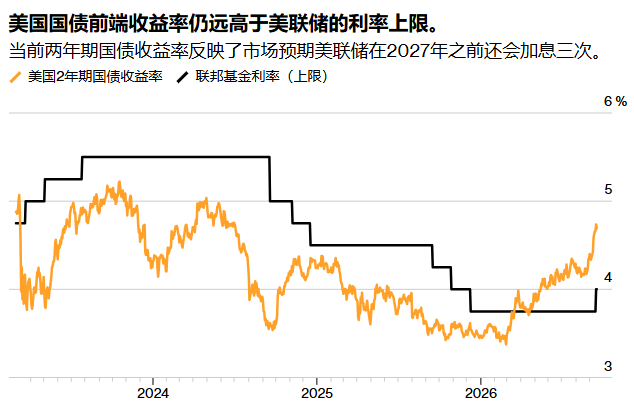
“If you look at any section of the curve now and ask where the yield is potentially overstretched, that is the front end.” Kevin Flanagan (Kevin Flanagan), head of investment strategy at WisdomTree, said, “The two-year yield is far higher than the current federal funds rate, which shows that the front end has gone too far.”
The two-year US Treasury yield — generally regarded as the most sensitive to the Fed's policy — has risen about 140 basis points from the February low, when the market was still planning to cut interest rates rather than raise interest rates. Currently, the yield is far higher than the new federal funds rate set at 3.75%-4%, and the bond market is moving far ahead of central bank officials — officials expect another rate hike during the year, and then maintain policy stability in 2027.
Proponents of the deal also point out that this period is not as susceptible to drastic price fluctuations as the long end of the curve, while providing holders with the highest yield since 2024.
“Our message to our customers is that now is a good time to add more time to the middle of the curve.” George Bory (George Bory), chief fixed income investment strategist at Allspring Global Investments, said. Borry said that after Walsh promised to restore price stability at the Jackson Hole annual meeting, the company increased its bond holdings, and the recent Federal Reserve meeting further strengthened their confidence in this position.
Investors are expecting the $69 billion two-year treasury bond offering on Tuesday (September 22) to provide a snapshot of demand for short-term bonds, followed by a $70 billion five-year auction on Wednesday (September 23). Key US Federal Reserve officials who will be speaking this week include New York Federal Reserve Chairman John Williams (John Williams) and Cleveland Federal Reserve Chairman Beth Hammack (Beth Hammack) — the latter a well-known inflation hawk.
Of course, there are a few risks that could disrupt this deal. There is no end in sight to the war between the Middle East and Ukraine. High energy prices may fuel further inflation and push up market expectations about how high the Federal Reserve will need to increase borrowing costs. If the US economy were stronger than expected, it would have the same effect.
Bank of America strategists say investors should prepare for the risk that the Federal Reserve will raise the benchmark interest rate above 5%, which exceeds current market expectations. These strategists believe that Walsh's statement on the September 16 (Wednesday) rate hike removed a dose of “easing” (a dose of accommodation) indicates that officials have yet to believe that monetary policy is dragging down the US economy.
“The question is how can you build confidence in where the Fed's final interest rate will be in a year.” Ed Al-Hussainy (Ed Al-Hussainy), portfolio manager at Columbia Threadneedle Investments (Columbia Threadneedle Investments), said, “The risk is that in every cycle of interest rate hikes, the market underestimates the extent to which the Fed will eventually do.”
However, oil prices have shown a trend of falling back when there are signs of an agreement with Iran or news of improved crude oil flows in war-torn regions. At the same time, some market participants said that as of now, the arithmetic of bonds is beneficial to investors who intend to hold them for a longer period of time.
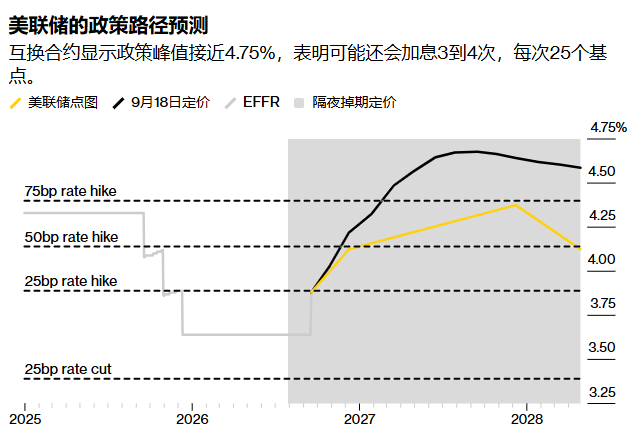
At around 4.75%, the two-year yield provides even more benefits than the market's current estimate that the Federal Reserve will push interest rates to 4.68% by September 2027 — the latter derived from swaps tracking future central bank meetings.
“In terms of where there is real value, that's where you can build the most coherent arguments on the front end.” Trevor Slaven (Trevor Slaven), head of multi-asset portfolio solutions at Barings, said, “This kind of pricing where interest rates are raised three more times seems like a low probability event.”