
Learn Why The Bull Case For Dow (DOW) Could Change Following Cost Cutting Plan
- Univar Solutions USA LLC recently expanded its agreement with Dow to distribute SupraCare polymers and specialty additives for homecare and industrial cleaning formulators across the US and Canada, widening access to Dow’s specialty ingredients portfolio.
- The combination of Dow’s SupraCare distribution expansion and its Transform to Outperform cost program indicates a tighter focus on higher value products and leaner operations in a chemicals sector facing cost pressure and mixed demand.
- We will now look at how Dow's Transform to Outperform efficiency initiative could reshape the investment narrative around its cash generation.
Dow Investment Narrative Recap
To own Dow, you need to believe management can turn a cyclical, capital heavy chemicals platform into a steadier cash engine through cost discipline and sharper portfolio choices. The Transform to Outperform plan, with targeted savings and automation, sits at the center of that effort. In the short term, execution on these efficiency moves looks like the key catalyst, while weaker macro demand and energy costs still weigh on margins.
The Univar SupraCare distribution deal matters operationally but does not radically change that equation. It supports mix and utilization, yet the bigger swing factor remains whether Dow can protect cash generation while delaying projects, restructuring European assets, and servicing debt when earnings are under pressure.
The most relevant recent development for this story is Dow’s Transform to Outperform program, which targets about US$700 million of savings this year and US$2 billion in total. Management is leaning on process optimization, automation, and AI to lift yields and maintenance productivity. If progress is steady, that could support the case for improved cash flow from a still volatile base.
For you as an investor, the upside case around Dow now leans on tying this cost program to other cash levers, including the planned US$2.4 billion proceeds from Gulf Coast asset sales and any Nova litigation inflows. The risk is that persistent margin pressure, European restructuring, and interest coverage constraints offset these efforts before the benefits fully show through.
What The Dow Numbers Assume About The Future
Dow's consensus narrative points to revenues of US$44.6b and earnings of US$2.1b by 2029. That path assumes 2.6% yearly revenue growth and a swing in earnings of US$3.4b from a loss of US$1.3b today.
Uncover how Dow's fair value indicates a 21% potential upside to its current price, a discount that could narrow quickly if sentiment shifts.
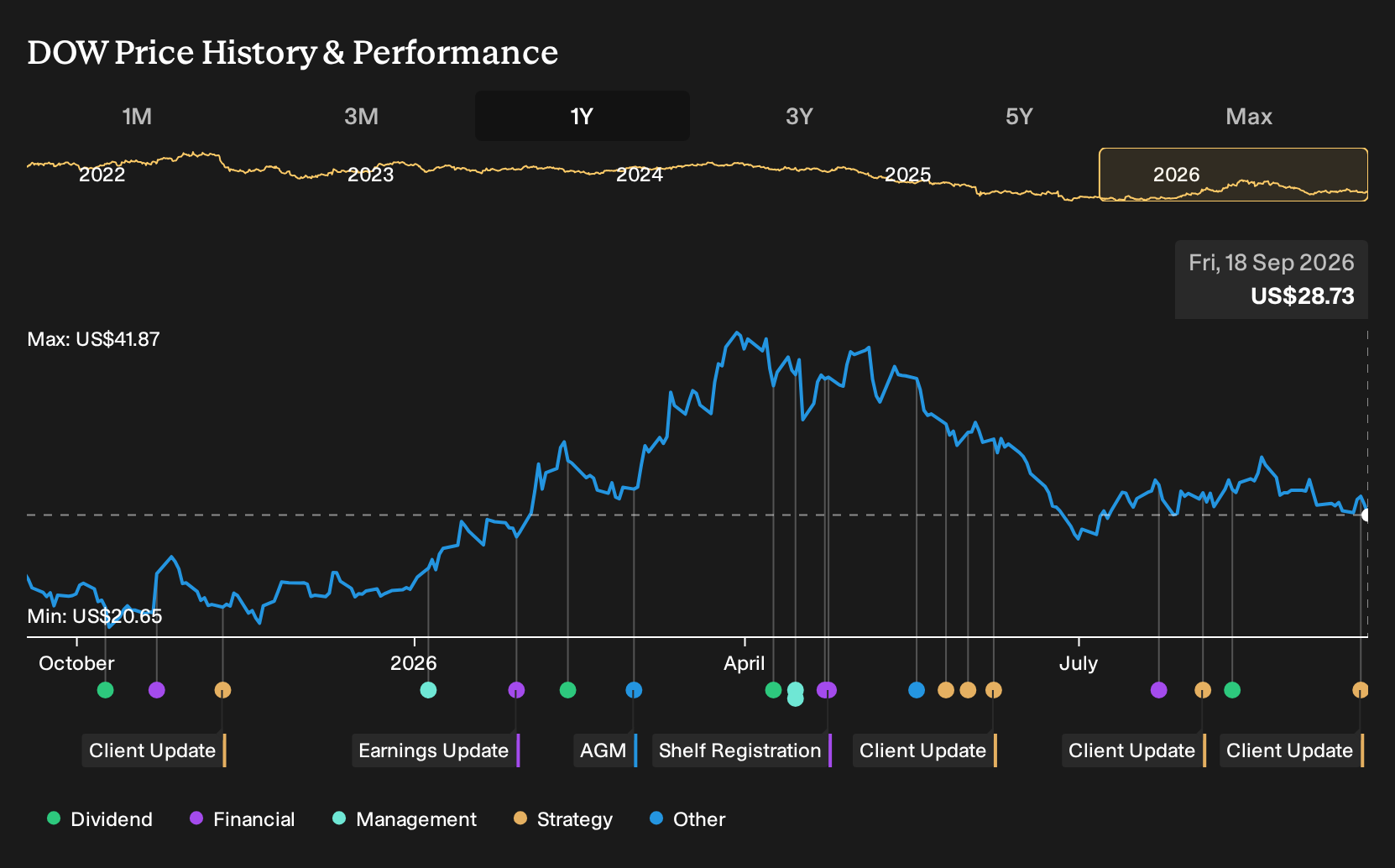
Exploring Other Perspectives
One alternate view argues that long term regulatory pressure and decarbonization could cap how much Dow benefits from deals like the Univar SupraCare expansion. The lowest analysts were already penciling in slower revenue of about US$42.7b and earnings of roughly US$1.6b by 2029. That is a more cautious story. These forecasts came before this distribution news, so you can reasonably expect some opinions to shift. It is worth comparing a few different scenarios before deciding how you feel about Dow’s path from here.
Explore 4 other Dow fair value estimates, including one that suggests it could be worth just $29.00.
The Verdict Is Yours
Don't just follow the ticker; dig into the data and build a conviction that's truly your own.
- A great starting point for your Dow research is our analysis highlighting 3 key rewards and 2 important warning signs that could impact your investment decision.
- See our latest analysis for Dow. The report includes a comprehensive fundamental analysis summarized in a single visual, the Snowflake, making it easy to evaluate Dow's overall financial health at a glance.
Looking for more investment ideas beyond Dow?
If the Dow story has sharpened your thinking on cash generation, balance sheet strength, and income reliability, it can be useful to scan a wider field of potential opportunities using structured filters rather than hunches.
- For investors who want income that works harder than cash in the bank, look at companies described as 7 dividend fortresses and see which businesses combine yield with staying power.
- If capital preservation sits high on your priority list, focus on stability first and growth second by reviewing a 30 resilient stocks with low risk scores that screens for resilient balance sheets and milder drawdowns.
- For readers willing to do extra homework in search of less crowded stories, survey a 16 high quality undiscovered gems and see which smaller players show strong fundamentals without heavy headline attention.
This article by Simply Wall St is general in nature. We provide commentary based on historical data and analyst forecasts only using an unbiased methodology and our articles are not intended to be financial advice. It does not constitute a recommendation to buy or sell any stock, and does not take account of your objectives, or your financial situation. We aim to bring you long-term focused analysis driven by fundamental data. Note that our analysis may not factor in the latest price-sensitive company announcements or qualitative material. Simply Wall St has no position in any stocks mentioned.
Have feedback on this article? Concerned about the content? Get in touch with us directly. Alternatively, email editorial-team@simplywallst.com