
3 US AI Defense Stocks Retail Investors Are Watching Right Now
AI policy has moved from think-tank white papers to the campaign stage, with Donald Trump promising to push hard for growth, new federal firepower and an “AI Force” while keeping tight regulation at bay. That kind of political tailwind can reshape where government technology dollars flow, and fast. This article explains how that backdrop touches three US AI focused government IT and defense contractors, and why their exposure to this news matters for your watchlist.
The stocks highlighted below are just a small sample of the idea, and the full screen surfaced 70 more US AI focused government IT and defense contractors with equally compelling narratives that do not fit into a single article.
To go deeper into this theme, identify your preferred risk profiles and analyze potential opportunities side by side, head straight into the US AI-Focused Government IT & Defense Contractors screener
AeroVironment (AVAV)
Overview: AeroVironment develops AI-enabled uncrewed aircraft, loitering munitions and other robotic defense systems for US and allied government customers.
Operations: AeroVironment generates about US$1.4b from Autonomous Systems and US$584 million from Space, Cyber and Directed Energy, with roughly US$1.4b from US customers and US$556 million internationally.
Market Cap: US$8.3b
AeroVironment is one of the clearest expressions of this AI-focused defense theme, since its business is built around autonomous drones, loitering munitions and AI-enabled systems that already sit inside US and allied military programs.
"The quarter arrived loaded with confirming data (EHEL awarded, LOCUST international sale announced, Titan contract wins stacking). Yet the call’s analytical interest lies less in the headlines than in what shifted underneath them. A narrative architecture built previously around anticipated inflection has now converted to one anchored in achieved inflection, and the pressure to explain why guidance wasn’t raised has become the new center of gravity."
What happens to AeroVironment’s earnings power if a single assumption about how quickly those new AI-heavy programs ramp into margins proves wrong.
If that earnings swing is what you are watching, read the full narrative for AeroVironment to see how AeroVironment’s ramp, risks and upside could be decoupling from expectations.

Ouster (OUST)
Overview: Ouster builds lidar sensors and perception tools that feed data into AI driven defense, robotics and smart infrastructure systems worldwide.
Operations: Ouster generates about US$204.9 million from selling lidar sensor kits, with roughly US$71.5 million reported from US customers.
Market Cap: US$2.5b
Ouster fits into the US AI focused government IT and defense theme because its lidar and perception stack is what lets autonomous machines, border systems and traffic networks see and react in real time.
"Ouster is tapping into the massive Intelligent Transportation Systems (ITS) market with their Blue City traffic management solution, which could drive significant revenue growth as they expand deployments across the US, Europe, and Asia."
The key focus is how changes in AI driven sensing demand could affect the company’s path to sustainable margins and cash generation.
That margin path is exactly what the full full narrative for Ouster unpacks, separating short term noise from where Ouster’s sensing demand could be quietly accelerating next.

Sanmina (SANM)
Overview: Sanmina is a global electronics manufacturer that designs, builds and services complex hardware systems for cloud, defense and industrial customers.
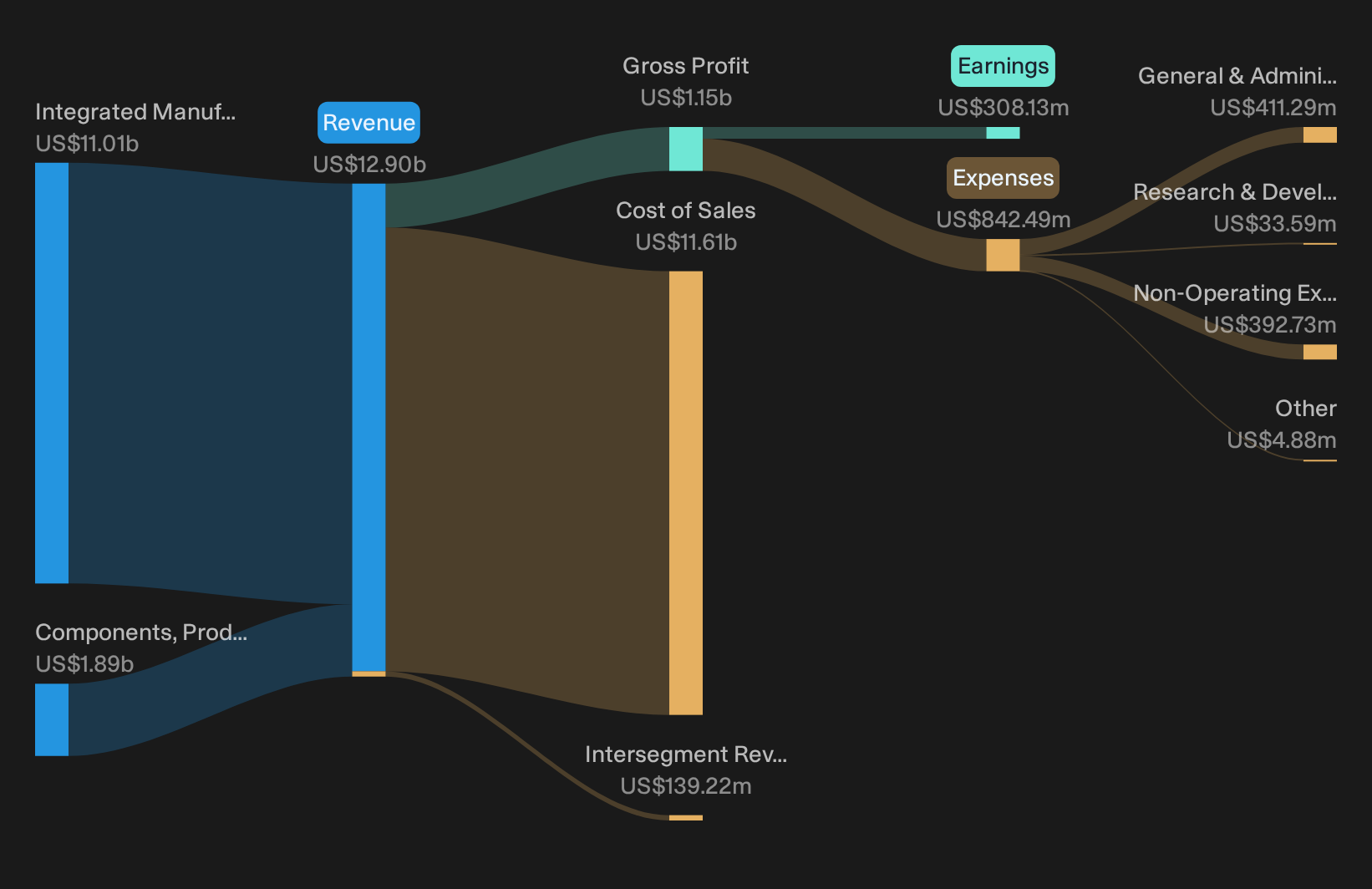
Operations: Sanmina generates about US$11.0b from Integrated Manufacturing Solutions and US$1.9b from Components, Products and Services, primarily serving customers across the United States, Mexico and APAC.
Market Cap: US$10.5b
Sanmina matters for this AI-focused government contractor theme because it supplies the secure, complex hardware that federal and defense partners need to deploy advanced analytics and machine learning at scale.
"The imminent acquisition of ZT Systems is expected to add between $5 and $6 billion of annual run-rate revenue, positioning Sanmina to double its net revenue within three years and capitalize on explosive growth in data center and AI infrastructure investment."
What happens to Sanmina’s earnings power if a single assumption about how profit sharing on those AI heavy systems integration contracts shifts.
That profit split is exactly where the full narrative for Sanmina shows whether Sanmina’s AI build out is quietly accelerating, stalling, or masking a bigger earnings reset.
Seeking Alternatives Before The Crowd
Fresh themes can gain momentum quickly, and some of the most compelling stories often accelerate once the broader market takes notice. Screen under the radar for now, while it matters, and consider getting positioned early.
- Scout income ideas that aim to keep paying even when sentiment drops by checking a curated group of high yield opportunities through the 6 dividend fortresses.
- Track future-facing automation trends before they break into the mainstream by scanning companies powering machines, factories and warehouses with the 95 robotics and automation stocks.
- Spot infrastructure players associated with AI build outs and rising data demand by reviewing a focused pool through the 38 power grid technology and infrastructure stocks.
This article by Simply Wall St is general in nature. We provide commentary based on historical data and analyst forecasts only using an unbiased methodology and our articles are not intended to be financial advice. It does not constitute a recommendation to buy or sell any stock, and does not take account of your objectives, or your financial situation. We aim to bring you long-term focused analysis driven by fundamental data. Note that our analysis may not factor in the latest price-sensitive company announcements or qualitative material. Simply Wall St has no position in any stocks mentioned.
Have feedback on this article? Concerned about the content? Get in touch with us directly. Alternatively, email editorial-team@simplywallst.com