
3 US Conglomerate Stocks Investors Are Reassessing After Berkshire Hathaway Succession News
Succession news at Berkshire Hathaway has put conglomerates back under the spotlight, as investors reassess how leadership, culture and capital allocation fit together once a legendary founder steps back. That shift can open gaps in pricing when fear of change outruns the facts. This article walks through three US large cap value conglomerate stocks exposed to the same governance questions, and examines where the market reaction may or may not match the underlying story.
The three stocks covered next are only a sample set, since the full screen surfaced another 60 US large cap value conglomerates with similarly detailed governance stories that are not broken out in this article. If you want to identify which of those might fit your own risk and balance sheet preferences, head straight to the US Large-Cap Value Conglomerates screener.
IDEX (IEX)
Overview: IDEX is an industrial conglomerate that supplies specialized pumps, fluid-handling equipment, safety systems and precision components across global health, science and infrastructure markets.
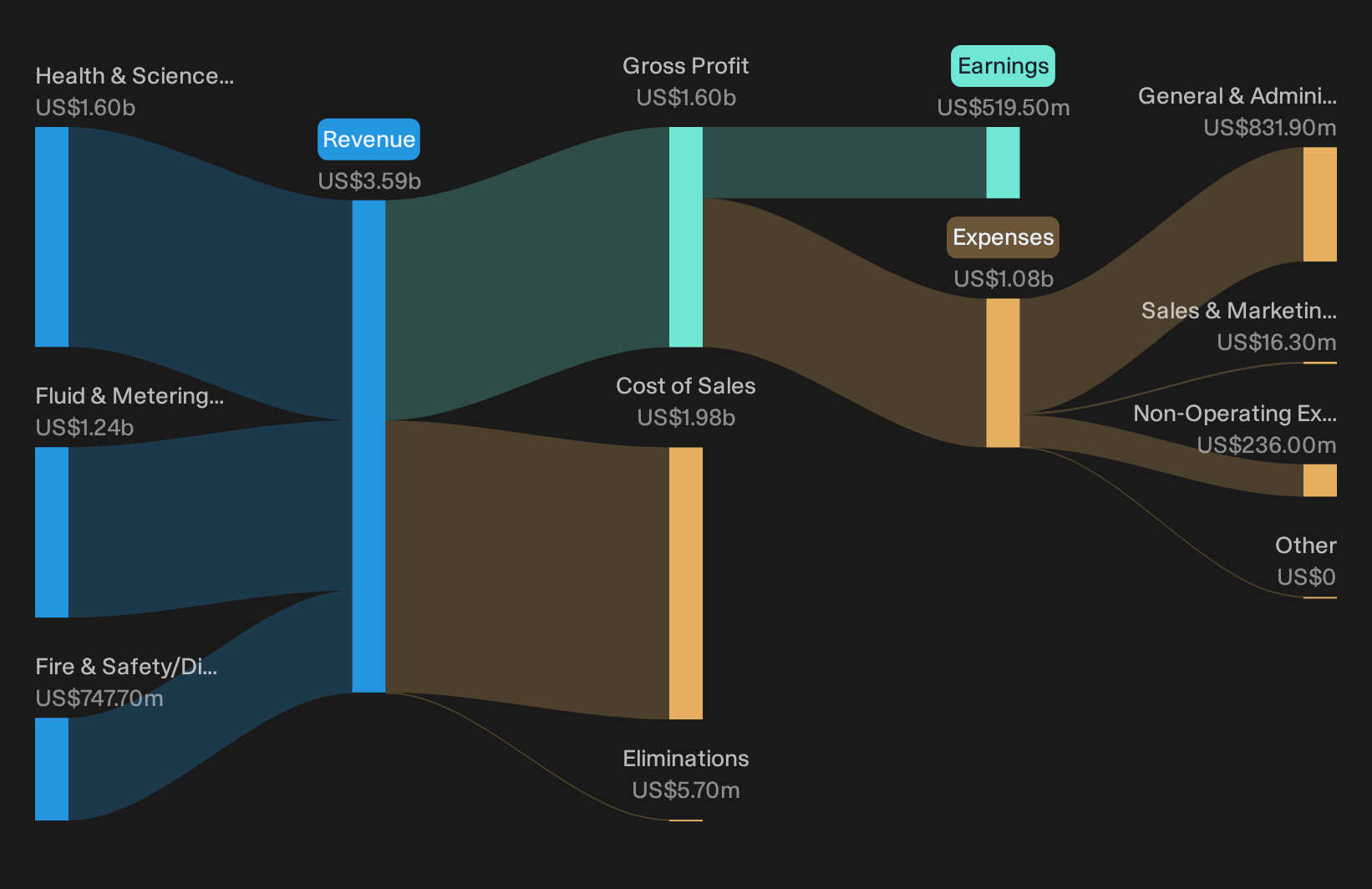
Operations: IDEX generates about US$1.6b from Health & Science Technologies, US$1.2b from Fluid & Metering, and US$748 million from Fire & Safety/Diversified Products, with revenue largely sourced from the United States and Europe.
Market Cap: US$16.4b
IDEX fits this conglomerate screen because it spreads its cash flow across several industrial niches. This matters when investors are rethinking leadership and capital allocation after Berkshire’s succession headlines.
Strong growth is expected in the space, defense, and energy transition sectors, which are key areas for IDEX.
What really moves the needle from here is how one quiet pressure on future margins resolves as those end markets ramp or stall.
That quiet pressure is exactly what the full narrative for IDEX unpacks, showing where IDEX’s margin story could be stalling or accelerating beneath those headline sectors.
Ingersoll Rand (IR)
Overview: Ingersoll Rand provides mission critical air, gas, fluid and vacuum technologies that support industrial, medical, energy and infrastructure customers worldwide.
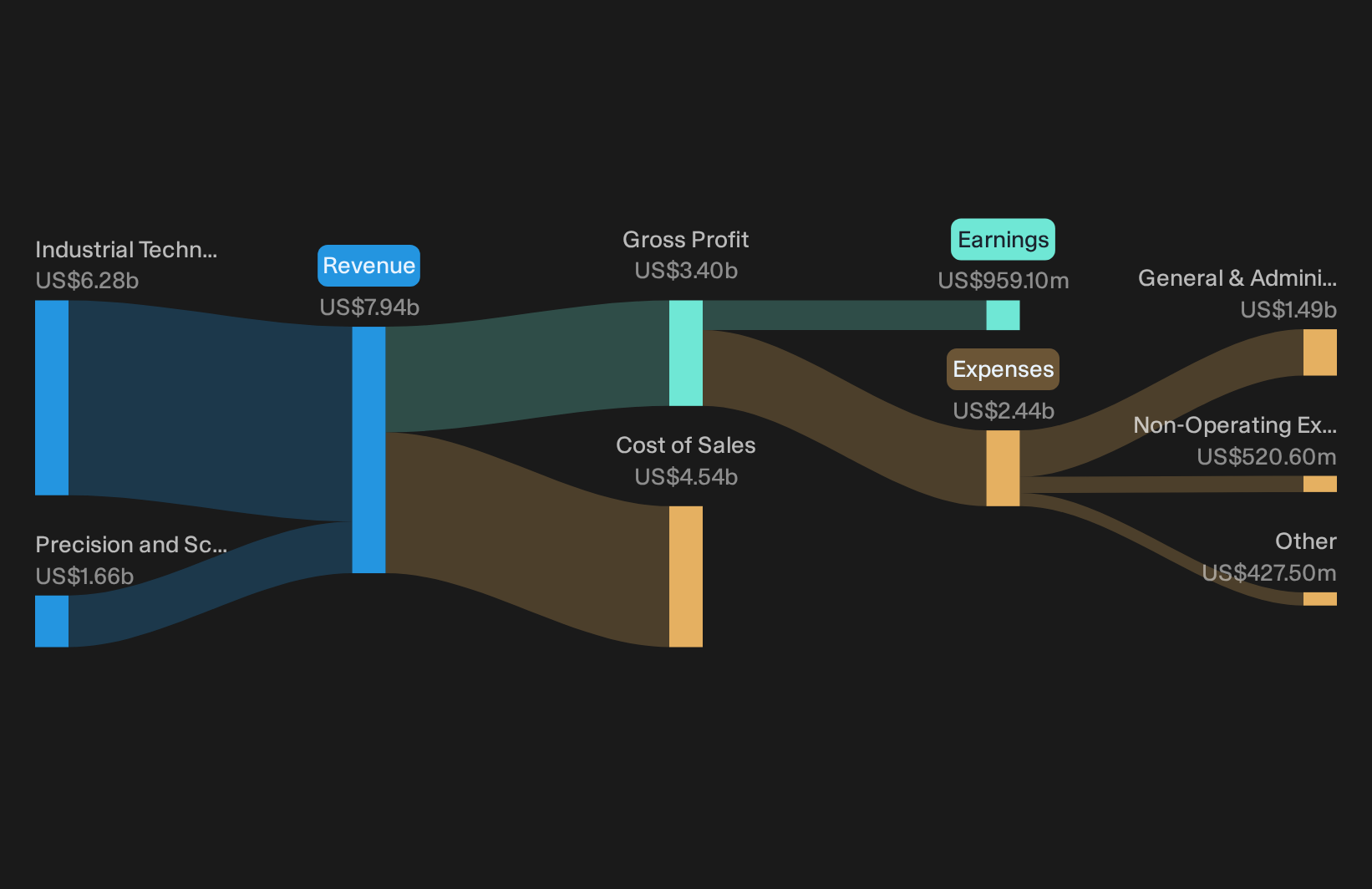
Operations: Ingersoll Rand generates about US$6.3b from Industrial Technologies and Services and US$1.7b from Precision and Science Technologies across global regions.
Market Cap: US$28.2b
For this US Large Cap Value Conglomerates screen, Ingersoll Rand matters because its multi segment industrial model and cash focused capital playbook echo the Berkshire style balance of diversification and discipline that investors are reassessing after the succession headlines.
The company continues building recurring, high-margin revenue streams through expansion of aftermarket services and value-added lifecycle solutions (aftermarket revenue grew to 37% of total), which increases the stability of net margins and supports long-term earnings resilience even if new equipment demand remains variable.
The real swing factor is how one less visible constraint on future pricing power and mix shapes those margins once demand normalizes.
That pricing constraint is exactly what the full narrative for Ingersoll Rand unpacks, showing where recurring aftermarket cash flows might be masking or accelerating the next leg of Ingersoll Rand’s earnings story.
DuPont de Nemours (DD)
Overview: DuPont de Nemours supplies technology based materials and solutions for healthcare, water, construction, automotive, aerospace and packaging customers worldwide.
Operations: DuPont de Nemours generates about US$3.7b from Diversified Industrials and US$3.3b from Healthcare & Water Technologies, with broad global exposure.
Market Cap: US$17.3b
DuPont de Nemours fits this large cap value conglomerate screen because its multi segment materials platform and balance sheet support multi industry cash generation that can matter when investors reassess how diversified groups handle capital and legacy liabilities after Berkshire’s succession news.
Intensifying global ESG and environmental regulations may increase DuPont's long-term compliance and remediation costs, particularly if ongoing PFAS and other environmental liabilities continue to create significant legal and cash flow burdens over an extended period, which could affect net margins and future earnings.
What really matters for DuPont de Nemours is how one still unresolved trade off between cleaner chemistry and future pricing power affects margins.
That trade off is exactly where the full narrative for DuPont de Nemours goes further, revealing how DuPont de Nemours could turn tighter chemistry rules into accelerating pricing power and cash generation.

Seeking Alternatives Before The Crowd
Fresh ideas move first. While attention sits on Berkshire style conglomerates, other themes are building quiet breakout momentum under the radar for now, so investors can seek to position earlier.
- Identify cash rich balance sheets before they get crowded by institutions by scanning the list of solid balance sheet and fundamentals (23 results) curated by strict quality and fundamentals rules.
- Track early compounding income streams and reinvested payouts using the 6 dividend fortresses to stay informed about high yield opportunities while they still appear overlooked.
- Follow the build out behind AI capacity by filtering the 89 AI infrastructure stocks for potential beneficiaries of rising demand for data centers and supporting hardware.
This article by Simply Wall St is general in nature. We provide commentary based on historical data and analyst forecasts only using an unbiased methodology and our articles are not intended to be financial advice. It does not constitute a recommendation to buy or sell any stock, and does not take account of your objectives, or your financial situation. We aim to bring you long-term focused analysis driven by fundamental data. Note that our analysis may not factor in the latest price-sensitive company announcements or qualitative material. Simply Wall St has no position in any stocks mentioned.
Have feedback on this article? Concerned about the content? Get in touch with us directly. Alternatively, email editorial-team@simplywallst.com