
Should Logistics Joint Venture Require Action From Ares Management Stock Investors?
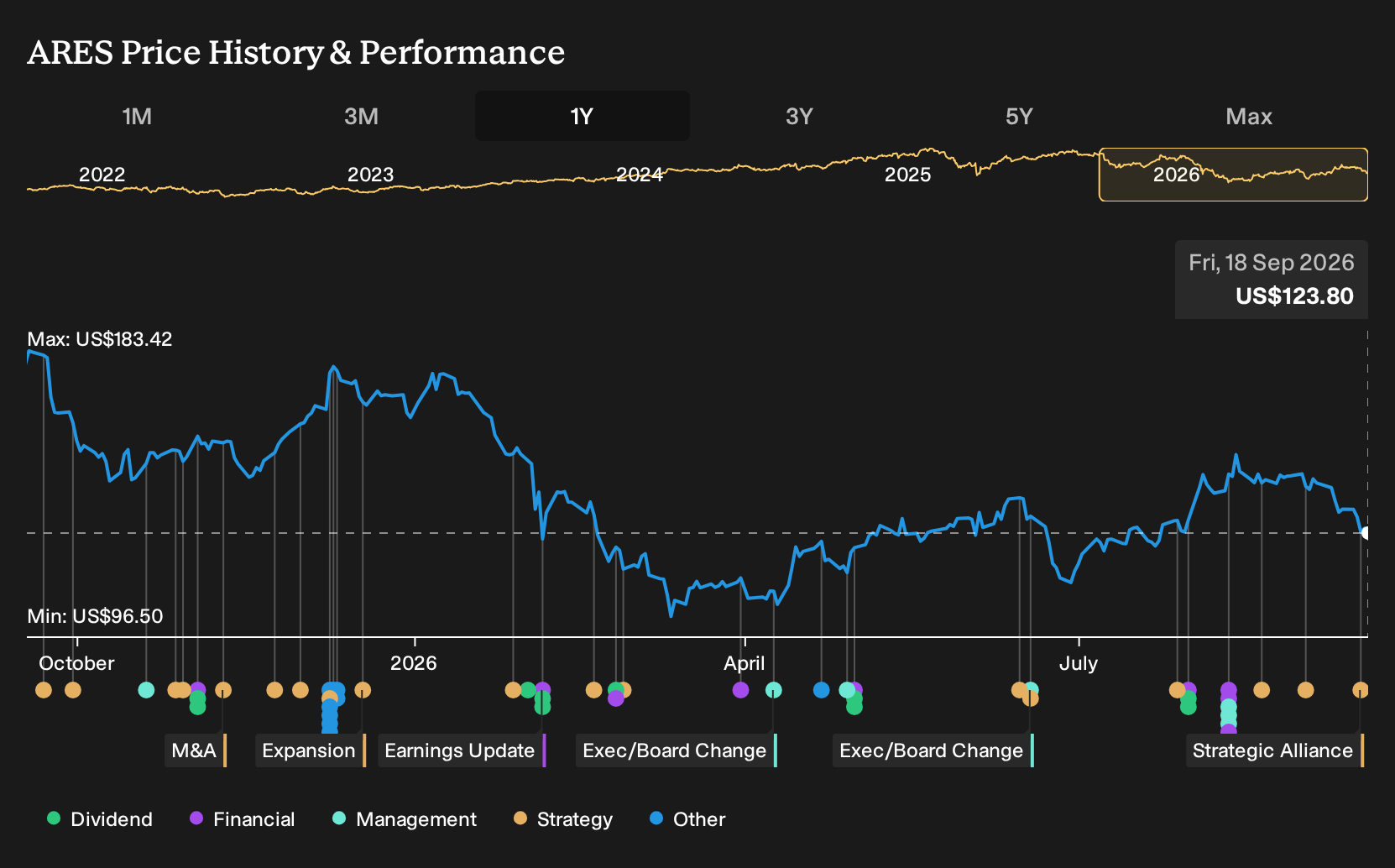
- Ares Management reported record quarterly fundraising of US$36b with higher assets under management, earnings measures and a 20% dividend increase, alongside a new joint venture with PSP Investments to deploy up to US$2.4b into U.S. logistics real estate seeded with 14 properties.
- The move into U.S. logistics through Marq Logistics, combined with scaled permanent capital trends, highlights Ares Management’s push for larger fee pools tied to modern warehousing demand.
- This article examines how Ares Management’s investment narrative is affected by the US$2.4b U.S. logistics real estate joint venture.
Compare Ares Management’s logistics push with other asset managers building real estate exposure by scanning our hand picked list of solid balance sheet and fundamentals (23 results) for potential alternatives in the same space.
Ares Management Investment Narrative Recap
Ares Management may appeal to investors who prioritize its multi asset platform, fundraising capabilities and perpetual capital base, which together aim to convert investor demand into fee income, even as competition in alternatives increases. The logistics joint venture appears additive rather than transformational in the near term. In the short term, the key factor to watch is how consistently Ares can convert dry powder into fee paying assets without sacrificing pricing.
The biggest watchpoint is pressure on profitability. Ares carries debt that is not well covered by operating cash flow, and its 4.36% dividend is not fully backed by earnings or free cash. Execution risk from newer verticals such as data centers, sports and media sits alongside fee compression as an ongoing concern if conditions tighten.
The logistics joint venture follows record quarterly fundraising of US$36 billion, 17% year on year growth in both AUM and fee paying AUM, and a 20% dividend increase to US$1.35 per share. For shareholders, that combination links operational scale to a new area of deployed capital in real assets, rather than leaving capital uninvested in commitments.
Fee related earnings and realized income both increased at double digit rates, supported by scale and fund performance. That context is relevant for assessing the logistics initiative. If Ares Management continues to convert capital raised into cash flowing assets such as the 5.2 million square foot seed portfolio, the narrative remains centered on recurring fees and earnings, with competition, leverage and dividend coverage as the main risks to monitor.
Ares Management Earnings and Revenue Assumptions
Ares Management's narrative projects US$6.9b in revenue and US$1.9b in earnings by 2029. Analysts assume revenue growth of 5.2% per year and an earnings increase of about US$1.3b from current earnings of US$561.7m.
Uncover why Ares Management's fair value indicates a 17% potential upside to its current price that could narrow quickly.
Exploring Other Perspectives
Some of the lowest analysts focus on rising costs rather than logistics upside. They were modelling slower revenue growth of about 2.6% a year to roughly US$6.4b by 2029 and earnings near US$1.8b. That is a more cautious Ares Management story. Read both views and decide whether this new joint venture shifts your own expectations.
Explore another Ares Management fair value estimate, including one that suggests there may be as much as 10% downside from the current price.
The Verdict Is Yours
Disagree with existing narratives? Extraordinary investment returns rarely come from following the herd, so consider relying on your own analysis.
- A great starting point for your Ares Management research is our analysis highlighting 2 key rewards and 3 important warning signs that could impact your investment decision.
- See our latest analysis for Ares Management. The report includes a comprehensive fundamental analysis summarized in a single visual, the Snowflake, making it easy to evaluate Ares Management's overall financial health at a glance.
Looking for more Ares Management investment ideas?
If the Ares Management story has sharpened your thinking about risk, income and balance sheet strength, it can help to line it up against a broader watchlist of potential opportunities.
- For investors who want potential upside with smaller companies, consider scanning 8 elite penny stocks with strong financials that meet your risk appetite and portfolio size limits.
- If capital preservation and quality are higher on your checklist, you could review a curated 30 resilient stocks with low risk scores that scores well on resilience metrics.
- To broaden your opportunity set beyond well known tickers, look through a focused 16 high quality undiscovered gems that filters for strong fundamentals and financial discipline.
This article by Simply Wall St is general in nature. We provide commentary based on historical data and analyst forecasts only using an unbiased methodology and our articles are not intended to be financial advice. It does not constitute a recommendation to buy or sell any stock, and does not take account of your objectives, or your financial situation. We aim to bring you long-term focused analysis driven by fundamental data. Note that our analysis may not factor in the latest price-sensitive company announcements or qualitative material. Simply Wall St has no position in any stocks mentioned.
Have feedback on this article? Concerned about the content? Get in touch with us directly. Alternatively, email editorial-team@simplywallst.com