
How Investors Are Reacting To Synopsys (SNPS) Earnings Beats
- Synopsys continues to post earnings and revenue that exceed analyst expectations, with recent upward revisions to earnings estimates pointing to stronger operational execution than previously modeled.
- The company’s Zacks Rank #2 and consistently positive estimate revisions highlight how Synopsys’ tools remain deeply embedded in customers’ chip design workflows, supporting a robust fundamental demand backdrop.
- We will now examine how Synopsys’ investment narrative is shaped by rising earnings estimates and consistent outperformance versus consensus expectations.
Scan how Synopsys’ earnings momentum compares with other potential breakout opportunities by reviewing the hand-picked 33 high quality undervalued stocks that pair strong fundamentals with compressed expectations.
Synopsys Investment Narrative Recap
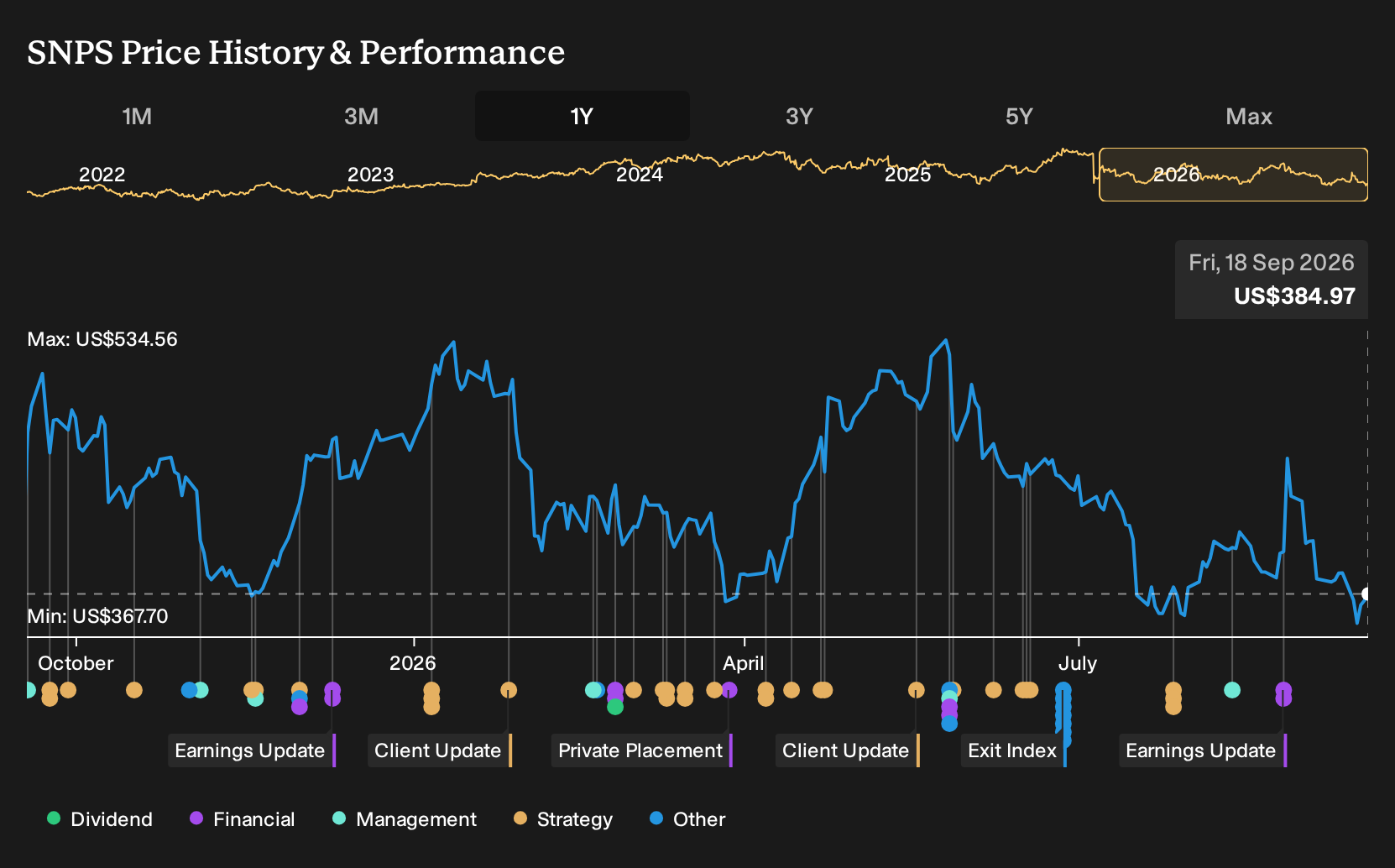
To own Synopsys, you need to believe its electronic design tools and IP remain essential as chips become more complex, and that the Ansys integration, SaaS shift, and IP repositioning eventually translate into steadier, higher quality cash generation. The recent share price pressure does not materially change that core thesis. The key near term swing factor is whether management can keep earnings quality high while digesting one off items and restructuring.
The biggest current operational risk is execution on the Ansys integration and the 10% workforce reduction. Integration delays, higher costs, or slower IP monetization could keep profit margins under pressure, especially with past margins already below last year. Export restrictions and China related contract uncertainty add another layer of variability that investors should keep in mind.
The most relevant recent datapoint for this setup is the Discounted Cash Flow work that values Synopsys above the current share price, based on projected free cash flow in the US$4b to US$8b range over the coming decade. That analysis underlines how much hinges on turning today’s earnings forecasts into consistent, recurring cash, rather than one off gains.
For catalysts, that same DCF framework effectively spotlights free cash flow execution as the main scorecard. Progress on shifting more EDA and Ansys workloads to subscription and cloud delivery, tighter IP focus on higher value subsystems, and disciplined cost control after the headcount cut all feed directly into that cash story. Any stumble in integrating Ansys, prolonged margin drag, or weaker returns on past IP investments would directly challenge the assumptions behind that valuation work.
Synopsys Forecast Setup and Valuation Bridge
Synopsys' narrative projects US$12.7b revenue and US$2.1b earnings by 2029. This assumes 10.5% yearly revenue growth and an earnings increase of about US$1.0b from US$1.1b today.
Analysts are effectively sketching out a future where Synopsys grows into a larger, more profitable platform, then asking you to judge whether the current share price already reflects that path. The core building blocks are clear. Forecast revenue reaches about US$12.7b by 2029, profit margins shift from 11.4% today toward 16.7%, and earnings move from roughly US$1.1b now to US$2.1b on the same timeline.
On those numbers, the stock would be trading at a P/E of 69.8x those 2029 earnings, compared with about 74.0x on current profits. That multiple is also well above the 30.7x cited for the wider US software group. You are effectively being asked to accept a premium valuation for Synopsys on the view that its chip design and simulation engines justify a higher long run earnings runway and more resilient cash flows.
The earnings path itself comes with a wide band of outcomes. Consensus centers on US$2.1b by 2029, but individual forecasts range from US$1.6b to US$4.3b. That spread tells you the market still disagrees on how smoothly Ansys integration plays out, how quickly IP monetization improves, and how much of the cost reset actually sticks.
Assumptions on the capital structure also matter. Analyst models bake in share count rising about 3.17% a year over the next 3 years. If that plays out, per share results will grow more slowly than total earnings, so long term holders need to keep one eye on dilution as well as on the headline profit line.
The discount rates in the report, at roughly 8.9%, translate those 2029 cash flows back into today’s dollars and help anchor the consensus fair value view. That framework underpins the average target price of US$544.97, with bullish analysts out near US$633 and the most cautious closer to US$414.77. With the stock last quoted at US$415.94, those targets imply upside based on the supplied numbers, although every investor still needs to decide whether the growth, margin, and multiple assumptions feel realistic.
For practical portfolio decisions, it helps to treat these Synopsys scenarios as a checklist rather than a forecast. Revenue growing at about 10.5% a year, margins pushing toward the mid teens, the Ansys tie up improving product breadth instead of clogging execution, IP returns improving after past disappointments, and a premium P/E remaining intact by 2029. The more of those boxes you think the business can genuinely tick, the closer your own intrinsic value estimate will sit to the analyst consensus band, and the more comfortable you may feel sizing any exposure.
Uncover why Synopsys' fair value indicates a 42% potential upside to its current price, which could narrow quickly.
Exploring Other Perspectives
Three fair value estimates from the Simply Wall St Community cluster tightly between about US$513.66 and US$544.97, suggesting retail investors in that group see Synopsys as broadly aligned with recent analyst targets. You still face clear execution and China related risks, so use these contrasting signals to explore several alternative viewpoints before deciding how Synopsys fits your portfolio.
Explore 2 other Synopsys fair value estimates, including one that suggests up to 42% potential upside from the current price.
Form Your Own Verdict
Don't just follow the ticker. Dig into the data and build a conviction that's truly your own.
- A great starting point for your Synopsys research is our analysis highlighting 3 key rewards and 2 important warning signs that could impact your investment decision.
- See our latest analysis for Synopsys. The report includes a comprehensive fundamental analysis summarized in a single visual, the Snowflake, making it easy to evaluate Synopsys' overall financial health at a glance.
Looking for more ideas beyond Synopsys?
If the Synopsys story has sharpened your thinking but you want a broader watchlist, use the Simply Wall St Screener to hunt for other stocks that fit your preferred mix of quality, valuation, and risk.
- If capital preservation and a smoother ride matter most to you, start with a basket of companies flagged as more resilient using 30 resilient stocks with low risk scores.
- If you like backing stronger balance sheets that can fund their own growth, scan the list of solid balance sheet and fundamentals (23 results) as a potential hunting ground for sturdier businesses.
- If you are hunting for ideas that the market may not be fully focused on yet, widen your search with a curated set of 16 high quality undiscovered gems.
This article by Simply Wall St is general in nature. We provide commentary based on historical data and analyst forecasts only using an unbiased methodology and our articles are not intended to be financial advice. It does not constitute a recommendation to buy or sell any stock, and does not take account of your objectives, or your financial situation. We aim to bring you long-term focused analysis driven by fundamental data. Note that our analysis may not factor in the latest price-sensitive company announcements or qualitative material. Simply Wall St has no position in any stocks mentioned.
Have feedback on this article? Concerned about the content? Get in touch with us directly. Alternatively, email editorial-team@simplywallst.com