
How Investors May Respond To Banc of California (BANC) Balance Sheet Reset
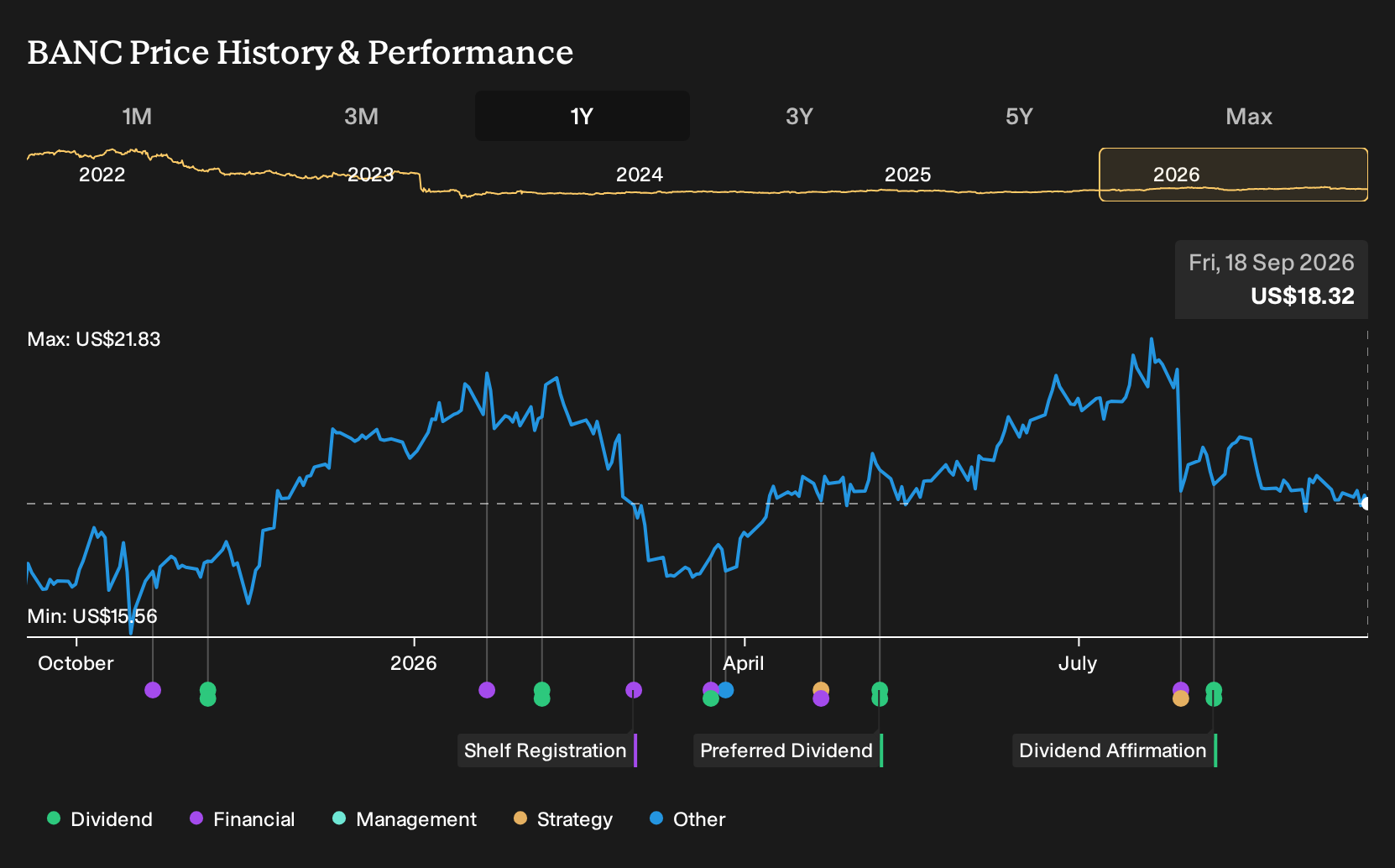
- Banc of California recently reported a second quarter net loss of US$251.3 million after repositioning securities and selling loans as part of a balance sheet reset, while loan and deposit volumes, net interest income, and problem loan metrics moved in a healthier direction.
- The report shows a sharp accounting hit tied to portfolio moves. At the same time, the underlying banking franchise of Banc of California is tracking toward stronger core lending and funding trends with fewer troubled credits on the books.
- The next area of focus is how Banc of California's investment narrative absorbs this large reported loss driven by its deliberate balance sheet repositioning.
Compare Banc of California's balance sheet reset with other banks that score well on funding strength and asset quality by scanning our curated list of solid balance sheet and fundamentals (23 results)
Banc of California Investment Narrative Recap
To own Banc of California, you need to be comfortable with a bank that is deliberately taking short term pain in reported earnings to reshape its balance sheet and loan mix. The central argument is that a cleaner book and healthier core funding can matter more than a single quarter headline loss. The immediate catalyst is execution on margin and loan profitability targets, which still needs to be demonstrated in reported results.
The largest near term risk sits in the combination of integration work, competitive deposit pricing, and the bank's exposure to Southern California commercial real estate. The recent US$251.3 million net loss does not fundamentally change those issues, but it does reduce the room for error if operating costs or credit quality deteriorate.
The key recent announcement is the second quarter report that paired the US$251.3 million loss with a voluntary reset of securities and loan portfolios. That move directly relates to the existing catalyst around repositioning toward lower risk, higher yielding categories such as lender finance, fund finance and residential mortgages, which analysts previously highlighted as important for earnings quality.
This same update also connects with the ongoing Pacific Western Bank integration. Execution in this area is important for the thesis built on cost synergies, scale benefits and improved efficiency. Any delays in integration timing, restructuring costs or deposit retention would feed directly into the risks analysts already identified around higher than expected expenses and pressure on net interest margins.
Banc of California's current loss of US$52.3 million is set against analyst expectations for earnings of US$755.2 million on US$1.6b of revenue by 2029. This implies revenue growth of 33.4% a year and an earnings swing of roughly US$807.5 million if those forecasts are met.
Uncover why Banc of California's fair value indicates a 21% potential upside to its current price that may not last much longer.
Exploring Other Perspectives
Some of the most optimistic analysts focus on Banc of California’s repricing opportunity as the key catalyst. They were modeling revenue of about US$1.6b and earnings of US$605.3 million by 2029, with a higher 8.0x P/E assumption. That is a much cheerier story than consensus, and the fresh US$251.3 million loss may push both narratives to shift. Readers can treat these as bookends and explore where their own view fits.
Explore 2 other Banc of California fair value estimates, including one that suggests as much as 329467% upside from the current price!
Form Your Own Verdict
Don't just follow the ticker. Dig into the data and build a conviction that's truly your own.
- A great starting point for your Banc of California research is our analysis highlighting 2 key rewards and 2 important warning signs that could impact your investment decision.
- See our latest analysis for Banc of California. The report includes a comprehensive fundamental analysis summarized in a single visual, the Snowflake, making it easy to evaluate Banc of California's overall financial health at a glance.
Looking for more Banc of California style investment ideas?
Once you have formed a view on Banc of California, it can help to compare that thesis with other opportunities that share similar qualities around value, balance sheet strength, or risk profile. The Simply Wall St Screener lets you filter for those traits in seconds and then spend your time where it matters: on the underlying stories behind the numbers.
- If you want income with fewer surprises, focus on companies that pair higher yields with resilient fundamentals by scanning 6 dividend fortresses.
- For investors hunting for value opportunities backed by solid business quality, use the screener built around 33 high quality undervalued stocks to find ideas worth a closer look.
- If capital preservation is your starting point, narrow the field to steadier profiles through the screener that highlights 30 resilient stocks with low risk scores.
This article by Simply Wall St is general in nature. We provide commentary based on historical data and analyst forecasts only using an unbiased methodology and our articles are not intended to be financial advice. It does not constitute a recommendation to buy or sell any stock, and does not take account of your objectives, or your financial situation. We aim to bring you long-term focused analysis driven by fundamental data. Note that our analysis may not factor in the latest price-sensitive company announcements or qualitative material. Simply Wall St has no position in any stocks mentioned.
Have feedback on this article? Concerned about the content? Get in touch with us directly. Alternatively, email editorial-team@simplywallst.com