
Is Rayonier (RYN) Undervalued Or Already Priced In At $20?
Rayonier (RYN) has drawn fresh attention after recent share moves left the timberland REIT trading around $20. With a roughly $6.0b market value, the business reflects a mix of timber, milling and real estate cash flows.
The recent move to $20.14 comes after a 30-day share price return that fell 6.19%, extending a year-to-date share price decline of 6.80%, while the 1-year total shareholder return, which includes dividends, is down 12.64%, which points to fading momentum for Rayonier.
Compare Rayonier's recent pullback with a hand picked group of resilient real asset and infrastructure plays in our 30 resilient stocks with low risk scores to see how other lower risk stocks have held up.
Rayonier now trades near US$20, while analyst targets and intrinsic value estimates sit materially higher. How wide is that gap in practical terms, and what does it imply for fair value today?
Most Popular Narrative: 23% Undervalued
Rayonier's most followed valuation story pegs fair value at $26 per share, which sits well above the recent $20.14 close and frames the current pullback as a potential discount to its modeled cash flow path.
Rayonier's land-based solutions segment is advancing numerous solar, carbon capture, and carbon offset projects, benefiting from strong demand for renewable energy and decarbonization solutions. This positions the company to create new, higher-margin revenue streams as policy support and market opportunities for these environmental services expand.
See why 22 investors see Rayonier as 23% undervalued.
Result: Fair Value of $26 (UNDERVALUED)
Still, Rayonier’s heavy exposure to climate events in the U.S. South and its reduced geographic diversification after the New Zealand sale could challenge that case of undervaluation.
Find out about the key risks to this Rayonier narrative.
Another View On Rayonier’s Valuation
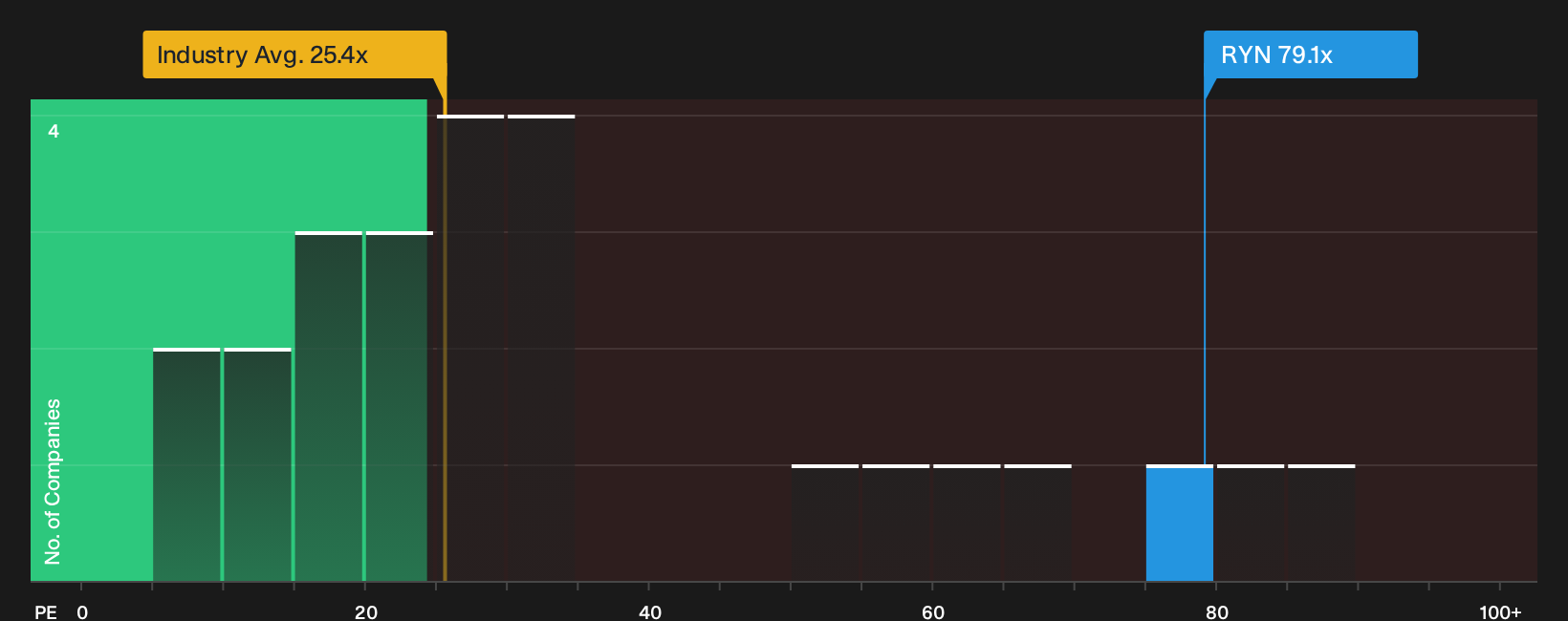
The first story around Rayonier leans on future cash flows and a fair value of $26 per share. A simple earnings multiple tells a very different story. At a P/E of 79.1x versus 25.4x for the Specialized REITs industry and a fair ratio of 65.2x, the stock screens as expensive rather than cheap. That raises a blunt question: Is the discount to fair value real, or is the market already paying up for Rayonier’s growth story?
Investors who prefer to anchor decisions on earnings comparisons rather than cash flow modeling may want to stress test this gap using our detailed multiple workup, then decide which framework they trust more over a full cycle. See what the numbers say about this price — find out in our valuation breakdown.
Next Steps
Mixed signals on Rayonier so far. If you want a clear view, move quickly, consider both sides of the story, and review the 3 key rewards and 4 important warning signs.
Looking for more Rayonier-sized investment ideas?
If Rayonier has your attention, do not stop here. Use the same disciplined approach across the market and give yourself more options before you commit.
- Target potential mispricings by scanning a curated pool of companies that combine quality fundamentals with attractive valuations through the 33 high quality undervalued stocks.
- Strengthen your income stream by focusing on businesses that pair higher yields with resilient fundamentals using the 6 dividend fortresses.
- Protect your downside by filtering for companies with sturdy balance sheets and solid financial footing via the list of solid balance sheet and fundamentals (23 results).
This article by Simply Wall St is general in nature. We provide commentary based on historical data and analyst forecasts only using an unbiased methodology and our articles are not intended to be financial advice. It does not constitute a recommendation to buy or sell any stock, and does not take account of your objectives, or your financial situation. We aim to bring you long-term focused analysis driven by fundamental data. Note that our analysis may not factor in the latest price-sensitive company announcements or qualitative material. Simply Wall St has no position in any stocks mentioned.
Have feedback on this article? Concerned about the content? Get in touch with us directly. Alternatively, email editorial-team@simplywallst.com