
Did COO Appointment Just Shift DexCom (DXCM) Investment Narrative?
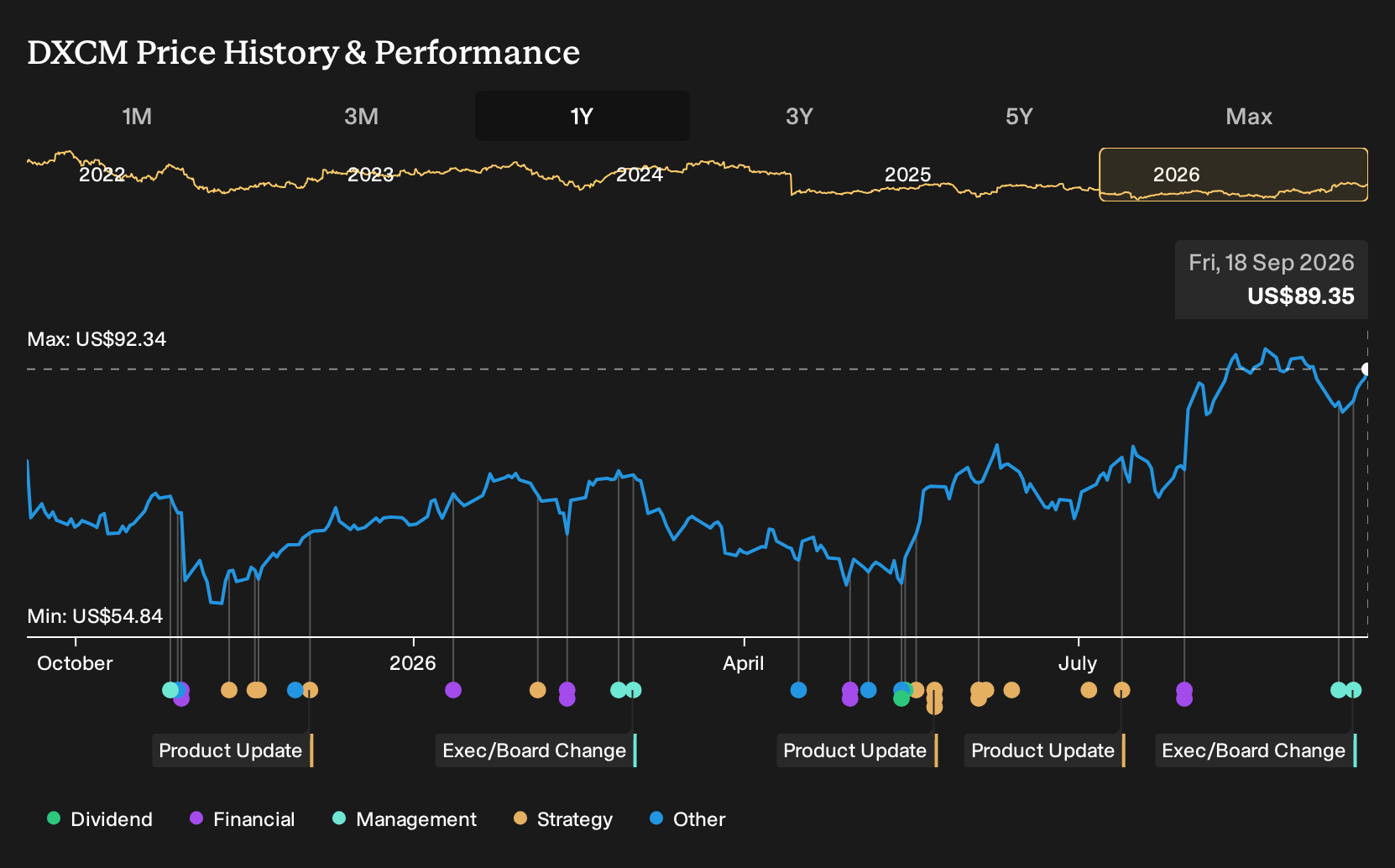
- DexCom recently elevated Executive Vice President and Chief Financial Officer Jereme Sylvain to Chief Operating Officer and added experienced medical technology finance leader Glenn S. Boehnlein to its expanded 13 member Board, with both appointments already in effect.
- The pairing of Sylvain’s operational remit with Boehnlein’s capital allocation and M&A background signals DexCom’s focus on tighter execution, supply chain reliability, and disciplined investment as it scales its continuous glucose monitoring platform.
- We will now examine how DexCom's investment narrative is shaped by Sylvain's expanded operating role and broader board-level financial expertise.
DexCom Investment Narrative Recap
To own DexCom, you need to believe its continuous glucose monitoring platform can keep expanding into type 2 and prediabetes while holding pricing and product differentiation against heavy competition and possible CMS bidding pressure. The near term hinge point is clean execution as new products scale and coverage broadens, without letting supply chain costs creep back up.
Sylvain stepping in as COO aims squarely at that execution question. His remit over global operations and quality sits right on top of current risks around inventory, expedited shipping, and manufacturing efficiency. If the integration of finance and operations works smoothly, the leadership transition to a new CEO in 2026 could feel far less disruptive. If it does not, those existing pressure points remain the main concern.
The board appointment of Glenn Boehnlein is the announcement that matters most in this context. DexCom is trying to serve a much larger addressable market, including roughly 6 million newly reimbursed type 2 non insulin lives through the big U.S. PBMs plus growing international coverage. That expansion leans heavily on disciplined capital deployment into factories, automation, and digital infrastructure.
Boehnlein's long medical technology finance background intersects directly with that need. His experience with capital allocation, M&A, and audit oversight could help management weigh trade offs between pricing risk from CMS bidding, competitive product pipelines, and the required spend behind AI features and 15 day sensors. For you, the focus is whether this governance structure tightens execution around those already known catalysts and hazards rather than introducing a new set of questions.
What The Current DexCom Forecasts Assume
DexCom's narrative projects US$6.8b in revenue and US$1.5b in earnings by 2029. This rests on analyst expectations for 11.2% yearly top line growth and an earnings move of roughly US$500m from about US$999.7m today to that US$1.5b mark.
Uncover why DexCom's fair value indicates a 5% potential upside to its current price, which could narrow quickly.
Exploring Other Perspectives
One alternate view zooms in on DexCom’s type 2 opportunity as the key swing factor. The most cautious analysts were penciling in about US$6.6b of revenue and US$1.4b of earnings by 2029, meaning slower CGM adoption among the roughly two thirds of covered patients not yet using sensors. Those projections came before these leadership moves. Use them as a reference point while you explore how opinions might shift from here.
Explore 2 other DexCom fair value estimates, including one that suggests it could be worth just $94.12.
Reach Your Own Conclusion
Disagree with existing narratives? Extraordinary investment returns rarely come from following the herd, so go with your instincts.
- A great starting point for your DexCom research is our analysis highlighting 3 key rewards that could impact your investment decision.
- See our latest analysis for DexCom. The report includes a comprehensive fundamental analysis summarized in a single visual, the Snowflake, making it easy to evaluate DexCom's overall financial health at a glance.
Looking for more DexCom style investment ideas?
If the DexCom story has sharpened your thinking and you want to widen your opportunity set, the Simply Wall St Screener can help you line up other candidates that fit the kind of financial profile you prefer, whether that is resilience, income, or potential mispricing.
- For investors who care most about stability and capital preservation, you can filter for companies with resilient balance sheets and steady fundamentals using the 30 resilient stocks with low risk scores.
- If income is a priority, you can focus on businesses that pair higher yields with underlying strength by scanning through the 6 dividend fortresses.
- When you want to go beyond well known tickers and hunt for underfollowed prospects with solid metrics, you can start with the 16 high quality undiscovered gems.
This article by Simply Wall St is general in nature. We provide commentary based on historical data and analyst forecasts only using an unbiased methodology and our articles are not intended to be financial advice. It does not constitute a recommendation to buy or sell any stock, and does not take account of your objectives, or your financial situation. We aim to bring you long-term focused analysis driven by fundamental data. Note that our analysis may not factor in the latest price-sensitive company announcements or qualitative material. Simply Wall St has no position in any stocks mentioned.
Have feedback on this article? Concerned about the content? Get in touch with us directly. Alternatively, email editorial-team@simplywallst.com