
Is Investment Banking Growth Altering The Investment Case For Jefferies Stock?
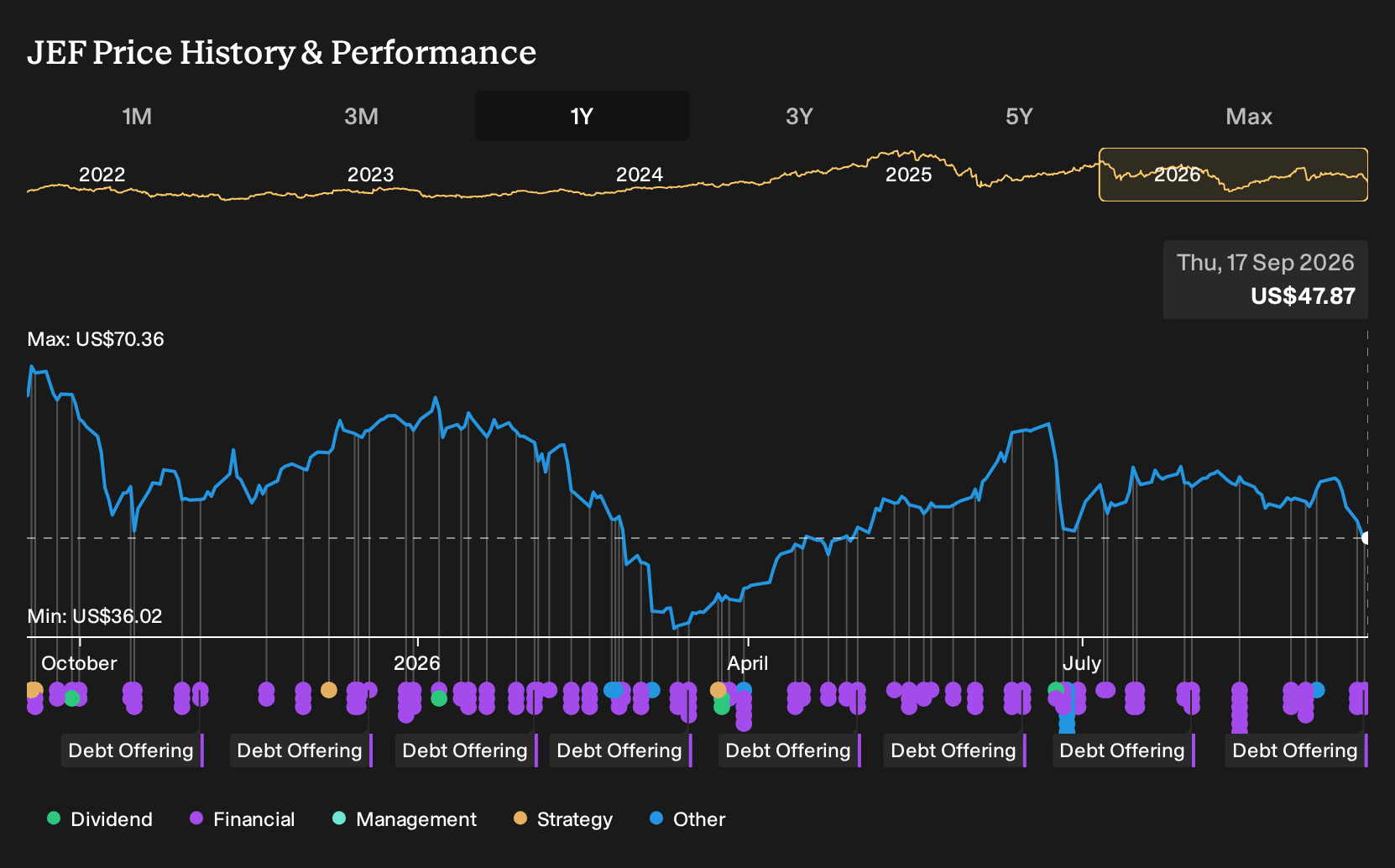
- Jefferies Financial Group recently announced several fixed income offerings, including new fixed and floating rate notes across 2028 to 2051 maturities, with features such as callable structures, senior unsecured status, and pricing at 100% of principal.
- The mix of long dated and intermediate maturity bonds, alongside both fixed and variable coupons, gives Jefferies Financial Group added flexibility in how it funds investment banking and capital markets activity.
- The focus now is on how Jefferies Financial Group's broader investment narrative aligns with this new debt issuance, particularly the effort to fund investment banking momentum.
Scan how Jefferies Financial Group's latest bond moves compare with other companies funding growth through debt by reviewing the hand picked list of solid balance sheet and fundamentals (23 results).
What Is Jefferies Financial Group's Investment Narrative?
To own Jefferies Financial Group, you have to buy into a fairly simple story. The heart of the business is investment banking and capital markets, where advisory, underwriting and trading activity drive most of the US$8.3b in revenue. Execution quality, deal flow and risk management matter more than anything else. The recent mix of 2028 to 2051 fixed and floating rate notes fits cleanly into that picture. It adds term funding that can support investment banking momentum without touching equity.
In the near term, the key swing factors are advisory and underwriting volumes, trading conditions, and how efficiently Jefferies deploys its balance sheet. Fresh unsecured debt can be helpful if it funds fee generating activity at returns above its 5% to 7% coupons. It also adds to higher risk wholesale funding, which already accounts for 100% of liabilities. The stock has fallen about 24% year to date and about 30% over 12 months, even as earnings grew 38.6% and net profit margins ticked up to 9.6%. That mix of pressure on the share price and improving profitability sets up an interesting entry thesis, as long as you are comfortable that advisory demand and trading revenue can justify the extra leverage.
Even so, there is a less obvious pressure point in the Jefferies story that only really shows up once you look closely at...
There's only one way to know the right time to buy, sell or hold Jefferies Financial Group. Head to Simply Wall St's company report for the latest analysis of Jefferies Financial Group's Fair Value.
Exploring Other Perspectives
Two fair value estimates from the Simply Wall St Community cluster between US$49.22 and US$59.50, so you are seeing a fairly tight band rather than wild outliers. Those views do not yet factor in Jefferies Financial Group's fresh bond issuance, which could shift how some investors weigh funding costs against investment banking momentum.
Explore another Jefferies Financial Group fair value estimate, including one that suggests there could be as much as 24% upside from the current price!
Decide For Yourself
Disagree with this assessment? Extraordinary investment returns rarely come from following the herd, so go with your instincts.
- A great starting point for your Jefferies Financial Group research is our analysis highlighting 5 key rewards that could impact your investment decision.
- See our latest analysis for Jefferies Financial Group. The report includes a comprehensive fundamental analysis summarized in a single visual, the Snowflake, making it easy to evaluate Jefferies Financial Group's overall financial health at a glance.
Looking For More Investment Ideas Beyond Jefferies Financial Group?
If Jefferies Financial Group has sparked some fresh thinking about your portfolio, it can be useful to scan a broader set of opportunities that fit different risk and income profiles using the Simply Wall St Screener.
- For investors hunting for strong cash generation and balance sheet resilience, start with companies that pass tough quality filters and appear in our 29 high quality undervalued stocks.
- If capital preservation and steadier profiles matter more to you than chasing every upswing, focus on businesses that score well on stability metrics through the 30 resilient stocks with low risk scores.
- For those who want their holdings to work harder on the income side, target stocks with robust payout characteristics and track records via the 6 dividend fortresses.
This article by Simply Wall St is general in nature. We provide commentary based on historical data and analyst forecasts only using an unbiased methodology and our articles are not intended to be financial advice. It does not constitute a recommendation to buy or sell any stock, and does not take account of your objectives, or your financial situation. We aim to bring you long-term focused analysis driven by fundamental data. Note that our analysis may not factor in the latest price-sensitive company announcements or qualitative material. Simply Wall St has no position in any stocks mentioned.
Have feedback on this article? Concerned about the content? Get in touch with us directly. Alternatively, email editorial-team@simplywallst.com