
How Investors May Respond To Bread Financial Stock Signet Partnership Renewal
- Bread Financial Payments, Inc. renewed its long-term partnership with Signet Jewelers Limited, aiming to upgrade credit programs and add new Blue Nile credit capabilities across Signet's U.S. brands.
- The focus on technology upgrades, analytics driven marketing and tailored credit experiences gives Bread Financial deeper integration into a major retail partner's ecosystem.
- The investment narrative for Bread Financial will now be viewed in the context of this renewed Signet partnership and its expanded Blue Nile credit offering.
Bread Financial Holdings Investment Narrative Recap
Bread Financial Holdings appeals to shareholders who buy into a story of tech driven credit partnerships, disciplined underwriting and deposit funding tied together in one platform. The renewed Signet deal supports that picture, but on its own does not fully change the near term focus on credit quality, flat to modest loan balances and tight economics on large retail programs.
In the short term, the key catalyst is execution on these large co brand and private label relationships while keeping net losses and delinquency trends under control. The biggest risk remains that a tougher consumer backdrop or competitive pricing pressure crimps yields and late fee income at the same time as BFH continues to spend on technology and marketing.
The pending merger of Comenity Bank into Comenity Capital Bank is the other announcement that matters operationally. Management has said it is not expected to materially change the consolidated balance sheet, earnings or liquidity. This puts the emphasis on simplicity of the banking structure and cleaner governance around a single charter and credit platform.
For investors watching catalysts, that bank combination ties directly into Bread Financial Holdings execution on funding costs, regulatory flexibility and risk management. If the integration is smooth and the amended US$700 million unsecured revolving facility continues to operate on existing terms, attention will likely stay on how effectively BFH prices new and renewed partner programs against its credit and funding risk.
Bread Financial Holdings' narrative projects US$4.4b revenue and US$510.9 million earnings by 2029. Analysts are assuming revenue will grow at 18.0% per year and earnings will decline by about US$54.1 million from US$565.0 million today to reach that forecast level.
Uncover how Bread Financial Holdings' fair value indicates a 6% potential upside to its current price that may be short-lived.
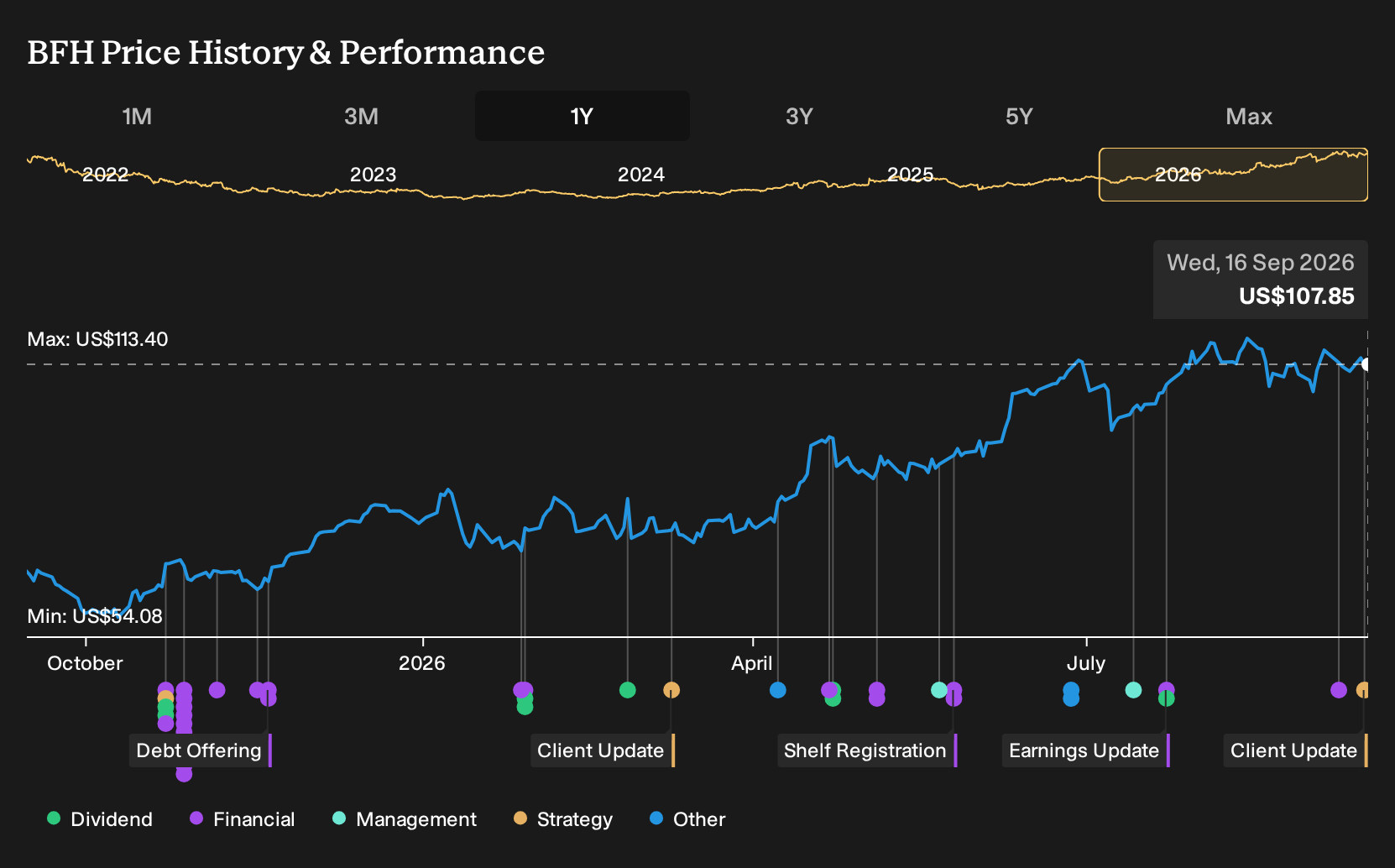
Exploring Other Perspectives
One alternate view puts partnership risk at the center. The most pessimistic analysts worry that tougher contract terms or lost deals could hit Bread Financial’s receivables, which helps explain why they were modeling only about US$4.4b revenue and US$385.0 million earnings by 2029. These pre news forecasts may shift after the Signet renewal, so explore both narratives.
Explore another Bread Financial Holdings fair value estimate, including one that suggests it could be worth just $114.47.
Decide For Yourself
Don't just follow the ticker; dig into the data and build a conviction that's truly your own.
- A great starting point for your Bread Financial Holdings research is our analysis highlighting 3 key rewards and 3 important warning signs that could impact your investment decision.
- See our latest analysis for Bread Financial Holdings. The report includes a comprehensive fundamental analysis summarized in a single visual, the Snowflake, making it easy to evaluate Bread Financial Holdings' overall financial health at a glance.
Looking for more investment ideas beyond Bread Financial Holdings?
Once you have a handle on Bread Financial Holdings, it can be useful to put its model alongside other businesses with different balance sheet strength, payout profiles and growth potential using the Simply Wall St Screener.
- For investors who want potential value plus resilience, compare BFH against a 33 high quality undervalued stocks that combine solid fundamentals with pricing that may not fully reflect them.
- If reliable income is a priority, see how Bread Financial's payout profile lines up beside a curated set of 6 dividend fortresses that aim to sustain higher yields.
- Readers focused on capital preservation and a smoother ride can scan a 11 resilient stocks with low risk scores and weigh those risk scores against what you see in BFH.
This article by Simply Wall St is general in nature. We provide commentary based on historical data and analyst forecasts only using an unbiased methodology and our articles are not intended to be financial advice. It does not constitute a recommendation to buy or sell any stock, and does not take account of your objectives, or your financial situation. We aim to bring you long-term focused analysis driven by fundamental data. Note that our analysis may not factor in the latest price-sensitive company announcements or qualitative material. Simply Wall St has no position in any stocks mentioned.
Have feedback on this article? Concerned about the content? Get in touch with us directly. Alternatively, email editorial-team@simplywallst.com