
Tether went from being a “big buyer” of gold to a “big money owner”! Providing approximately US$1.5 billion in financing to US gold traders
The Zhitong Finance App learned that Tether, the world's largest stablecoin USDT issuer, is deepening its reach into the traditional gold market. After accumulating large amounts of gold and becoming one of the world's largest private gold holders, the company has now become an important gold lender, providing approximately US$1.5 billion in financing to Gold.com, a major US precious metals trader, in an attempt to transform its huge gold reserves from simply holding assets to capital that can generate income.
According to Gold.com's annual report, as of the end of June this year, the company's unpaid precious metals leases amounted to about $1.7 billion, the vast majority of which came from Tether. For the same period, Gold.com's accounts payable and prepayment balance to Tether reached $1.45 billion. This means that the relationship between Tether and the gold market is being further extended from previous “big purchases” to the field of yellow finance and leasing.
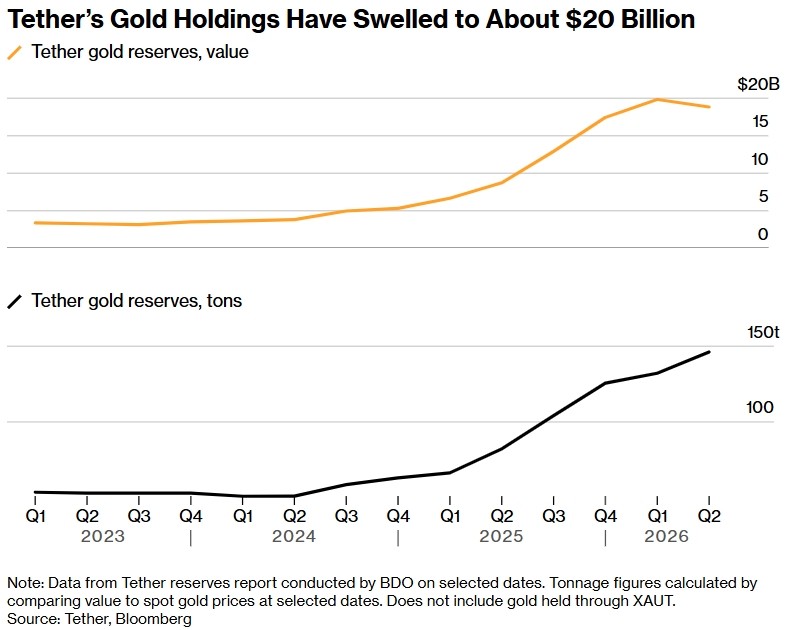
Hoarding 146 tons of gold is currently worth about 20 billion US dollars
Tether attracted market attention last year due to large purchases of gold. At one point, its procurement scale surpassed almost all central banks in the world, making it one of the world's largest buyers of gold.
As of June of this year, Tether's gold holdings have reached about 146 tons, worth about 20 billion US dollars based on current gold prices.
Tether's ability to continue to expand its gold investment is largely due to the huge financial strength brought by USDT. As the world's largest US dollar stablecoin, USDT is issued by Tether. After investors exchange assets such as US dollars for USDT, Tether can allocate the funds obtained to reserve assets such as US Treasury bonds and gold, and obtain investment income from them.
However, unlike US Treasury bonds, which can generate interest income, physical gold itself does not generate cash flow; at the same time, it is also necessary to bear the costs of insurance and storage. Therefore, after accumulating huge reserves of gold, how to improve the efficiency of the use of these assets is becoming the next step in Tether's gold strategy.
Providing gold finance to Gold.com is providing it with a new revenue channel.
Investing US$150 million in Gold.com, the cooperation between the two sides continues to deepen
Tether's relationship with Gold.com is no longer limited to gold loans. Earlier this year, Tether spent $150 million to acquire about 13% of Gold.com's shares. Since then, the two sides have further signed a number of cooperation agreements, including mutual trading of precious metals. At the same time, Tether also reached an agreement with Gold.com to store some of the precious metals in the latter's Las Vegas facility.
Gold.com owns major US precious metals brands such as A-Mark Precious Metals and JM Bullion, and has great influence in the US physical gold trading and distribution market. The company's CEO Greg Roberts said in an earnings conference call this month that the scope for cooperation between the company and Tether is very broad, and that Gold.com can provide Tether with some opportunities that other trading partners cannot provide.
For Tether, the partnership with Gold.com has not only further opened up the gold procurement, storage and trading chain, but more importantly, physical gold, which would otherwise not generate revenue, can begin contributing to returns through gold leasing.
Can gold also be “charged interest”? Tether cuts into traditional banking core business
Gold leasing is actually an important financing business that has existed in the global physical gold market for a long time.
For institutions that have held gold for a long time, such as central banks, large amounts of gold bars are usually stored in treasury for a long time. Not only do they themselves have no interest income, but they also incur storage costs. As a result, some large gold holders will lend their gold to banks at lower interest rates, and banks will then provide this gold to refiners, jewelers, and other gold market participants.
For enterprises in the gold industry chain, this type of financing is particularly important. Refiners, jewelers, and precious metals traders often need to hold valuable gold inventories for a long time. If they all rely on US dollar loans to buy gold, they not only need to bear higher financing costs, but also directly face the risks caused by fluctuations in gold prices.
Through gold leasing, these companies can directly borrow gold to operate, thereby reducing their dependence on US dollar financing.
However, in the past, this market was mainly dominated by large multinational banks. Tether is now entering this field with its huge physical gold reserves, which is equivalent to beginning to play the role of a traditional gold financial institution.
Earlier this year, Tether also contacted a number of Swiss gold refiners to discuss the possibility of providing them with financing. Previously, the price of gold hit a record high and was accompanied by sharp fluctuations. At one point, it boosted banks' credit exposure to gold refiners, putting pressure on the traditional yellow finance market in the first quarter. This also provided an opportunity for Tether, which has a large amount of physical gold, to enter.
1.75% vs 6% gold leasing financing cost advantage is obvious
Judging from the specific financing terms disclosed by Gold.com, the gold liquidity provided by Tether has a clear cost advantage.
According to a terms document submitted to the US securities regulator, Tether and Gold.com agreed on a $100 million gold lease arrangement in February this year, with an annual interest rate of only 1.75%.
In contrast, the cost for Gold.com to obtain financing in dollars through a bank line of credit was about 6% at the time.
In other words, judging from nominal financing rates alone, the cost of borrowing gold through Tether is far lower than traditional dollar bank loans. However, the economic effects of leasing gold are not exactly the same as borrowing directly into dollars, and using leased gold may also mean that companies need to give up some of the potential benefits they could have obtained by hedging with derivatives.
Roberts said that for Gold.com, it is still a lower cost source of liquidity, and the two sides have found a mutually beneficial cooperation model.