
’AI Not Worth Pursuing’ If It’s Not ‘Helping Humanity.’ Microsoft’s Satya Nadella Pushes Back on Anthropic’s Control Framing and Offers a Practical Way Out.
Satya Nadella entered the AI safety debate this weekend with a post on X. The Microsoft (MSFT) CEO argued that any push toward superintelligence has to stay under human control and actually help people. Here's what he said:
“Any pursuit of superintelligence has to be grounded in the core principle that if the AI we build is not helping humanity and under human control, it's not worth pursuing.”
His comments came after Anthropic’s Dario Amodei called for the industry to deliberately slow the pace of AI development. Amodei also wanted outside reviewers placed inside AI labs to check their safety work. Nadella agreed with that safety goal, saying he supports the careful approach and likes the idea of independent evaluators.
Where he pushed back was on control. Nadella argued that AI shouldn’t be run by just a few big labs. He said every company should build and control its own AI without being locked to a single provider. The CEO also stated that he wants open-source and closed models to both thrive. To show he means it, he said Microsoft will publish a code of conduct for its Microsoft AI (MAI) models and open it to public feedback.
A Strategy Already Showing Up in Microsoft’s Numbers
What Nadella is saying in his post isn’t just talk. Microsoft is already running this playbook, and it showed up on the last earnings call. Its MAI models now handle real work inside Excel, GitHub, and PowerPoint, often far cheaper than outside models. In PowerPoint, one MAI model cut GPU costs by up to 84%. Yet customers still reach frontier models from OpenAI and Anthropic through Foundry, which crossed 100,000 customers last quarter.
The reason this matters for the stock is that Microsoft’s heavy reliance on OpenAI has kept investors worried. Earlier this year, Microsoft said OpenAI constituted about 45% of its $625 billion commercial backlog. That is a lot riding on one partner. Working with every model instead of betting on one is how Microsoft answers that concern.
About Microsoft Stock
Microsoft Corporation is a global technology company that provides software, devices, cloud services, and other technology solutions. The company serves both individual users and enterprise customers around the world. Its business is divided into three main segments: Intelligent Cloud, Productivity and Business Processes, and More Personal Computing. The company’s flagship products include Microsoft 365, Windows, Azure, LinkedIn, and Xbox.
MSFT stock has had a turbulent year, so far, declining on AI concerns at first, then recovering incredibly well through strong earnings. It is now up 25% in just three months, though still in the red 3% over the last 12 months.
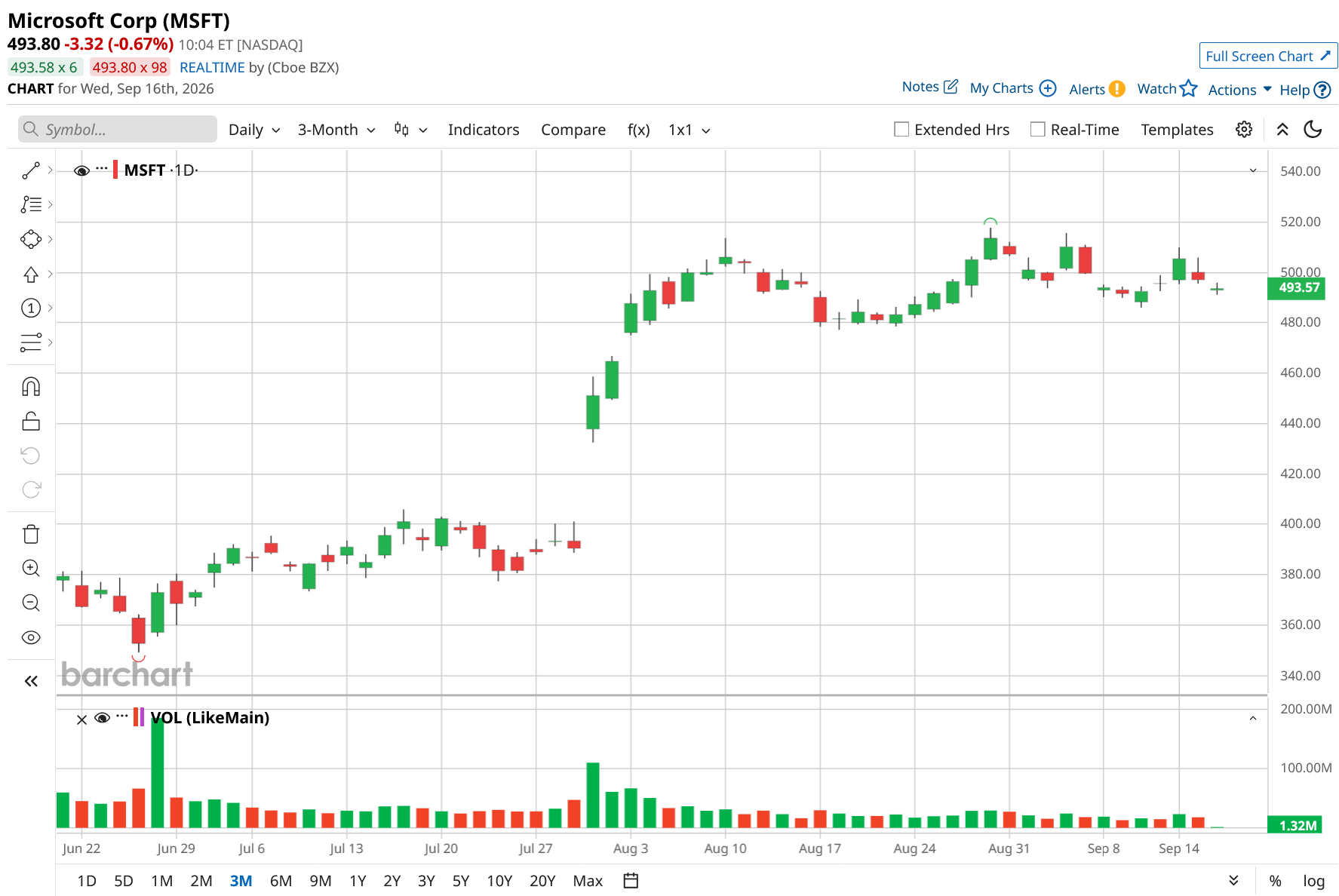
Microsoft’s valuation looks reasonable as per most measures. The forward GAAP price-to-earnings (P/E) of 25.17x sits about 18% below its 5-year average of 30.54x. The forward price-to-sales (P/S) ratio of 9.41x is also roughly 13% below its 5-year average of 10.81x. So investors are paying less than they typically have for Microsoft, despite a business that keeps expanding. The EPS outlook shows steady, durable growth. Analysts expect earnings to grow 14% in fiscal 2027, 19% in 2028, 22% in 2029, and 20% in 2030. That is a solid trajectory for a company already worth over $3.6 trillion.
The balance sheet is in good shape. Microsoft holds $76.84 billion in cash against $128.81 billion in debt. Although the nearly $52 billion net debt figure doesn’t look strong on paper, it is easily manageable for a company generating this much profit. For context, Microsoft generated around $134 billion in net income in fiscal 2026 and is also one of the few companies with a AAA credit rating. Overall, the OpenAI reliance is one of the concerns behind that discount, and the model-neutral push is how Microsoft starts to answer it. For now, the below-average price looks fair for a business this strong.
Still Beating Earnings Estimates
The company reported its fourth-quarter fiscal 2026 earnings on July 29. It generated $90 billion in revenue, surpassing consensus estimates by $2.37 billion. Microsoft Cloud revenue rose 27% to $59.3 billion; however, revenue from More Personal Computing dropped 4% to $12.9 billion. The Intelligent Cloud segment also delivered strong growth, with revenue rising 32% to $39.3 billion. Non-GAAP Earnings for the quarter came in at $4.74, beating market expectations by $0.50.
Looking ahead, Microsoft projects first-quarter fiscal 2027 total revenue of $89.85 billion to $90.95 billion. Cost of revenue is expected to be between $29.6 billion and $29.8 billion, with operating expenses of $16.8 billion to $16.9 billion. Capital spending is anticipated to exceed $50 billion, including the impact of lease reclassification. At the segment level, Intelligent Cloud revenue is forecasted to range from $40.95 billion to $41.25 billion. Productivity and Business Processes revenue is projected between $36.7 billion and $37 billion, and More Personal Computing revenue is expected to reach $12.2 billion to $12.7 billion.
What Are Analysts Saying About MSFT Stock?
After the Q4 earnings report, Ivan Feinseth of Tigress Financial raised the firm’s price target on Microsoft from $680 to $690 while keeping a “Buy” rating on Aug. 5. According to the firm, MSFT is well-positioned to lead the next wave of enterprise AI adoption. Its strong cybersecurity platform could also create additional long-term growth opportunities. Earlier, on Aug. 3, Jefferies reaffirmed its “Buy” rating with a $575 price target.
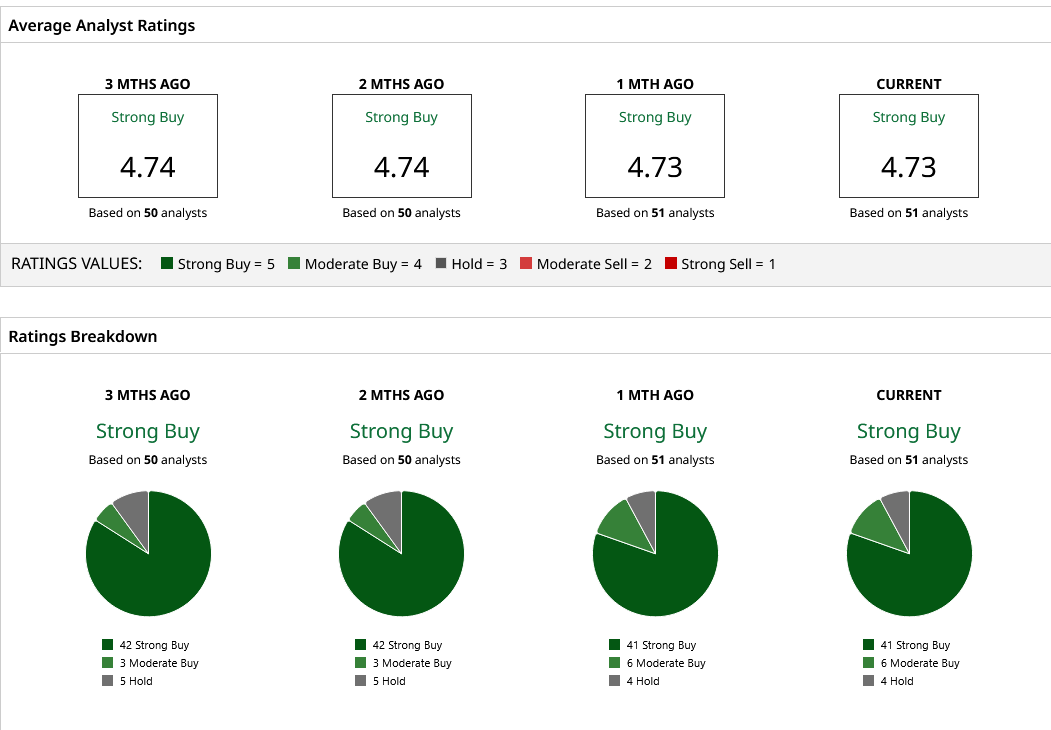
MSFT stock holds a consensus “Strong Buy” rating from 51 Wall Street analysts covering it. According to their estimates, MSFT has an average price target of $559.76, suggesting a further 13% upside from current levels. Moreover, the highest price target of $700 implies an additional 42% upside from here. What's more, these price targets are on the rise, so expect some bullish activity in the coming weeks.
On the date of publication, Jabran Kundi did not have (either directly or indirectly) positions in any of the securities mentioned in this article. All information and data in this article is solely for informational purposes. For more information please view the Barchart Disclosure Policy here.