
US debt “extreme shorts” are gathering! Expectations of interest rate hikes are full under the “double impact” of oil prices and US bond yields, and the market is betting on a new round of austerity with real money
The Zhitong Finance App learned that as of the Asian trading session on September 16, the core conflict in the US bond market had completely turned — the return of the US Federal Reserve to raise interest rates, which was almost 100% valued by the market, could be exchanged for investors' positive confidence in falling US inflation and the rapid decline in long-term US bond yields. Furthermore, with interest rate hikes of 25 basis points already being highly valued by the market, the Federal Reserve's guidance on the number, magnitude, and duration of subsequent interest rate hikes will be an important factor affecting the repricing of the bond market. Based on federal funds futures pricing estimates, Deutsche Bank shows that if the Federal Reserve chooses not to raise interest rates, it will be the “biggest dovish accident” of the FOMC monetary policy meeting since 1994 when the Federal Reserve began announcing the benchmark interest rate decision at the end of the meeting.
In the face of the intensifying geopolitical conflict in the Middle East, global energy supply risks can be described as strengthening policies and tightening expectations. According to media reports on September 14, the number of ships passing through the Strait of Hormuz every day has dropped to only a single digit. The Houthis recently seized the large and small Hanish islands, further expanding their threat of military attack on Red Sea shipping and even the vast majority of Saudi oil exports, driving Brent crude oil to continue to rise this week, once approaching the 110 US dollar mark. At the end of February, the US-Iran war has risen by more than 60%.
These recent developments have made bond investors even more concerned that energy shocks will prolong the impact of rising prices through transportation, production costs, and inflation expectations. Interest rate hikes cannot directly restore shipping and crude oil supply, but they can curb demand and restrain inflation expectations; as a result, the market has begun to require the central bank to provide a more clear response path. Morgan Stanley expects the Federal Reserve to raise interest rates in September and December. TD Securities is the most hawkish. The agency's strategists expect that the Fed will start the current interest rate hike cycle in September and raise interest rates three times in total — 25 basis points each in September and October, respectively, and complete the third rate hike in January 2027. J.P. Morgan expects to raise interest rates twice during the year, but does not believe that the Federal Reserve will continue to act at every meeting.
This repricing has spread to long-term global treasury bonds. On September 15, US 10-year Treasury yields rose to 5.041% intraday, a record high since 2007; German 10-year Treasury yields rose to 3.572%, a record high since 2009; and Japan's 10-year Treasury yield rose to 3.036%, reaching a 30-year high. The pressure on Japan's long-term debt is also compounded by expectations of normalization of domestic monetary policy and expectations for a new round of large-scale fiscal stimulus policies prepared by the Takaichi Sanae government. Therefore, although the yield of each country is rising, the main driving factors do not completely overlap, the common denominators all focus on the continued high inflation expectations brought about by the continued rise in energy prices and the surge in long-term treasury bond maturity premiums due to the accelerated expansion of fiscal deficits.
Oil prices impact the yield curve of the global bond market! The main battleground is only after the Federal Reserve raises interest rates by 25 basis points. Subsequent policy prospects will affect the market
The yield on US 10-year Treasury bonds, known as the “anchor of global asset pricing,” is widely involved in pricing the benchmark interest rate and discount rate used in the valuation of US dollar bonds, loans, and stocks; its rise will not only increase the cost of additional financing, but also reduce the present value of future cash flows when other conditions remain unchanged. Currently, it is worth noting that long-term yields include future short-term interest rate expectations and term premiums. Market concerns about the continuation of inflation and the risk of holding long-term bonds, and if the Fed does not choose to raise interest rates, which may damage the Fed's anti-inflation reputation, it is very likely that long-term yields will remain high even after an interest rate hike is implemented.
According to federal funds futures pricing estimates, if the Federal Reserve chooses not to raise interest rates, it will be the “biggest dovish accident” of the FOMC monetary policy meeting since 1994 when the Federal Reserve began announcing the benchmark interest rate decision at the end of the meeting. However, Deutsche Bank also stated that judging the gap between actual decisions and market expectations at scheduled policy meetings is not tantamount to predicting that the financial market will experience the biggest decline since 1994. Statistics compiled by the agency dating back to 2008 also show that when interest rate futures market expectations reached such a high level, the Federal Reserve implemented interest rate hikes in historical samples.
The two core pieces of evidence and data compilation mentioned above support “the Federal Reserve's choice to raise interest rates at this week's FOMC meeting is the current benchmark scenario,” but historical rules cannot turn policy decisions into definitive events. What makes more investment sense is that when most positions have already been established around the same outcome, any decision or wording that deviates from expectations may trigger a more rapid position adjustment than usual.
After the Federal Reserve's monetary policy decision, the short-term and long-term yield trajectory trends may go in different directions. If the Federal Reserve raises interest rates and sends a signal of continued tightening that exceeds expectations, short-term yields may continue to rise; in the long term, higher future policy interest rates and more credible anti-inflationary promises must be measured at the same time. The latter may depress inflation compensation and part of the risk premium.
If the Federal Reserve accidentally chooses not to raise interest rates, or does not provide sufficient clear follow-up policy guidelines after raising interest rates, short-term yields may decline due to tightening expectations and cooling; however, if investors are also concerned that the central bank is not sufficiently resistant to inflation, long-term yields may instead rise, leading to a steeper curve of short-term decline and long-term rise. Therefore, judging whether this conference will ease the pressure on the bond market depends on policy path expectations and long-term inflation confidence at the same time. Looking at the words “interest rate hike” alone, it is easy to misjudge the actual market pricing situation.
According to some senior Wall Street analysts, the combination that is more conducive to market digestion is a slight increase in interest rates combined with a clear data reliance position, so that investors can understand this as limited and moderate monetary policy adjustments to prevent repeated inflation. If the bitmap and press conference further point to higher, longer-lasting policy interest rates, corporate financing and stock valuations will need to re-adapt to the overall upward trend in interest rates, and the pressure will also be far greater than a single adjustment of 25 basis points.
The options market has shown this kind of division, that is, the SOFR options market also has a different trading layout to deal with falling short-term interest rate expectations and prevent long-term bonds from continuing to fall, plus sales volatility. Each of these transactions bears different risks and determines the direction of the bond market after the meeting. The key is still to compare the differences between actual policies and subsequent guidelines and pre-conference pricing.
Before the meeting, the market already included interest rate hikes of more than 50 basis points during the year, including September; if 25 basis points are realized in September, the focus should be on observing whether the interest rate hike expectations for the rest of the year are higher than the previous level of about 25 basis points. If subsequent policy guidelines are weaker than market expectations, some short-term bonds and interest rate futures may rise and cause related short recovery; long-term bonds will also be affected by changes in inflation expectations and term premiums. If the energy shock continues and the market further revises expectations of interest rate hikes, bonds may still be under pressure. Crowded short positions alone do not constitute a basis for peaking yields.
Some of the capital bought bullish options for SOFR futures in October and November to prepare for a scenario where short-term interest rate expectations are lowered and futures prices rise; at the same time, long-term US bond options still show stronger demand for decline protection. In addition, the cross-modal portfolio sale transaction of about 80,000 units in June 2027 is a volatile shorting structure and cannot be directly classified as a short type of directional bond short. Currently, what is more worth tracking is whether interest rate hikes will exceed about 50 basis points within 2026 after the resolution, whether long-term yields will continue to rise independently, and whether crowded bears will begin to make up. If the policy only fulfills expectations and anti-inflation confidence improves, some bonds may receive recovery support; if oil prices continue to rise and policy expectations are further revised, the bearish congestion itself will not be enough to stop yields for a period of 10 years or more from continuing to rise.
“Extreme” bears are attacking in the bond market! Big bets that the Federal Reserve will meet expectations of interest rate hikes
Focusing on the US Treasury bond market, bond traders established a large number of bearish positions before the Federal Reserve meeting resolution on Wednesday EST (around 2 a.m. Beijing time on Thursday) came out, betting that the sell-off that pushed US Treasury yields to the highest level in nearly 20 years will continue.
Benchmark US 10-year Treasury yields rose to their highest level since 2007 on Tuesday as traders prepared for the Federal Reserve to raise interest rates due to concerns about inflation. Meanwhile, 2-year Treasury yields hit their highest level since 2024.
Market positions indicate that investors expect the bond market to weaken further and are less willing to buy on dips. According to J.P. Morgan Chase's US Treasury customer survey, in the past week, spot market traders increased their short positions at the fastest rate since the beginning of 2025.
According to CME's open position data, investors all increased their short positions in US Treasury futures before and after the release of the better-than-expected inflation report last week. In the federal funds futures market, every change in the underlying contract of a bearish trade can result in a profit or loss of 1.9 million US dollars for every basis point. Swap market pricing shows that, including the September meeting, the Federal Reserve will tighten by a total of about 50 basis points for the rest of the year.
Citibank strategist David Bieber said, “Over the past week, as the market chased upward yield, we saw a rapid increase in short positions.” He added that short positions “have reached extreme levels on a tactical level.”
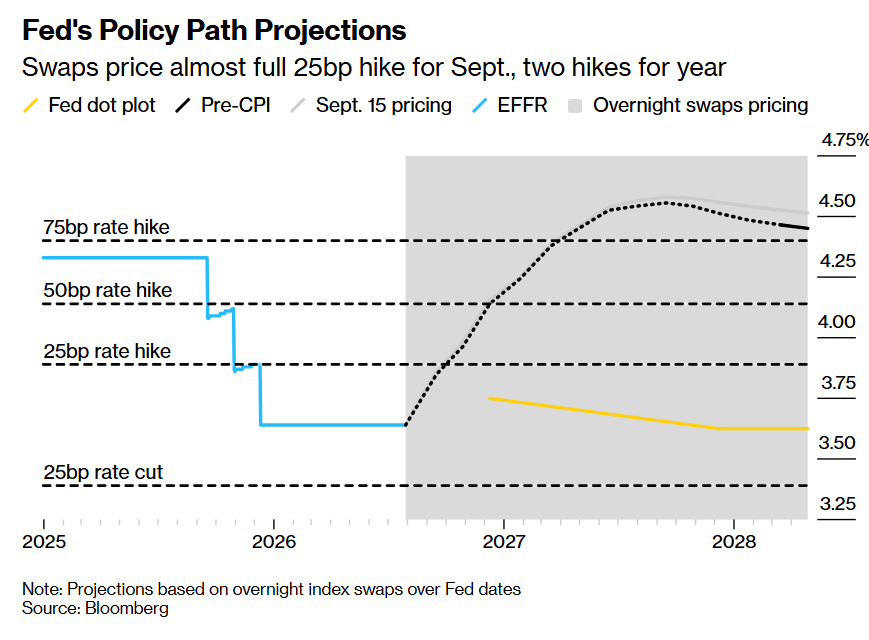
The above chart shows the Federal Reserve's policy path forecast — the swap market accounts for almost 100% of the 25 basis points of interest rate hikes in September, and is expected to raise interest rates twice during the year. Note: Expectations are calculated based on overnight index swaps linked to the date of the Federal Reserve meeting.
These bearish positions appeared before the Federal Reserve meeting. Wall Street's current pricing shows that the probability that the Federal Reserve will raise interest rates for the first time since 2023 is over 90%; experience over the past few decades shows that such a high level of confidence is confirmed by actual decisions. The war fueled a sharp rise in oil prices, signs of a rebound in inflation, and budget concerns, all reinforced this conviction.
Jason Thomas, head of global research and investment strategy at Carlyle Group, said in an interview with Bloomberg TV that the Federal Reserve is facing “tremendous pressure” to raise interest rates by 25 basis points.
He said, “The cumulative rise in prices has hurt people. The standard of living has declined, and I think the Federal Reserve must take its responsibility to maintain price stability seriously.”
If the Federal Reserve does not raise interest rates, or if it does raise interest rates, there is no clear explanation of whether interest rates will be raised further, traders may require long-term bonds to provide higher yields to prevent the risk of inflation; at the same time, short-term bond yields that closely follow changes in the Federal Reserve's policy may decline.
Some market participants are already targeting the latter scenario: demand for low price call options in October and November for futures contracts linked to guaranteed overnight financing rates during short-term interest rate options trading on Tuesday surged. It is also a tool that is profoundly influenced by the outlook for monetary policy.
However, at present, this is still a minority view, and the broader guaranteed overnight financing rate options market is still hedging the risk of future monthly futures contracts being further factored into expectations of interest rate hikes in the next few months.
US 10-year Treasury yields fell slightly by one basis point to 4.99% during the Asian trading session on Wednesday.
Bank of America strategists Megan Sweber and Eleanor Shaw wrote, “Before the Federal Reserve meeting, positions were still bearish. Short positions have been established for each period of the yield curve. Most asset managers have cut or increased their bears, and there is still little sign of buying long-term assets on dips.”
The following is an overview of the interest rate market position indicators for the past week:
J.P. Morgan US Treasury Client Survey
As yields continued to slowly rise, J.P. Morgan customers actively increased their short positions. In the week ending September 14, the share of bears jumped 10 percentage points, mainly due to the transfer of neutral positions, and the neutral ratio decreased by 8 percentage points. Currently, a survey covering all customers shows that the net long ratio has fallen to its lowest level in about four months.
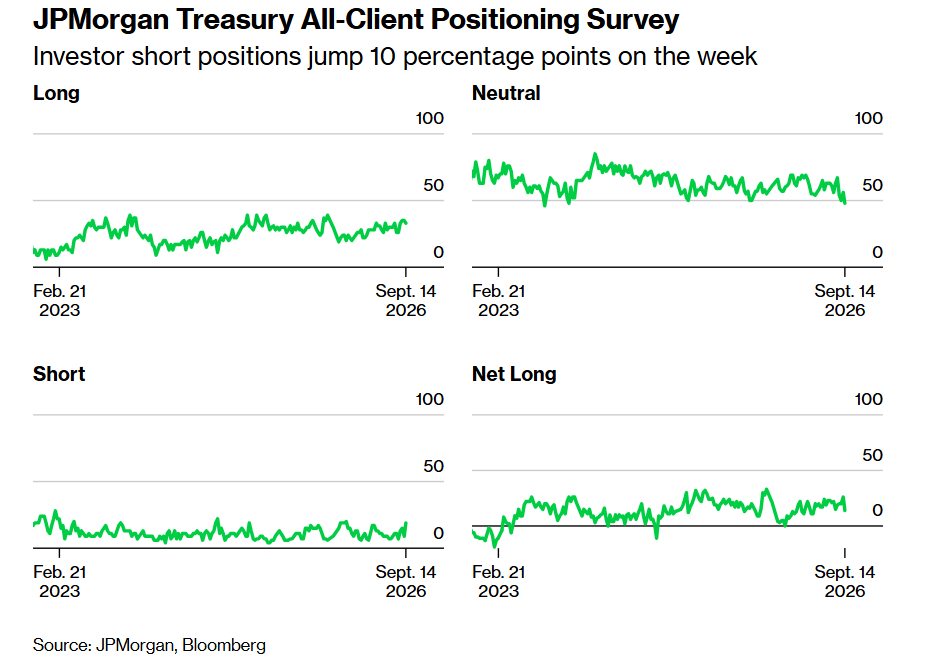
The chart above shows J.P. Morgan Chase's survey of all US Treasury customer positions — the share of investors who are short jumped 10 percentage points in a week.
Guaranteed overnight financing rate option positions
Among the guaranteed overnight financing rate options for December 2026, March 2027, and June 2027, a large number of new risk positions were added to the 95.4375 trading price, mainly due to large-scale volatile short positions established through the sale of cross-option portfolios in June 2027. In total, about 80,000 positions were accumulated during the two trading sessions last Friday and Monday, involving more than $100 million in premium. About 30,000 new cross-style option packages were sold last Friday, then about 50,000 identical cross-style options were sold on Monday. The June 2027 guaranteed overnight financing rate option will expire on June 11 next year.
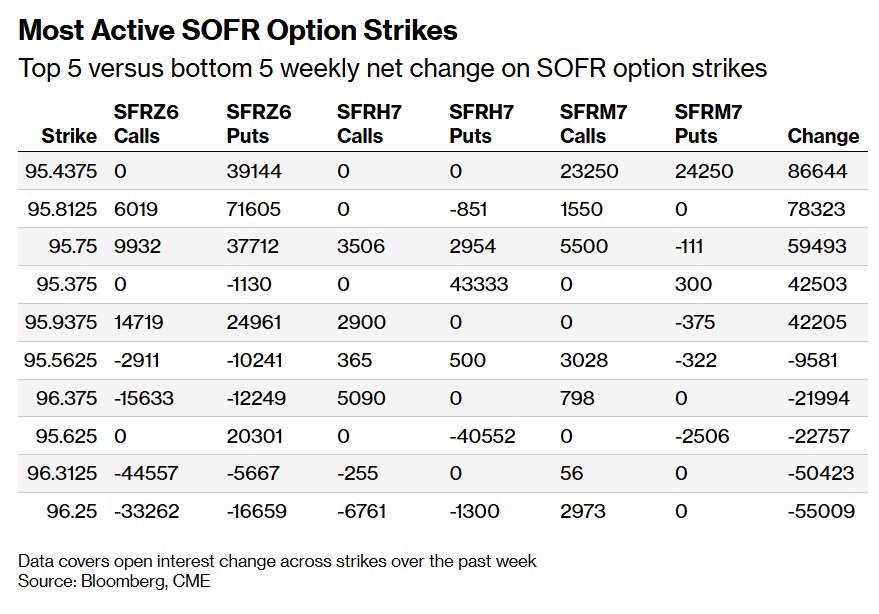
The chart above shows the exercise price of the most actively traded guaranteed overnight financing rate option. The net change in each exercise price for each week of open contracts: comparison between the top five and the bottom five — the data covers the changes in unclosed contracts in each exercise price over the past week.
This table shows the net change in open SOFR options contracts over the past week. Among them, the net increase in positions at 95.4375 was the biggest. As mentioned above, traders sold about 30,000 sets and 50,000 cross-style option packages in June 2027 on Friday and Monday, respectively, for a total of about 80,000 units, involving more than 100 million US dollars in premium. The core is to sell bullish and put options at the same time, and shorting volatility: in the case of a combination without additional hedging, the closer the price of the futures at maturity to 95.4375, the more beneficial it is for the seller; a sharp deviation in either direction may cause losses to exceed the premium collected. This transaction shows that part of the capital is willing to take on the risk of future interest rate expectations fluctuating in both directions.
Open positions are still the most concentrated at 96.50 exercise price. Among them, there are still a large number of bullish options positions in December 2026. Following the release of the consumer price index on Friday, the market established a significant number of additional downside protection positions. These positions appear to be aimed at coping with the possibility that the market will further factor into the Fed's interest rate hike expectations in the next few months. It is worth noting that SFRZ6 95.875/95.8125/95.75 non-standard put option tree combination and SFRZ6 95.9375/95.8125/95.3125 put option vulture combination are very active in trading.
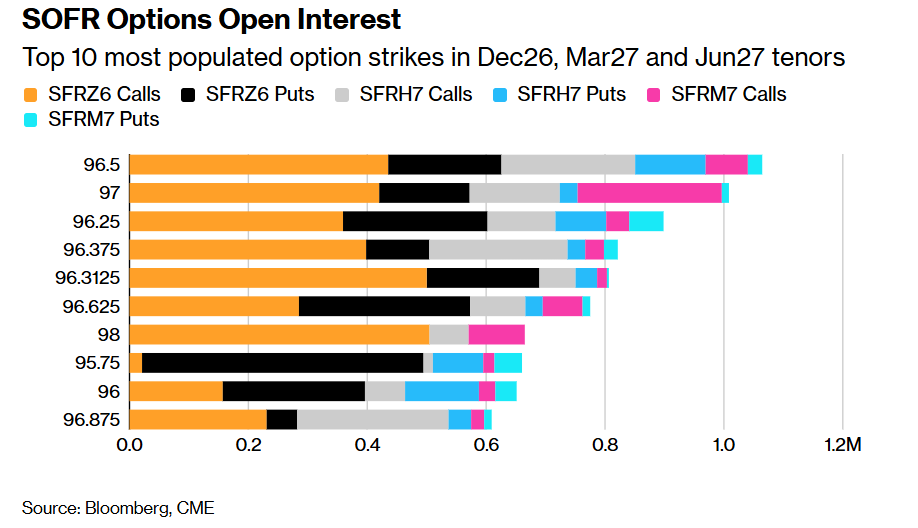
The chart above shows guaranteed overnight financing rate option outstanding contracts — the top ten exercise prices for the period of December 2026, March 2027, and June 2027.
This chart, combined with the recently released core CPI data that slightly exceeded expectations and more inflation data showing that US inflation is still heating up, highlights that some traders are paying more attention to the risk that the Fed's interest rate hike expectations will continue to rise in the next few months, and have increased corresponding protection. Due to the reverse change in the price of SOFR futures and the corresponding interest rate, the tree and vulture combination of put options in December 2026 dealt with the scenario of rising interest rate expectations and falling futures prices through a specific income structure. At the same time, the 96.50 exercise price still gathers a large number of bullish options. However, this is only the distribution of stock positions. It cannot be directly explained that the market is generally betting on interest rate cuts. However, these bets highlight that the risk management of some funds has been extended to the risk of the Federal Reserve being further tightened after September.
US Treasury bond options are biased
In hedging long-term US Treasury futures contracts, premiums are still biased towards put options: compared to preventing prices from rising from current levels, traders are willing to pay higher fees to hedge the risk of selling bonds on the long end of the yield curve. The bias in options from 2-year to 10-year US Treasury bonds continues to hover closer to neutral levels.
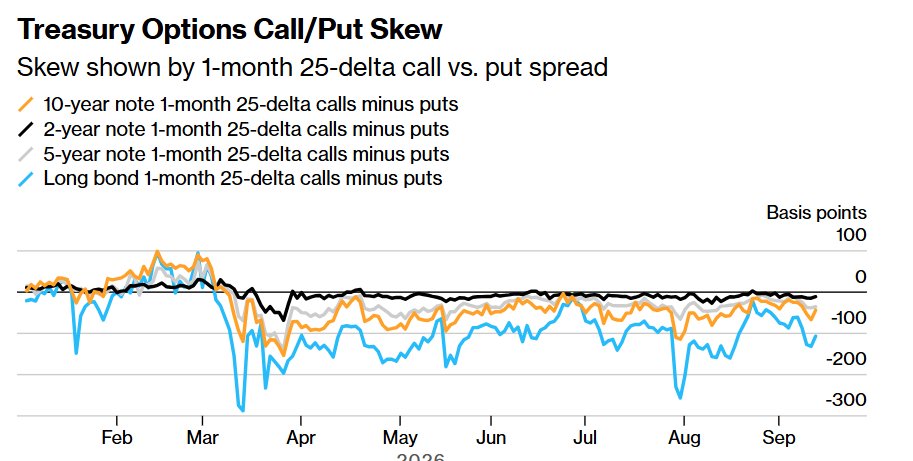
The chart above shows a bullish/bearish bias for US Treasury options — the bias is expressed by the difference in implied volatility between a one-month 25-Delta call option and a put option.