
The “AI deceleration theory” hit the 5% “anchor of global asset pricing”, and technological risks soared! Wells Fargo redraws the US stock investment landscape and cuts the S&P 500 point mark
The Zhitong Finance App learned that US stocks and even global stock markets seem to be undergoing a stress test of “whether the profit growth trajectory driven by the AI boom can withstand valuation compression”, and the semiconductor sector is the first to bear the impact. Ohsung Kwon, chief stock strategist from Wall Street financial giant Wells Fargo Bank, lowered the S&P 500 index's year-end target from 7,950 points to 7,700 points, leaving only about 1.1% room for growth compared to Monday's closing, and downgraded the tech sector from the “overrated” rating to “equal-weight standard” (equal-weight). The Wall Street giant favors the software sector that benefits from the trend of AI applications rather than current hottest semiconductors, and raised the health-care investment sector rating that favors defensive attributes.
The strategist is increasingly concerned that the profit expansion that has continued for many years has pushed market expectations to near historic highs, while AI capital spending, US state governments' policy restrictions on the data center construction process, and uncertainty about fiscal policy and monetary policy have been increasing recently. It is worth noting that Wells Fargo's chief stock strategist did not show much concern about 2027 earnings. The main warning is that the slowdown in capital expenditure associated with AI data center construction may impact 2028 profits. As a result, this adjustment is closer to re-examining the long-term growth and valuation of the US stock market.
The “AI deceleration theory” that has recently taken the global stock market by storm has caused these concerns to quickly enter trading prices — global AI leaders such as Anthropic and OpenAI unanimously called for slowing down the development of cutting-edge AI models over the weekend. On September 12, Anthropic CEO Dario Amodei called for slowing down the pace of upgrading cutting-edge model capabilities to keep up with progress in safety research and protection measures. OpenAI CEO Sam Altman and SpaceX and Tesla helmsman Musk later expressed support.
On September 14, the first stock market trading day after Anthropic CEO Amodei threw out the “deceleration theory,” the stock price of the “AI chip superpower” Nvidia fell by about 3.4%, while the global semiconductor weather vane, the Philadelphia Semiconductor Index, rarely fell sharply by about 6%, highlighting the risks brought about by factors such as AI deceleration discussions.
The AI slowdown compounded the impact of 10-year US Treasury yields, and US stocks and even global stock markets began to compete for the ability to deliver on profit growth under the AI boom
As a result, the market began to re-evaluate investment in large-scale training, the pace of model release, and growth expectations for future computing power purchases. On September 14, the Philadelphia Semiconductor Index fell sharply by about 6%; Korea's KOSPI Index, which has the title of the global “AI computing power investment weather vane,” fell more than 3% on Monday. After that, on September 15, Korea's KOSPI index fell another 0.85% to close at 6627.26 points, falling for the fourth consecutive trading day.
For the semiconductor sector, which is the core beneficiary of the global trillion-dollar AI computing power infrastructure craze, even if existing orders are still strong, as long as investors lower expectations for the growth rate and duration of subsequent orders, valuations may be drastically adjusted ahead of schedule.
Meanwhile, the 10-year US Treasury yield, known as the “anchor of global asset pricing,” once rose to 5.012% in the session on September 14, the highest intraday level since 2007, and then fell back to 4.960%. Since then, up to the close of the US stock market on September 15, the 10-year US Treasury yield remained stable above 5%, closing at around 5.04%, and continued to rise to the highest level since 2007. The “anchor of global asset pricing” is an important reference for long-term US dollar risk-free interest rates. It affects corporate financing costs, and also affects the discount rate used when converting future profits to current values. Energy prices and inflationary pressure are driving interest rates upward, causing technology stocks to simultaneously face rising capital costs and adjustments in future growth expectations.
Another change cited by Wells Fargo's chief stock strategist Ohsung Kwon is that in the past three months, the number of government orders suspending AI data center development in the US has increased dramatically by 175%. Looking at the investment mechanism, more expensive financing and slower project implementation will prolong the cash flow recovery cycle for some large-scale AI investments, and will also escalate market concerns about the fulfillment of orders related to AI infrastructure and fears that the free cash flow growth trajectory is moving towards a negative range.
In contrast, the main reason Wall Street bulls continue to be optimistic about US stocks and the global stock market bull market is that there is still support for corporate profit expansion under the unprecedented AI infrastructure boom and the frenzy of AI applications penetrating into various industries. Goldman Sachs publicly expects the S&P 500 target to be 8,000 points. The core framework is that profit growth drives the index to rise and the valuation ratio is roughly flat; Ed Yardney, president and chief investment strategist of Yardeni Research, still retained the 8,400 point target on September 12, while raising his guard against bearish situations; Michael Purvis, CEO and founder of Tallbacken Capital Advisors, raised the year-end target from 7,400 points to 8,500 points, believing that profit growth is strong and continuous The coverage is wide, and moderate price-earnings ratio expansion may also increase room for growth.
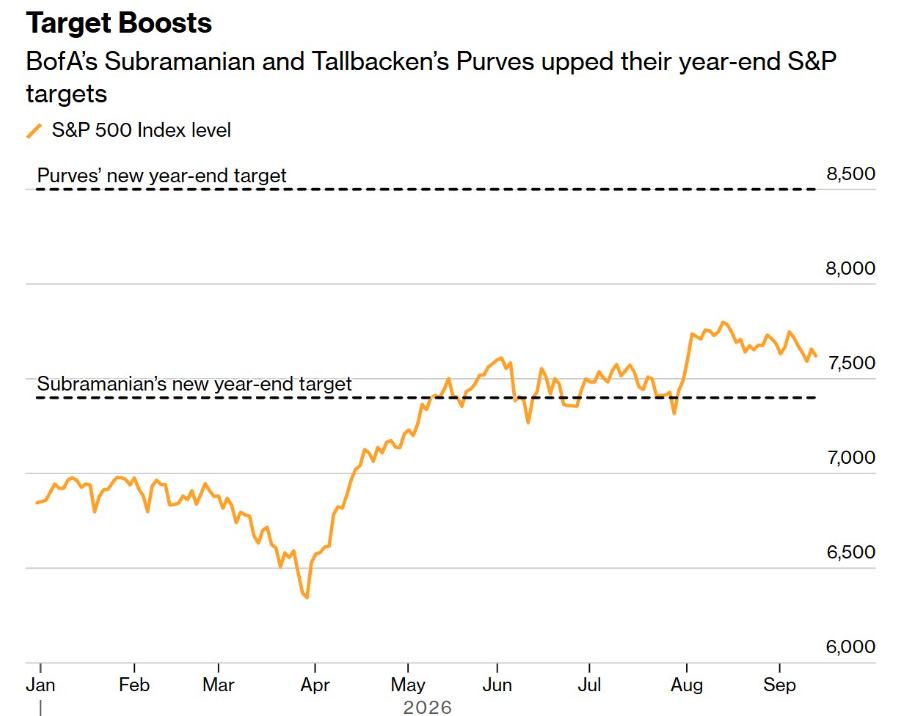
The valuation assumptions of the three are different, but the common concern is whether corporate profits can continue to be realized. According to the relationship of “index points = earnings per share × price-earnings ratio”, as long as profit growth is sufficient to offset the decline in the valuation multiplier, the index can still rise; the core difference between Wells Fargo and the bulls is how long this ability to offset can last.
Looking at the underlying technology, the pace of cutting-edge model development and commercial usage of deployed models are two interrelated but unsynchronized growth curves. A model that has completed training can continue to service programming, customer service, financial analysis, and enterprise knowledge management; as the number of users, task frequency, and task complexity increase, inference (inference) requirements can still expand. Agentic Workflows (Agentic Workflows) will also expand a question to multiple rounds of model call, data retrieval, tool execution, and result verification. Anthropic's open engineering practices have demonstrated this operating mechanism. One conclusion that can be deduced from this is that even if the rate of improvement in cutting-edge capabilities is limited, enterprise application penetration may still drive growth in cloud services and inference revenue; however, new semiconductor orders also depend on existing computing power utilization, reasoning efficiency, and expansion plans, and cannot simply be equated with application revenue.
Therefore, the profitable expansion path that deserves more attention is the gradual spread of AI revenue from infrastructure vendors to application platforms and companies that use AI. Software companies can earn revenue through paid features and workflow services; cloud platforms charge for computing power and model services; other companies may improve profits by shortening R&D cycles, increasing sales conversion, and reducing repetitive labor. Only when these benefits exceed the costs of additional reasoning, system integration, and manual review will productivity gains translate into sustainable profits and cash flow.
Goldman Sachs also sees whether AI investment can generate continuous profits as the key to whether profit growth can continue. High yields and the Fed's FOMC's long-term background of maintaining high interest rates may further increase the performance differences within the AI sector: companies that can prove customer payments, profit growth, and return on capital are more in a position to support valuations; companies that mainly rely on long-term expansion expectations need stronger performance evidence.
Wells Fargo “steps on the brakes” to lower the S&P 500 index: technological risks rewrite the outlook for the US stock bull market
At a time when Wall Street giants are calling for a long-term bull market in US stocks under the AI boom, Ohsung Kwon from Wells Fargo chose to lower the target point of the S&P 500 index at the end of the year, saying that the 10-year profit growth cycle will eventually slow down, while risks in US stocks and even the technology sector of the global market are accumulating.
The chief stock strategist is one of the few people on Wall Street to lower their forecasts in recent weeks, lowering the target from 7,950 points to 7,700 points. The new target means there is slightly more room for growth than 1% compared to the index's closing point on Monday. Kwon is also more cautious about the technology sector, downgrading its rating from overrated to standard because the upcoming midterm elections are increasingly at risk for this sector, especially as voices against data center development continue to grow.
Kwon wrote in a newly released research report: “Over the past three months, the number of government orders suspending data center development in effect across the US has increased dramatically by 175%. We expect this trend to continue, especially in the context of security concerns expressed by cutting-edge AI laboratories.” He added that he believes the Democratic Party has a high chance of winning the election overall, which further increases these risks because the party generally advocates regulation of artificial intelligence.
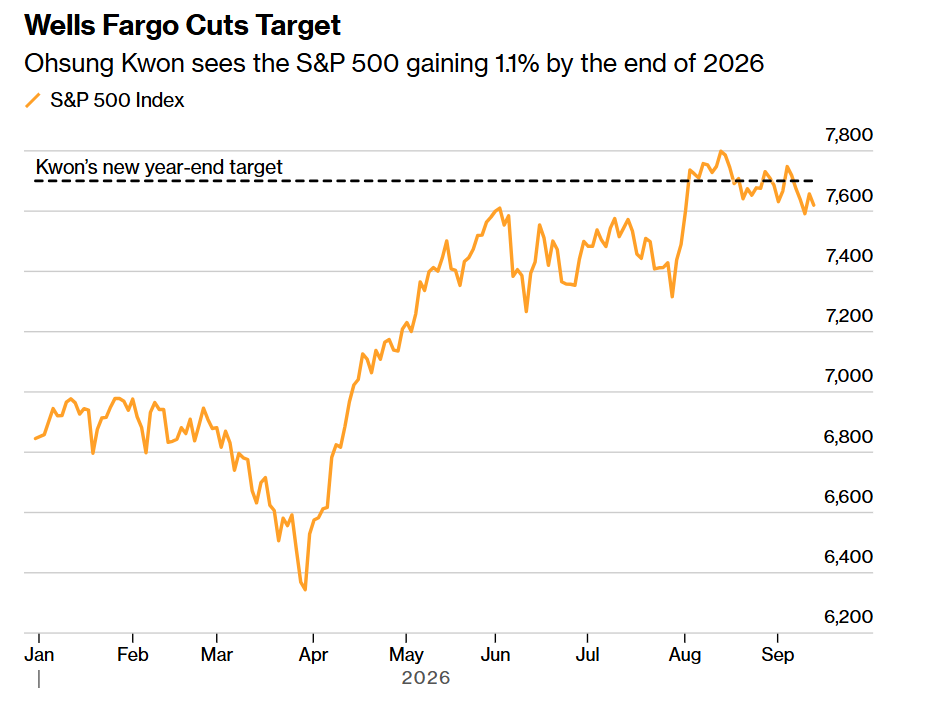
As shown in the chart above, Wells Fargo lowered the S&P target point — strategist Ohsung Kwon expects the S&P 500 index to rise by only 1.1% by the end of 2026.
Before Kwon lowered his target, others on Wall Street raised their predictions one after another. Bank of America and Tallbacken Capital Advisors both raised their year-end targets for the S&P 500 index on Monday, while J.P. Morgan Chase and Wall Street veteran Ed Yardney raised their respective targets in August.
Meanwhile, differences between the Trump administration and AI industry leaders have further intensified market pressure, and investors are worried about whether these infrastructure investments will pay off. Developers, including Anthropic and OpenAI, have been calling for a slowdown in the development of cutting-edge AI technology to prevent disasters, and the US President is pushing the US to stay ahead in this development race.
Kwon began taking a cautious approach to US stocks earlier this month, warning that the AI capital expenditure cycle could enter a late stage in 2027. The analyst said that compared to semiconductors, he favors software, and semiconductor stocks are likely to retest the July low.
The midterm election results are likely to benefit the healthcare sector, and Kwon upgraded the sector's rating from standard to overrated. The Democratic Party's victory in the Senate or House of Representatives elections may create conditions for the resumption of additional subsidies under the Affordable Care Act, which will boost hospitals and health insurance companies that account for a relatively high share of businesses related to health insurance trading platforms.
Kwon said that the increase in earnings per share exceeding expectations may give upward momentum to the stock market, but this year's earnings are already at a high cyclical level.
Kwon wrote, “This was one of the strongest earnings per share growth cycles in history. By 2027, the annualized growth rate of earnings per share over the past ten years is expected to reach 14%. Only the post-World War II bull market in the 1950s surpassed this level.”
He sees little risk next year, but warned that slowing AI spending would put 2028 profits at risk.
Kwon estimates that the current stock allocation ratio has reached 72%, the highest level since 1969, but according to his estimates, this ratio should be around 60%. He said that the gap between the actual configuration ratio and the level shown in the model is even larger than during the period when the tech bubble was most fanatical.