
New Fortress Energy (NFE) Faces A Reverse Split, Is The Stock Still Cheap?
New Fortress Energy (NFE) has seen a cluster of boardroom changes and capital actions, including a 1 for 50 stock split set for September 14, 2026, that together reshape how investors might view the shares.
Recent trading has been rough for New Fortress Energy, with the share price down 45.6% over 90 days and 75% year to date, and total shareholder returns declining 86.1% over one year, which points to fading momentum despite a 7.6% gain over the past week.
Scan beyond New Fortress Energy and compare this setup with a hand-picked 35 high quality undervalued stocks that currently combines depressed share prices with stronger fundamentals.
New Fortress Energy is now trading at a fraction of where it was a year ago, with a 1-for-50 split about to reset the share count. Does that make today’s price compelling, or does patience still look cheaper?
Price-to-Sales of 0.1x: Is it justified?
On simple revenue terms, New Fortress Energy looks extremely compressed, with a P/S of 0.1x compared with 1x for close peers and 2x for the broader US Oil and Gas group. That gap sits beside an SWS DCF fair value estimate of $93.99 versus a last close of $13.88, which frames how far expectations have reset.
P/S compares the market value of the equity to annual sales. It is often used for capital intensive businesses where earnings move around, because it anchors on top line activity rather than short term profit swings. For New Fortress Energy, the low multiple comes against reported revenue of $1,266.65m and a market cap of about $79.24m.
The compression in that ratio lines up with a tougher fundamental picture. New Fortress Energy remains unprofitable, with losses of $1,896.89m and a track record of losses increasing at 66.8% per year over the past 5 years. The group also reports negative shareholder equity, less than one year of cash runway, and all liabilities funded through higher risk sources such as external borrowing rather than deposits, which can justify investor caution even at a low P/S.
Relative to context, the 0.1x P/S is far below both the 2x industry average and the 1x peer average. This signals the market is heavily discounting the business compared with similar energy players. That kind of gap often reflects concerns that current sales may not translate into durable cash generation, especially when a firm is unprofitable and has a stretched balance sheet, rather than a simple bargain on headline revenue.
See what the numbers say about this price — find out in our valuation breakdown.
Result: Price-to-Sales of 0.1x (UNDERVALUED).
DCF fair value of $93.99: what it says about New Fortress Energy
The SWS DCF model currently estimates a future cash flow value of $93.99 per share for New Fortress Energy, compared with a spot price of $13.88. This indicates a very large discount if those projections play out. That implies the market price is reflecting a far more cautious path for future cash generation than the model output.
A discounted cash flow approach projects the cash the business might produce in future years and then discounts those amounts back to today using a required rate of return. The SWS model then sums those discounted figures to reach an intrinsic value per share, which can be compared against the current market price.
For New Fortress Energy, the tension between a very low P/S ratio and a high DCF value against price highlights how sharply investors are weighing risks such as consistent losses, negative equity, and limited cash runway. The wide gap between the intrinsic estimate and the current share price suggests that the model assumes meaningful future cash generation from the terminals, infrastructure, and LNG shipping operations that is not reflected in today’s market valuation.
Look into how the SWS DCF model arrives at its fair value.
Result: DCF Fair value of $93.99 (UNDERVALUED).
Still, New Fortress Energy faces real pressure from ongoing losses of US$1,896.891m and negative shareholder equity. This could keep funding risk firmly in focus.
Find out about the key risks to this New Fortress Energy narrative.
Another view on New Fortress Energy's valuation
On one hand, New Fortress Energy trades on a very low 0.1x P/S. On the other, the SWS DCF model points to a future cash flow value of $93.99 per share versus a market price of $13.88, which flags the stock as heavily undervalued on that framework.
That kind of gap tells you two different stories. The P/S suggests investors are heavily discounting the business today. In contrast, the cash flow model assumes much stronger value creation ahead. The question for you is which set of assumptions feels more realistic given New Fortress Energy's recent losses and balance sheet pressure.
Look into how the SWS DCF model arrives at its fair value.
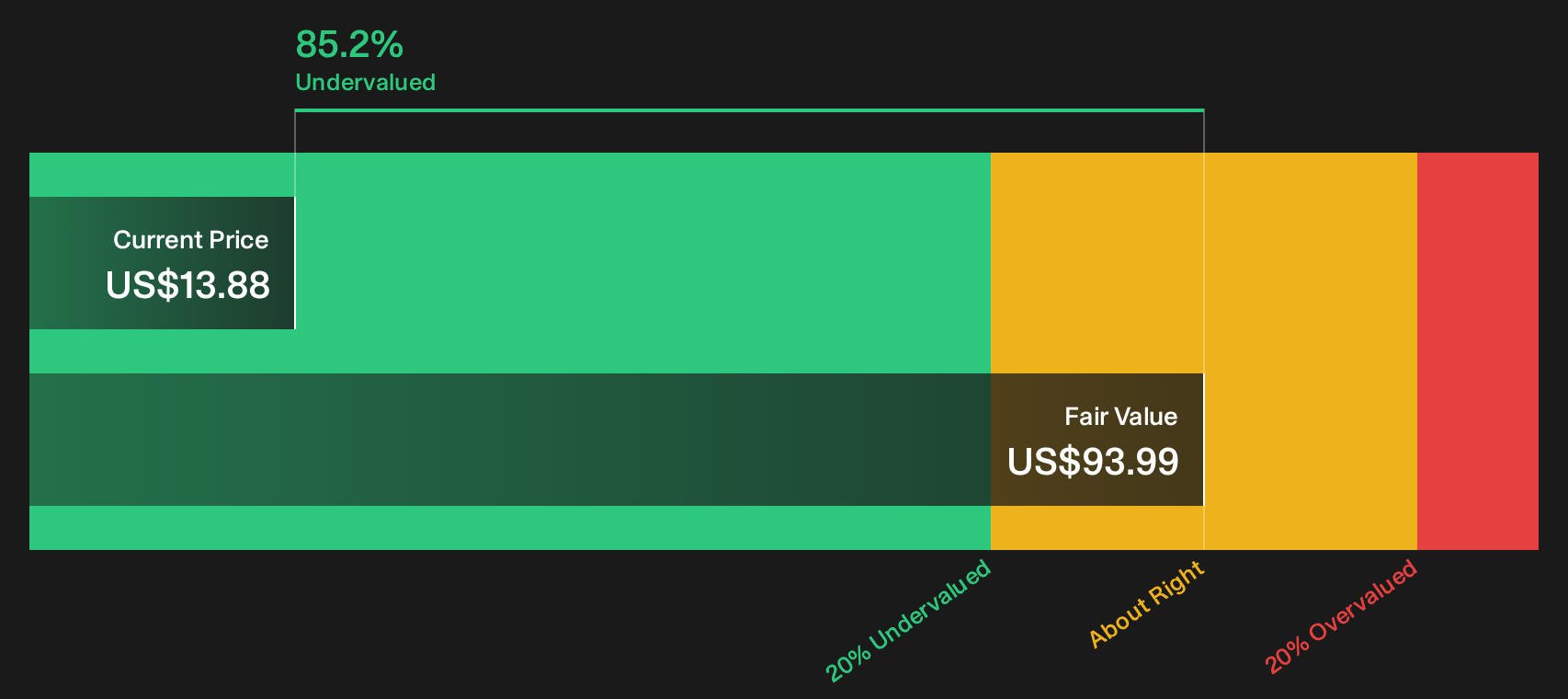
Simply Wall St performs a discounted cash flow (DCF) on every stock in the world every day (check out New Fortress Energy for example). We show the entire calculation in full. You can track the result in your watchlist or portfolio and be alerted when this changes, or use our stock screener to discover 35 high quality undervalued stocks. If you save a screener we even alert you when new companies match - so you never miss a potential opportunity.
Next Steps
Mixed signals around New Fortress Energy can make it hard to know what matters most, so move quickly, review the numbers independently, and weigh both sides of the story using the 1 key reward and 4 important warning signs
Looking for more investment ideas beyond New Fortress Energy?
If New Fortress Energy has your attention, do not stop there. Broader opportunity often sits in fresh ideas that match your style and risk comfort.
- Target higher income potential by reviewing 6 dividend fortresses that may help anchor your portfolio with sizeable cash returns.
- Hunt for mispriced opportunities by scanning the 15 high quality undiscovered gems before other investors catch on.
- Prioritise capital preservation and a smoother ride potential by focusing on the 11 resilient stocks with low risk scores built around more resilient profiles.
This article by Simply Wall St is general in nature. We provide commentary based on historical data and analyst forecasts only using an unbiased methodology and our articles are not intended to be financial advice. It does not constitute a recommendation to buy or sell any stock, and does not take account of your objectives, or your financial situation. We aim to bring you long-term focused analysis driven by fundamental data. Note that our analysis may not factor in the latest price-sensitive company announcements or qualitative material. Simply Wall St has no position in any stocks mentioned.
Have feedback on this article? Concerned about the content? Get in touch with us directly. Alternatively, email editorial-team@simplywallst.com