
Why Did Duolingo (DUOL) Stock Climb As Attention Turned Back To It?
Duolingo (DUOL) is back in focus after management prepared to showcase its AI-driven learning tools at Citi’s 2026 Global TMT Conference, just as it folds former Max features into the core Super subscription.
The conference spotlight and subscription refresh arrive after a mixed stretch for Duolingo’s investors. The share price has climbed 13.78% over the past month and 22.49% over 90 days, yet year to date it is down 14.36% and the 1 year total shareholder return has declined 46.16%. This points to momentum rebuilding from a much weaker longer term base.
Scan beyond Duolingo’s AI push and see how other education and consumer-tech platforms are priced and moving with our curated list of 15 high quality undiscovered gems.
The rebound in Duolingo’s share price could signal that investors are refocusing on the underlying app and AI rollout rather than just shaking off pessimism. Which story does the current valuation tell today?
Most Popular Narrative: 19% Overvalued
Duolingo last closed at $151.14 while the most followed valuation narrative anchors fair value at $127.07. The current price sits noticeably above that reference point and places more emphasis on the AI roadmap and user trends than the model does.
Street research on Duolingo has become more mixed in recent months, with several firms lifting price targets and others turning more cautious. The debate centers on how quickly user growth, engagement, and new products can translate into bookings and earnings, as well as how much investors should pay for that potential.
See why 167 investors see Duolingo as 19% overvalued.
Result: Fair Value of $127.07 (OVERVALUED)
Still, the Duolingo story can change quickly if stronger daily user trends fail to feed through to bookings, or if AI heavy rivals squeeze pricing power.
Find out about the key risks to this Duolingo narrative.
Another View: Duolingo and the DCF Gap
The fair value narrative around Duolingo paints the stock as 19% overvalued at $151.14 versus $127.07. A different lens tells a very different story. The SWS DCF model estimates future cash flows at $307.15 per share. This frames the current quote as trading at roughly half that level and therefore as undervalued on this approach.
That split between a cautious earnings based fair value and a far higher cash flow estimate raises a simple question for investors. Which set of assumptions do you trust more when the same business screens as expensive on P/E checks yet appears cheap on discounted cash flows?
Look into how the SWS DCF model arrives at its fair value.
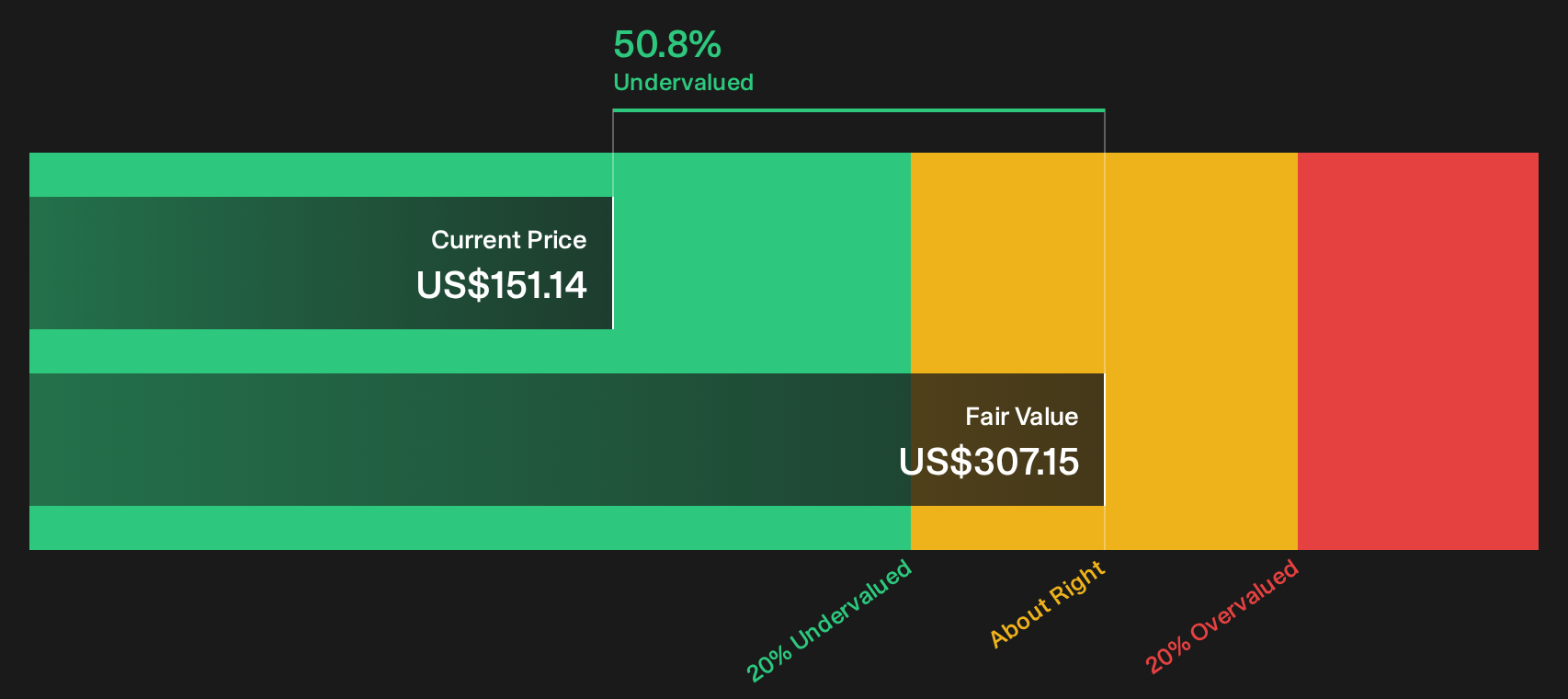
Simply Wall St performs a discounted cash flow (DCF) on every stock in the world every day (check out Duolingo for example). We show the entire calculation in full. You can track the result in your watchlist or portfolio and be alerted when this changes, or use our stock screener to discover 35 high quality undervalued stocks. If you save a screener we even alert you when new companies match - so you never miss a potential opportunity.
Next Steps
Mixed signals on Duolingo’s value can be useful if you use them as a prompt rather than a verdict. Act while sentiment is split, stress test the assumptions yourself, then weigh the 2 key rewards and 2 important warning signs.
Looking for more investment ideas beyond Duolingo?
Do not stop with Duolingo. Use the Simply Wall Street Screener to surface fresh opportunities, compare quality, and pressure test where you deploy your next dollar.
- Target potential mispricings by scanning a focused set of 35 high quality undervalued stocks that may offer stronger fundamentals than the headlines suggest.
- Prioritise resilience by filtering for 11 resilient stocks with low risk scores that aim to balance return potential with more controlled downside.
- Strengthen your shortlist by reviewing a list of solid balance sheet and fundamentals (23 results) so you are not caught out by weak finances when sentiment turns.
This article by Simply Wall St is general in nature. We provide commentary based on historical data and analyst forecasts only using an unbiased methodology and our articles are not intended to be financial advice. It does not constitute a recommendation to buy or sell any stock, and does not take account of your objectives, or your financial situation. We aim to bring you long-term focused analysis driven by fundamental data. Note that our analysis may not factor in the latest price-sensitive company announcements or qualitative material. Simply Wall St has no position in any stocks mentioned.
Have feedback on this article? Concerned about the content? Get in touch with us directly. Alternatively, email editorial-team@simplywallst.com