
Target Stock Option Trade Targets a Price of $170 by Nov 20th
A bullish diagonal spread is an advanced option trade and generally not suitable for beginners, but it can have its place within an option portfolio.
It is a bullish strategy that benefits from time decay and is best placed when volatility is low, such as the current conditions.
The strategy involves buying a long-term call and selling a monthly out-of-the-money call against it.
The trade is best placed when the trader has a bullish outlook and thinks the stock could get to the short call strike by the first expiration date.
A rise in implied volatility will benefit the trade as it has positive Vega overall.
The big risk with the trade is a sharp move lower early in the trade.
Let’s look at an example using Target (TGT).
TGT Stock Bullish Diagonal Example
Target has been in a solid uptrend for the past six months and looks ready to retest the 52-week high around 170..
Of the 34 analysts following Target, 9 have a Strong Buy rating, 3 have a Moderate Buy rating, 19 have a Hold rating, 1 has a Moderate Sell rating and 2 have a Strong Sell rating.
Let’s look at how we can use options to find a favorable risk to reward trade on the assumption that TGT stock might rally to $170 in the next two months.
We will look at a bullish diagonal spread which allows traders to get long TGT without risking too much capital.
A bullish diagonal spread is a trade that involves buying a long-term call option and selling a shorter-term, further out-of-the-money call option.
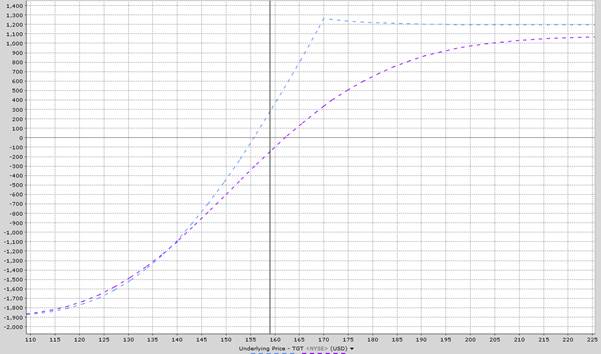
Structuring the trade at $170 gives the trade around 41 delta, which is roughly equivalent to being long 41 shares of the stock.
Selling the November 20th, $170-strike call option will generate around $555 in premium and buying the January 15th, $140-strike call will cost around $2,455.
That results in a net cost for the trade of $1,900 per spread, which is the most the trade can lose.
The estimated maximum profit is around $1,250, but that can vary depending on changes in implied volatility. The maximum profit would occur if TGT closes right at $170 on November 20th.
The trade benefits from time decay as the short-term option will decay at a faster rate than the longer-term option.
The ideal scenario for this TGT trade is for the stock to move towards $170 in the next few weeks.
A bullish diagonal spread is a good way to gain some upside exposure on a stock without risking too much if the move doesn’t eventuate.
The suggested stop loss level is a close below $150.
Here is a visual of what the trade looks like:
Company Details
Target Corp. has evolved from just being a pure brick-&-mortar retailer to an omni-channel entity.
It has been modernizing supply chain to compete with pure e-commerce players. Its acquisition of Shipt to provide same-day delivery of groceries, essentials, home, electronics as well as other products.
Target provides an array of owned & premium branded goods ranging from household essentials and electronics to toys and apparel for men, women and kids. It also houses food and pet supplies, home furnishings and d'cor, home improvement, automotive products and seasonal merchandise.
It also offers in-store amenities, consisting of Target Caf', Target Photo, Target Optical, Portrait Studio, Starbucks and other food service offerings.
A greater number of general merchandise stores provides an edited food assortment, including perishables, dry grocery, dairy & frozen items. Its digital channels include a wide merchandise assortment, including many items found in stores, along with a complementary assortment.
Implied volatility is at 30.10% compared to a 12-month low of 28.73% and a 12-month high of 53.26%.
Target is due to report earnings on November 18th, so this trade would have any earnings risk if held through that date.
Please remember that options are risky, and investors can lose 100% of their investment. This article is for education purposes only and not a trade recommendation. Remember to always do your own due diligence and consult your financial advisor before making any investment decisions.
On the date of publication, Gavin McMaster did not have (either directly or indirectly) positions in any of the securities mentioned in this article. All information and data in this article is solely for informational purposes. For more information please view the Barchart Disclosure Policy here.