
Iran's negotiations with the Gulf postponed: the risk of rising oil prices has intensified! Interest rate hike bets are heating up before the Fed's decision, adding more variables in the midterm elections
The Zhitong Finance App learned that a regional meeting on navigation issues in the Strait of Hormuz, which was highly anticipated by the market, was suspended at the last minute before opening. The talks between Iran and the Gulf countries scheduled to be held in Oman on Monday were postponed at the request of Saudi Arabia. According to news on September 14, against the backdrop of the Houthis continuing attacks on targets in Saudi Arabia, the long-awaited first regional summit since the US and Israel went to war against Iran in February this year came to an end. The price of Brent crude oil has recently broken through 108 US dollars per barrel. At a time when the market is tense due to the war in the Middle East driving up energy inflation, the Federal Reserve will hold an interest rate meeting on September 15-16, and the interest rate futures market's bet on the September interest rate hike has risen to more than 85%. Meanwhile, the US midterm elections are only 50 days away.
Before and after the postponement of talks: Saudi dissatisfaction is a key variable
According to Iran's Ministry of Foreign Affairs, the talks were originally scheduled to be held in Oman on Monday, but they were “temporarily” postponed at the request of Saudi Arabia. A person familiar with the matter, who did not wish to be named due to discussions on sensitive matters, revealed that part of the delay stemmed from Saudi Arabia's anger over the continued attacks on its territory by Iran-backed Houthis and other groups.
“Saudi Arabia attributed the postponement of the regional summit to developments in Yemen, which is shifting the root cause of this crisis.” Iran's Ministry of Foreign Affairs said in a statement on Monday. The Saudi government did not immediately respond to requests for comment.
Omani Foreign Minister Badr Albusaidi (Badr Albusaidi), who has been in negotiations with Iran for several weeks on the management of maritime traffic in the Strait of Hormuz, said on Sunday evening that the decision to postpone the talks was “in the interest of consensus.”
This was originally the first meeting between Iran, the Gulf Cooperation Council (GCC) member states, and Iraq since the US and Israel went to war against the Islamic Republic of Iran in February of this year. However, escalating fighting between Saudi-backed forces and the Houthis, entrenched in neighboring Yemen, complicated the conference plans.
Diplomatic stalemate: US “steps back behind the scenes”, regional consensus is far away
Further complicating the situation is America's changing role in Hormuz shipping diplomacy. According to three people familiar with the matter, Trump administration officials have privately informed relevant parties in the Gulf region that they hope future negotiations between the US and Iran will focus on Iran's nuclear program rather than the issue of passage through the Strait of Hormuz. This means that Washington chose to stay outside of Oman-brokered shipping diplomacy.
This “segmentation strategy” means that the mitigation path will mainly rely on regional consensus between Iran, Oman, and the Gulf countries. Without direct US participation, the time to reach a lasting shipping arrangement may be extended, and every incident similar to the attack on the Saudi pipeline could bring the negotiation process back to zero.
US Secretary of Energy Wright clearly threw cold water on the market in Vienna on Sunday, warning oil traders not to expect a quick breakthrough in the Strait of Hormuz issue. “Expecting that a consensus agreement can be reached with Iran today is clearly not a good choice.” Wright also sent a tough signal on Iran's nuclear issue, saying that Tehran's nuclear program will end “no matter what.”
Impact: Supply throats around the Strait of Hormuz continue to be under pressure
The intensity of the attacks is increasing. Towns with several energy facilities in southwestern Saudi Arabia continued to be hit hard by the Houthis this month; the Saudi government said its key “East-West pipeline” (East-West pipeline) was shut down last week after multiple drone attacks from Iraq — a number of Iran-backed militias are active in Iraq. Yemen's Houthis issued a statement on Monday saying they attacked the Saudi air base in Khamis Mushait (Khamis Mushait); Riyadh had previously issued a potential danger warning for the southwestern city, but did not confirm the specific target of the attack.
Supply-side tension is not limited to Saudi Arabia. According to previous reports, this 1,200-kilometer key export channel, which bypasses the Strait of Hormuz, has continued to be closed since the attack on September 11, and Yanbu Port's oil storage is only enough to maintain exports for 5 to 7 days; after the oil storage is exhausted, up to 4% of the world's oil supply will be at risk, and the average number of tankers passing through the Strait of Hormuz per day has dropped to single digits (the average for the previous 10 days was 14).
This east-west pipeline runs through the entire territory of Saudi Arabia, with a total length of more than 1,000 kilometers, connecting the oil production area along the Persian Gulf with the export terminals along the Red Sea coast. Since the Strait of Hormuz was basically closed due to the US-Iran war, Saudi Arabia has used this pipeline to divert crude oil export routes from the Gulf to the Red Sea, effectively avoiding the risk of strait blockade. Saudi Aramco CEO Nasser said during the August results conference call that the pipeline's role in stabilizing the oil market has even surpassed large-scale strategic reserve release operations led by the United States.
Oil prices surged above 100
Fears that the protracted war in the Middle East will further tighten fuel supplies such as diesel have pushed Brent crude oil to a recent high above $108 per barrel. On Monday (September 14), Brent crude oil rose 3% to 107 US dollars/barrel, which once pointed to 110 US dollars. WTI rose 3% to 102 US dollars/barrel. Last week, Brent broke through $100 per barrel for the first time since July, hitting an intraday high of $109; according to market data, the US diesel price has broken the historical record of 6.20 US dollars per gallon.
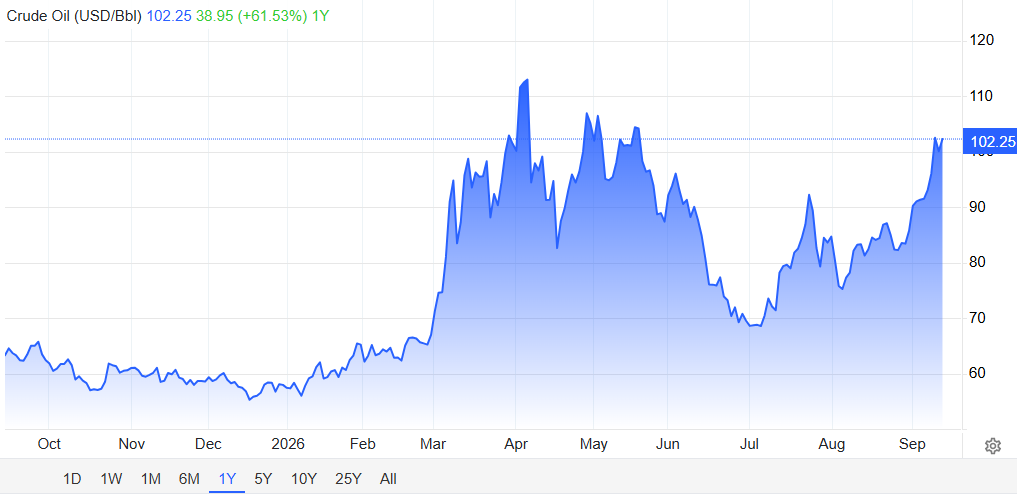
However, the US government's assessment of the supply situation is relatively relaxed. In an interview last Sunday, Wright downplayed expectations that the Hormuz agreement would be reached in the short term. He estimated that the current transportation volume of crude oil and refined oil products through the Strait of Hormuz is about 10 million barrels per day. With bypass pipelines, “we have recovered to two-thirds or more of our previous flow. The current world oil market is more critical than we would like, but it's not overly tense.”
Analysts pointed out that the US chose not to directly intervene in Hormuz shipping diplomacy, which meant that the party with the most military leverage did not use that leverage at the negotiation table, and the mitigation path would mainly rely on regional consensus. For oil prices, this means that the geo-risk premium currently embedded in the price may subside more slowly than the market previously anticipated.
From gas stations to CPI: inflation expectations are heating up across the board
For the Federal Reserve, this is no longer the right time. Soaring oil prices are driving up gas station prices in the US, and there are only 50 days left until the midterm elections. This has become a political problem facing the Republican Party led by President Trump. When asked about possible meetings between the Gulf countries and Iran earlier on Sunday, Trump told reporters: “I don't care. That's their thing. No problem.”
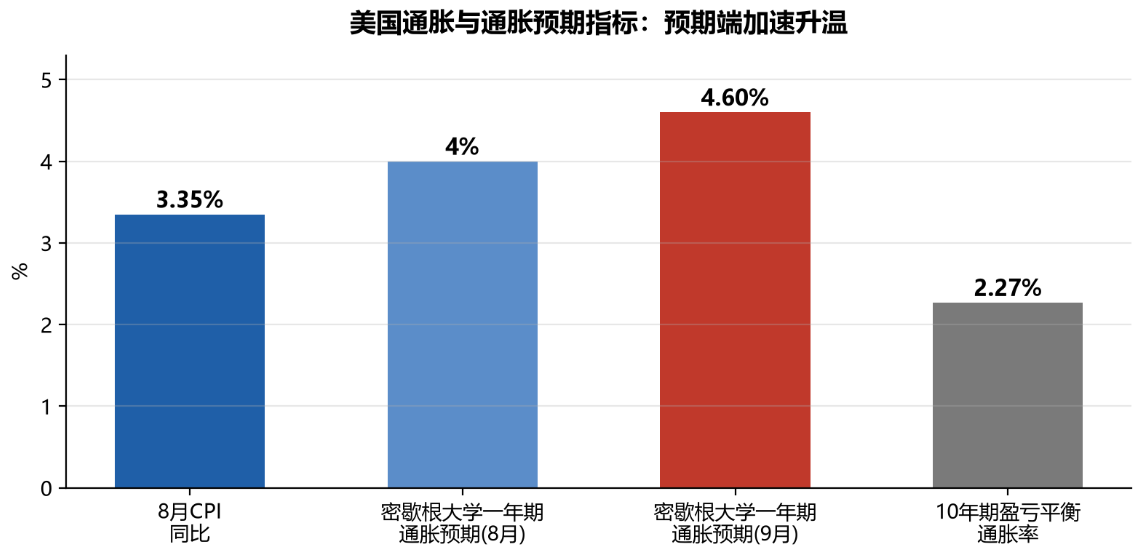
Inflation data is already putting pressure on policymakers: US CPI rebounded to 3.35% year on year in August, and core CPI rose 0.3% month-on-month (according to the US Bureau of Labor Statistics); the University of Michigan survey showed that consumer one-year inflation expectations rose to 4.6% in September from 4.0% in August; and the 10-year break-even inflation rate was 2.27%.
Oil prices stir up midterm elections
Continued high energy prices are putting increasing political pressure on the Trump administration and the Republican-controlled Congress. The retail price of diesel in the US broke through $6 per gallon for the first time last week, a record high; the average price of gasoline remained above $4 per gallon. Diesel is the core fuel for freight, agriculture, and logistics, and its soaring price means that transportation costs for food and consumer goods will face a new round of upward pressure, which in turn will lead to overall inflation.
According to a poll last month, the Democratic Party is 8 percentage points ahead of the Republican Party on the question of which political party has a better solution to the cost of living issue. High diesel prices particularly affect Maine — which has the highest percentage of households using heating oil in the country — and agricultural states such as Ohio, Kansas, and Iowa.
Second, a national poll of 1,914 registered voters conducted by Focaldata, a London nonpartisan research agency commissioned by the Financial Times, from August 28 to September 1 showed that only 33% of registered voters approved Trump's presidential performance, down 3 percentage points from the previous month, setting the lowest record since the survey began in May this year. Polling data clearly shows that voters' dissatisfaction with the economic situation and rising cost of living is the core driving force behind the continued decline in Trump's approval rating.
The Federal Reserve's Choice This Week: Interest Rate Hikes Are Almost a foregone conclusion
The Federal Reserve will hold an interest rate meeting on September 15-16. Interest rate market pricing has clearly turned hawkish: According to CME FedWatch, the probability of interest rate hikes in September has risen from about 70% a week ago to over 85%, and the market began to raise interest rates for the second time before December. Institutional forecasts are changing at the same time: TD Bank and J.P. Morgan Chase have moved to more austerity policy path predictions.
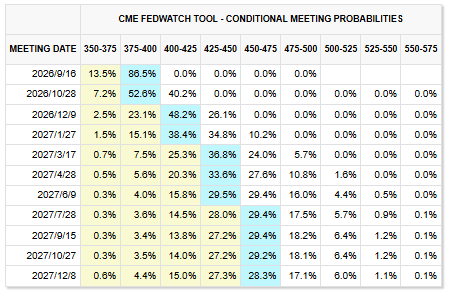
The traders' logical chain is clear: the postponement of the talks means that the schedule for the full reopening of the Strait of Hormuz has moved further back, and the closure of Saudi Arabia's east-west pipeline will damage short-term supply flexibility; high oil prices will directly boost CPI through energy segments and strengthen the “price-wage” spiral risk through inflation expectations channels. Against the backdrop of the Federal Reserve's tough stance on inflation under the leadership of Walsh, the attitude of hedging energy inflation with interest rate hikes will only be more resolute — expectations of austerity, which had already been heated up due to the rebound in CPI in August, are being further strengthened by the Middle East's geopolitical situation.