
ExxonMobil (XOM) Stock Still Has Value Appeal On Its 259% Run
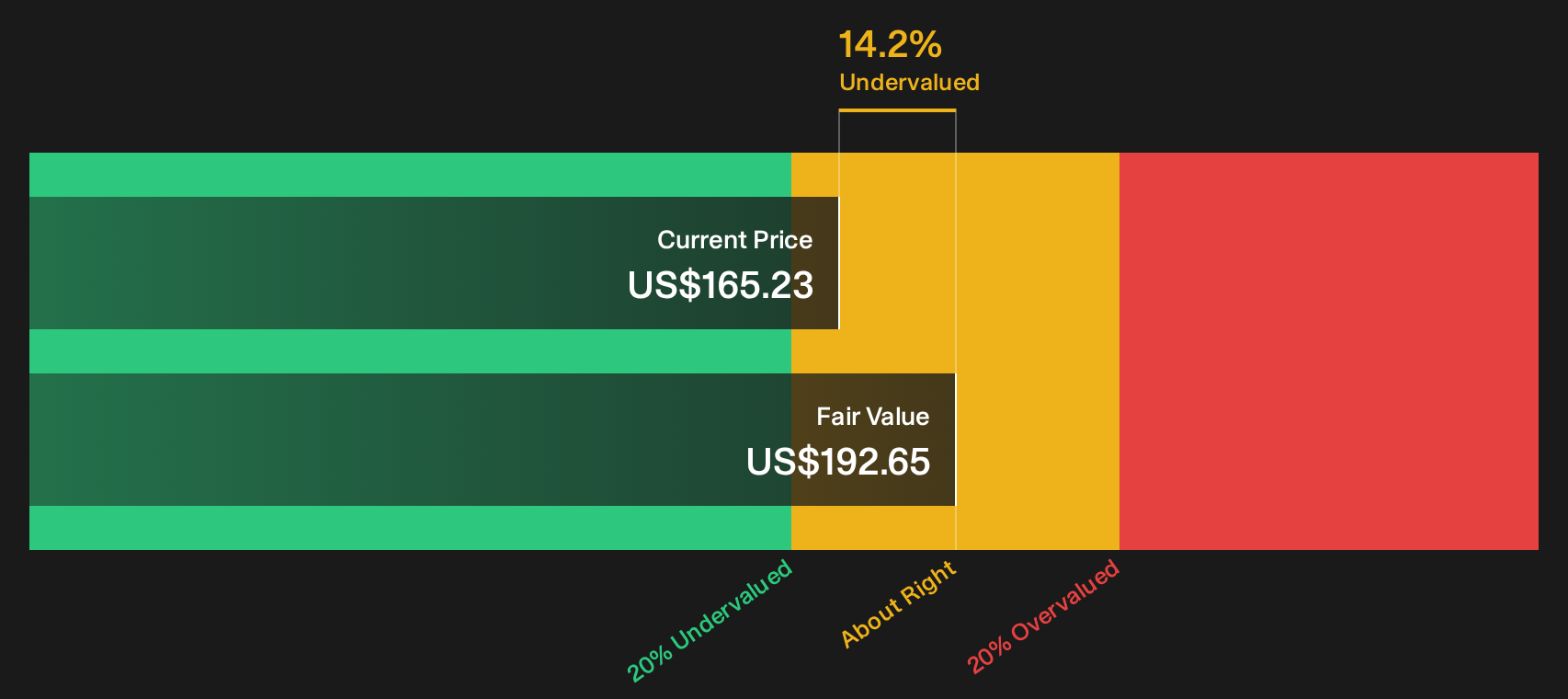
ExxonMobil Holdings has been on a strong multi year run, yet current valuation checks point to a stock that still screens as undervalued on both intrinsic value estimates and market multiples. The Discounted Cash Flow (DCF) work suggests the share price trades at roughly a 13.8% discount to intrinsic value, even after a sizeable rise in recent years.
- Over the past 5 years, ExxonMobil Holdings has delivered a total return of about 258.6%, which puts extra focus on whether the recent share price now overestimates or underestimates the business.
- Exposure to higher Brent crude prices and expanding LNG projects such as Papua LNG and Rovuma LNG can support future cash flow expectations. At the same time, geopolitical risk around key supply routes and project approvals may constrain how confidently investors price those cash flows today.
- With a value score of 2 out of 6, ExxonMobil Holdings does not screen as a clear bargain on broader checks even though both the intrinsic value work and the multiples comparison currently lean towards undervalued.
The issue now is whether the current discount to intrinsic value for ExxonMobil Holdings offers enough cushion after such a strong multi year return.
Scan energy peers with similar upside screens and strong balance sheets by running the hand picked 31 high quality undervalued stocks alongside ExxonMobil Holdings in your watchlist.Is ExxonMobil Holdings a Bargain on Cash Flow?
The Discounted Cash Flow model here uses projected free cash flows to estimate what ExxonMobil Holdings might be worth today. Latest twelve month free cash flow sits at about $32.8b, and the projections assume a broadly growing cash flow profile rather than a shrinking one.
On those assumptions, the model lands on an intrinsic value of roughly $192.65 per share in $ terms. At that level, the stock is indicated to trade at about a 13.8% discount to the model estimate. The recent surge in Brent crude above $100, driven by conflict around the Strait of Hormuz, is one factor used to explain why the market assigns value to ExxonMobil Holdings cash generation but still prices the shares below the full DCF output.
On this DCF view, ExxonMobil Holdings currently appears undervalued relative to the cash flows investors are paying for in the market.
Our Discounted Cash Flow (DCF) analysis suggests ExxonMobil Holdings is undervalued by 13.8%. Track this in your watchlist or portfolio, or discover 31 more high quality undervalued stocks.
Is ExxonMobil Holdings a Bargain on Earnings?
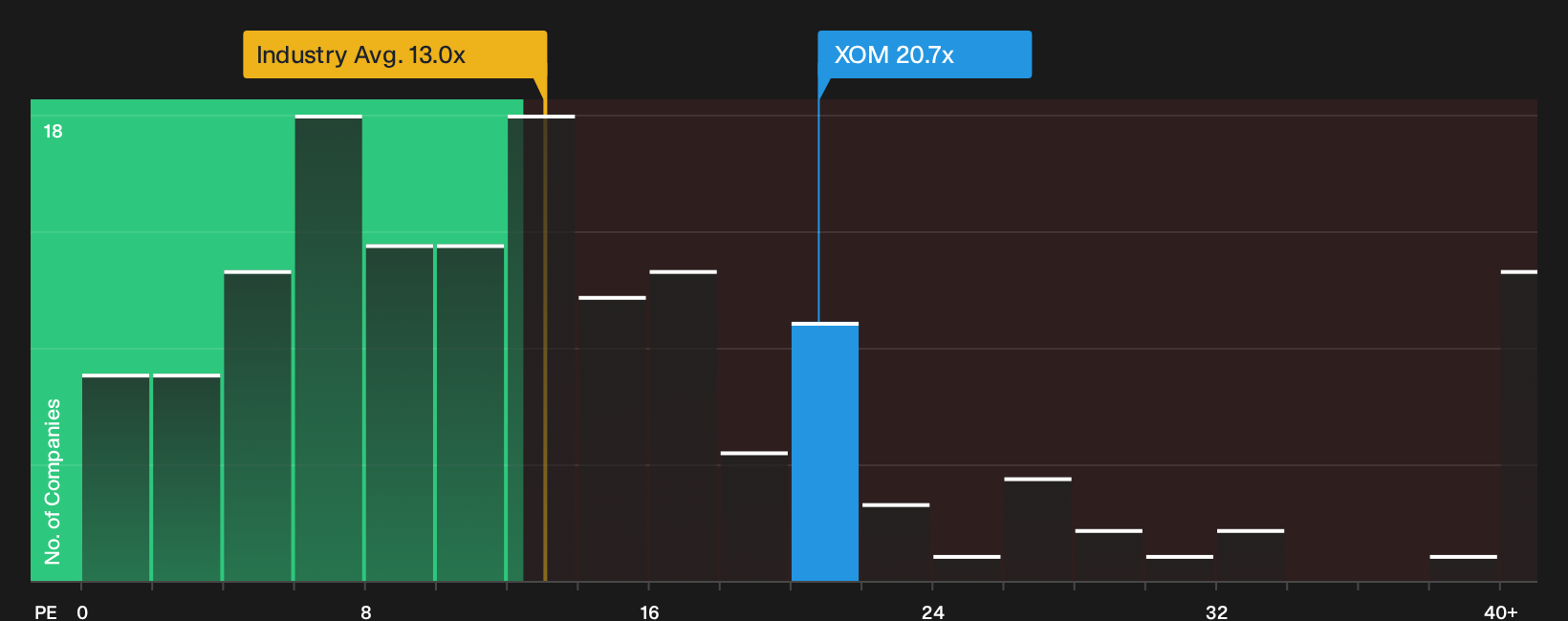
The P/E ratio is a useful shortcut here because earnings still drive how most investors value ExxonMobil Holdings. On this measure, the stock trades at about 20.8x earnings. That sits above the broader Oil and Gas sector average of roughly 13.0x and the peer group on about 17.3x. So on simple comparisons, you are paying a premium for each dollar of profit relative to many other large energy companies.
The in house fair P/E for ExxonMobil Holdings screens closer to 27.9x, which is higher than both the market multiple today and the sector benchmarks. That gap implies the current 20.8x is below what this framework suggests for a business with these earnings, margins and risk profile, even after the recent lift in oil prices and sentiment across energy stocks.
On this earnings yardstick, ExxonMobil Holdings appears undervalued relative to the P/E that the model suggests investors might typically pay.
See what the numbers say about this price — find out in our valuation breakdown.
The ExxonMobil Holdings Narrative: What Would Justify Today's Price?
ExxonMobil Holdings' valuation story only really makes sense once the underlying expectations are on the table. Simply Wall St Narratives sit on the Community page and spell out which specific paths for growth, margins and earnings would need to play out for the stock to be worth materially more or materially less than today's price. Each narrative links a fair value to a particular mix of potential catalysts and risks so you can track which version of events is actually unfolding over time.
One of the top community narratives on ExxonMobil Holdings: roughly fairly valued
"Strong production growth from high return, advantaged assets in Guyana and the Permian Basin is set to increase volumes and net margins, supported by advanced technologies that improve recovery efficiency and overall cost structure…"
Read one of the top narratives on ExxonMobil Holdings
Do you think there's more to the story for ExxonMobil Holdings? Head over to our Community to see what others are saying!
The Bottom Line
ExxonMobil Holdings screens as undervalued on both Discounted Cash Flow (DCF) work and P/E based comparisons, yet broader checks remain cautious. The gap between intrinsic value estimates and the current share price only matters if future cash generation and earnings quality hold up against geopolitical risk and project execution hurdles. For investors, the key question is whether the current discount reflects mispricing or is simply compensation for those uncertainties around long dated energy projects and commodity exposure.
This article by Simply Wall St is general in nature. We provide commentary based on historical data and analyst forecasts only using an unbiased methodology and our articles are not intended to be financial advice. It does not constitute a recommendation to buy or sell any stock, and does not take account of your objectives, or your financial situation. We aim to bring you long-term focused analysis driven by fundamental data. Note that our analysis may not factor in the latest price-sensitive company announcements or qualitative material. Simply Wall St has no position in any stocks mentioned.
Have feedback on this article? Concerned about the content? Get in touch with us directly. Alternatively, email editorial-team@simplywallst.com