
Is New York Times (NYT) Fairly Valued Or Too Expensive On Earnings?
New York Times stock has delivered a strong 63.0% gain over the past three years, while the valuation checks now point to a company that looks fairly priced on an intrinsic value estimate but expensive on common market multiples. That mix leaves New York Times looking less like a clear bargain and more like a publication business investors need to price carefully against its cash flow potential.
- The 63.0% return over three years highlights how strongly the stock has rewarded investors who stayed with the story over a longer window.
- Future cash generation from subscriptions and advertising can support the current share price, while any disappointment in revenue growth or margins may weigh heavily on what investors are willing to pay.
- The broader valuation checks suggest New York Times leans expensive rather than cheap, with the company screening as undervalued in 0 of 6 tests.
The stock's next move may depend on whether the current price already reflects a full and fair view of New York Times' intrinsic value or still leaves room for upside if cash flows come through as expected.
Spot other media and subscription businesses with similar return profiles and more comfortable valuation checks by scanning our curated list of 31 high quality undervalued stocks.Where Does New York Times Sit on Cash Flow?
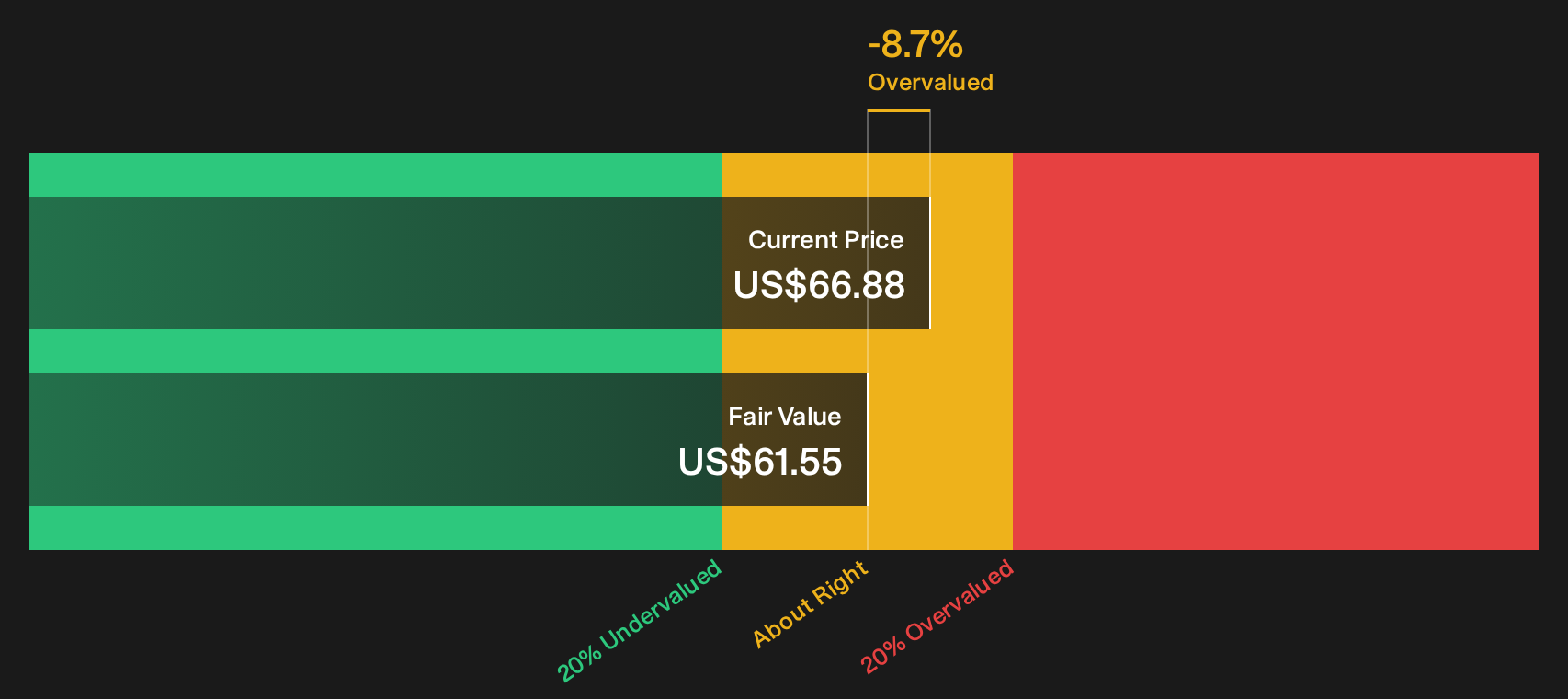
The Discounted Cash Flow model here values New York Times based on the cash it is expected to generate for shareholders over time. In this framework, the business is treated as a mature publisher where free cash generation remains broadly steady rather than moving sharply. Latest twelve month free cash flow is about $623 million, and the longer term projections assume only modest growth on that base rather than a significant increase.
On those assumptions, the model estimates an intrinsic value of about $62 per share and indicates that the stock trades roughly 8.7% above that figure. For readers, the message is straightforward. New York Times appears to be a solid cash generator, but the current share price already reflects that profile rather than presenting a clear discount relative to the DCF estimate.
On this cash flow view, New York Times stock appears roughly fairly valued with a slight tilt toward overvalued territory.
New York Times is fairly valued according to our Discounted Cash Flow (DCF), but this can change at a moment's notice. Track the value in your watchlist or portfolio and be alerted on when to act.
Is New York Times Getting Expensive on Earnings?
P/E is a useful lens for New York Times because earnings remain a central yardstick for how investors value a mature, cash generative media business.
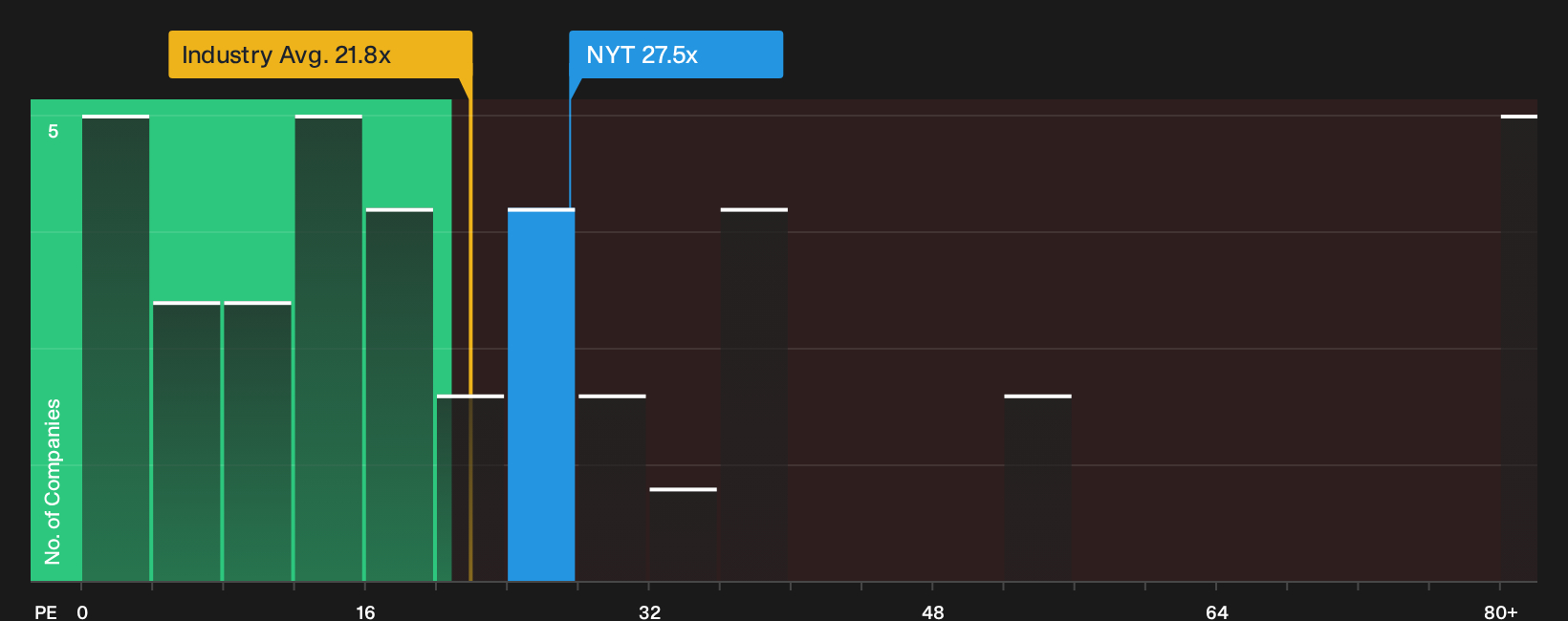
The stock trades on a P/E of about 27.5x, which is above both the media industry average of roughly 21.8x and a peer group near 15.6x. A tailored fair P/E ratio for New York Times sits lower at about 18.9x, which implies the current earnings multiple carries a clear premium to what the model suggests might be reasonable given its sector, profitability profile and risk mix.
That gap means you are paying a higher price for each dollar of profit than either the industry benchmark or the fair ratio would imply. For anyone considering the shares today, the P/E signal suggests expectations already build in a lot of good news and leave less room for error in future earnings delivery.
On the P/E test, New York Times stock appears to trade at a richer earnings multiple than the fair ratio would indicate.
See what the numbers say about this price — find out in our valuation breakdown.
The New York Times Narrative: What Would Justify Today's Price?
New York Times' valuation puzzle only really comes into focus once the story behind the numbers is spelled out, which is where Simply Wall St Narratives on the Community page come in. Narratives lay out the earnings, margin and growth paths that would need to line up for the stock to be worth materially more or materially less than today. Rather than relying on a single multiple or model output, each one breaks out the assumptions behind its fair value so you can compare those expectations against the figures New York Times reports over time.
Community views on New York Times sit wide apart, with one camp focused on digital scale and another fixated on competitive and traffic risks.
Bull case: 14% undervalued
"Robust growth in digital subscriptions, driven by an expanding portfolio of bundled offerings and a focus on direct consumer relationships, positions the company to capture more recurring revenue…"
Read the full Bull Case to see why New York Times could be undervalued
Bear case: 6% overvalued
"The ongoing shift of consumer attention toward social media, short-form content, and AI-driven news aggregators is intensifying, leading to a reduction in direct traffic to The New York Times' platforms…"
Read the full Bear Case to see why New York Times could be overvalued
Do you think there's more to the story for New York Times? Head over to our Community to see what others are saying!
The Bottom Line
New York Times now screens as roughly fairly valued on a Discounted Cash Flow (DCF) view, with the share price sitting above the intrinsic value estimate rather than below it. The richer P/E multiple points to an overvalued reading on earnings, and the broader valuation checks remain weak despite the cash generation profile. For anyone weighing the stock today, the key question is whether subscription and advertising cash flows prove strong and resilient enough to justify that premium valuation without leaving much margin for disappointment.
This article by Simply Wall St is general in nature. We provide commentary based on historical data and analyst forecasts only using an unbiased methodology and our articles are not intended to be financial advice. It does not constitute a recommendation to buy or sell any stock, and does not take account of your objectives, or your financial situation. We aim to bring you long-term focused analysis driven by fundamental data. Note that our analysis may not factor in the latest price-sensitive company announcements or qualitative material. Simply Wall St has no position in any stocks mentioned.
Have feedback on this article? Concerned about the content? Get in touch with us directly. Alternatively, email editorial-team@simplywallst.com