
Eagle Materials (EXP) Stock Still Looks Like A Bargain Following Its 41% 5 Year Return
Eagle Materials has pulled back sharply over the past year, yet both its earnings multiples and an intrinsic value estimate still point to a stock that screens cheap relative to its own cash flow potential.
- Over the past 5 years, Eagle Materials has returned 41.2%, which suggests that long term holders have still come out ahead despite the recent slump.
- Future cash generation from Eagle Materials' cement and building materials operations can support the current price if demand and margins hold up. However, a downturn in construction activity or cost pressure could weigh on that cash flow and compress the valuation.
- The broader checks lean cheap, with Eagle Materials scoring 5 out of 6 on value, which aligns with an intrinsic value estimate that sits well above the recent share price.
The issue now is whether the current discount to intrinsic value offers enough compensation for the operational and cycle risks that Eagle Materials still carries.
Scan for more Eagle Materials style value setups that combine recent share price pressure with strong fundamentals by reviewing the 31 high quality undervalued stocks in a single place.
Does Eagle Materials Look Undervalued on Cash Flow?
The Discounted Cash Flow (DCF) model here focuses on what Eagle Materials can generate in free cash over time. Latest twelve month free cash flow is about $355.7 million, so this is a business already generating a meaningful cash stream rather than one still ramping up.
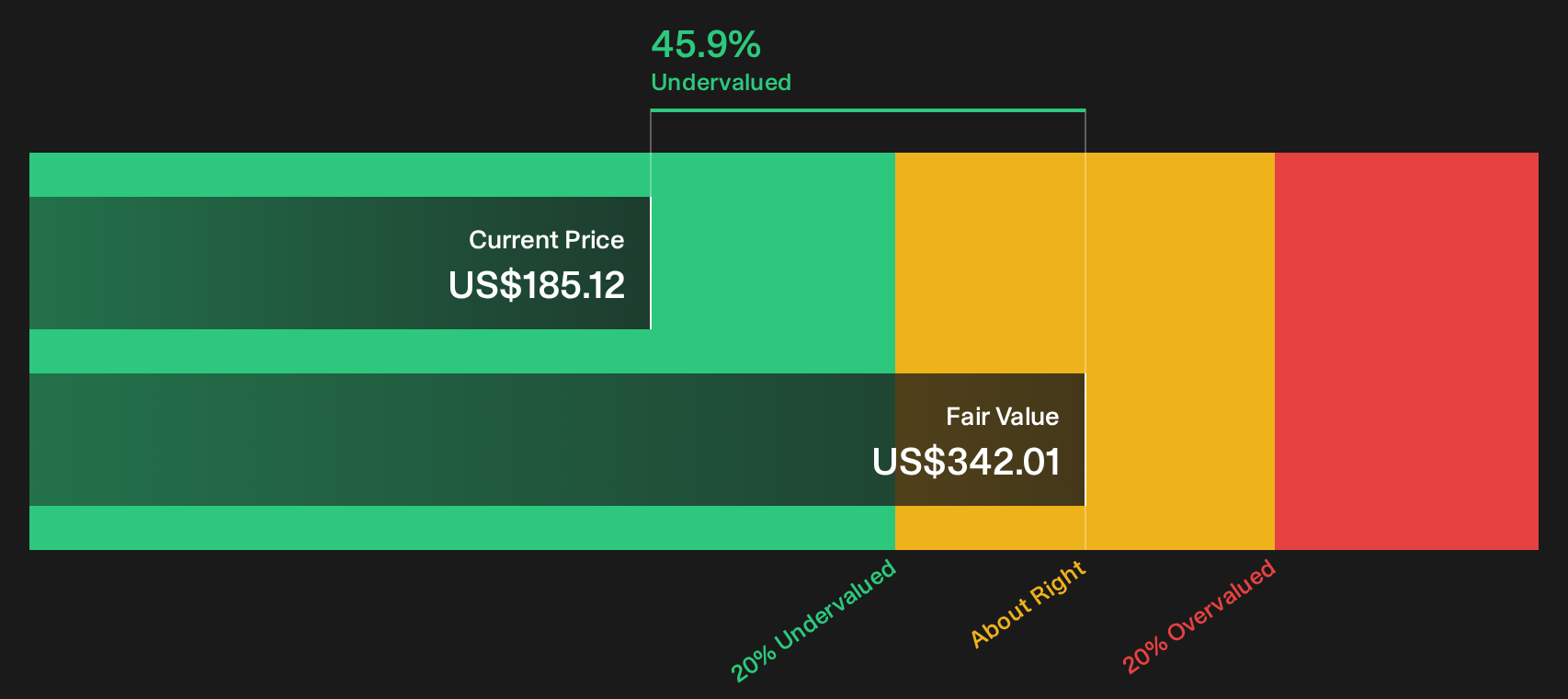
The model assumes those cash flows continue rather than shrink, then discounts them back to today to arrive at an intrinsic value of about $342 per share. That figure is above the recent share price, which indicates the market may be treating Eagle Materials more cautiously than the DCF output. The gap also aligns with the broader valuation checks that show the stock trading on a lower P/E than both its implied fair multiple and the peer average.
On this cash flow view, Eagle Materials appears undervalued relative to what its projected free cash generation supports.
Our Discounted Cash Flow (DCF) analysis suggests Eagle Materials is undervalued by 45.9%. Track this in your watchlist or portfolio, or discover 31 more high quality undervalued stocks.
Does Eagle Materials Look Undervalued on Earnings?
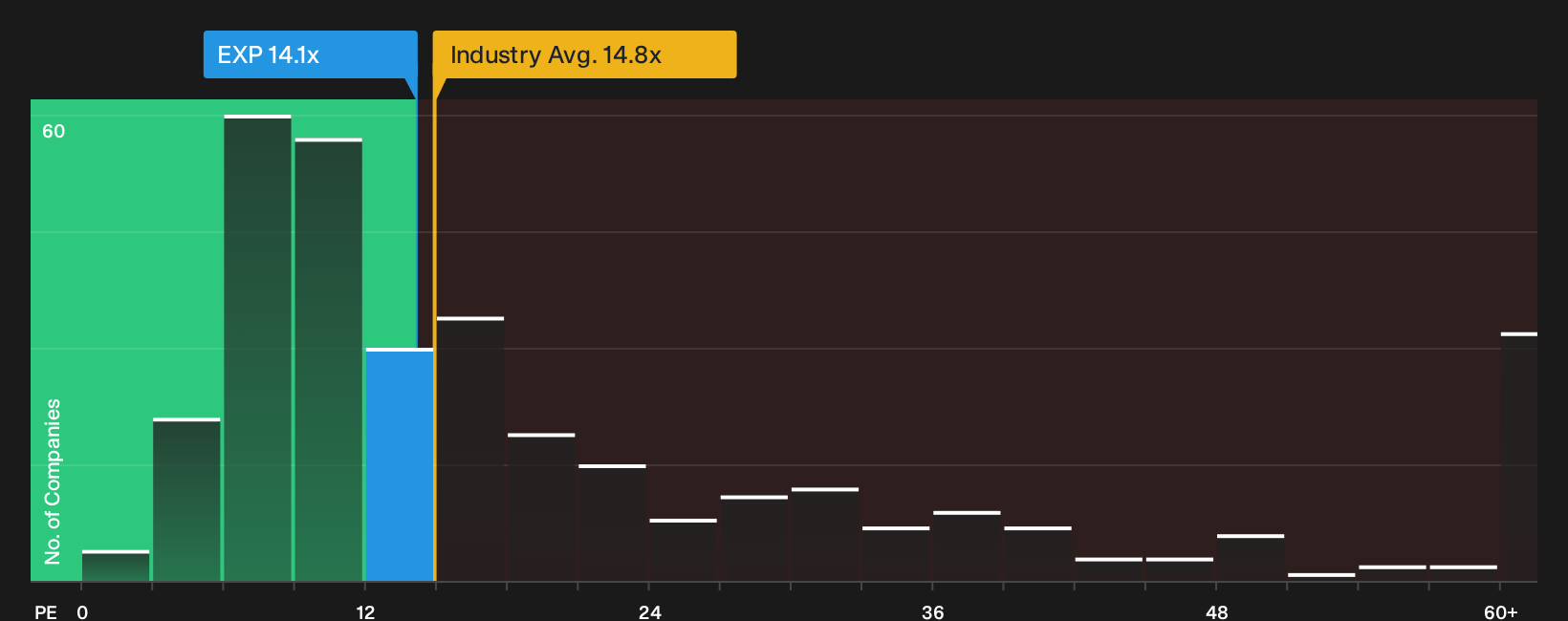
The P/E multiple suits Eagle Materials because earnings capture both its cement and wallboard cycles and the capital intensity needed to support them. At roughly 14.1x earnings, Eagle Materials trades close to the broader basic materials sector average near 14.7x, so on a simple comparison it does not screen wildly offside against the sector.
The fair P/E ratio implied by the model is about 16.9x, which is above both the current multiple and the peer average of roughly 25.7x. That gap suggests the market is pricing Eagle Materials below what its earnings profile might justify once cash generation, margins and risk are blended into a single figure.
On this earnings yardstick, Eagle Materials stock appears undervalued relative to the fair P/E implied by its fundamentals.
See what the numbers say about this price — find out in our valuation breakdown.
The Eagle Materials Narrative: What Would Justify Today's Price?
Simply Wall St Narratives pick up where the Eagle Materials valuation puzzle leaves off by spelling out which paths for growth, margins and earnings would need to play out for the stock to be worth meaningfully more or less than today’s price, and they sit on the Community page. Instead of a single output from a ratio or model, Narratives set out the future that number assumes so you can later check whether Eagle Materials' reality is matching that script.
You can add your voice to the Eagle Materials story by sharing a Narrative that lays out your number driven view on where its growth, margins and execution go from here.
Publish a case, track how it plays out against future results, and see how your thesis compares with the rest of the Simply Wall St community over time.
Do you think there's more to the story for Eagle Materials? Head over to our Community to see what others are saying!
The Bottom Line
Eagle Materials screens undervalued on both the Discounted Cash Flow (DCF) intrinsic value estimate and the earnings multiple view, which points to a consistent message from two different frameworks. The key debate now is whether cash generation and margins from cement and building materials can hold up well enough for that valuation gap to close. If demand softens or costs bite harder, the current discount may prove to be justified rather than generous. The real swing factor from here is whether the market eventually re-rates the P/E closer to the implied fair level as confidence in those cash flows builds or fades.
This article by Simply Wall St is general in nature. We provide commentary based on historical data and analyst forecasts only using an unbiased methodology and our articles are not intended to be financial advice. It does not constitute a recommendation to buy or sell any stock, and does not take account of your objectives, or your financial situation. We aim to bring you long-term focused analysis driven by fundamental data. Note that our analysis may not factor in the latest price-sensitive company announcements or qualitative material. Simply Wall St has no position in any stocks mentioned.
Have feedback on this article? Concerned about the content? Get in touch with us directly. Alternatively, email editorial-team@simplywallst.com