
Is Abbott Laboratories (ABT) Reasonably Priced After Its FDA Win?
Abbott Laboratories has had a rough year in the market, with the share price down about 22% over the past 12 months, yet the valuation checks send a mixed message as the Discounted Cash Flow (DCF) estimate points to a premium while market multiples suggest the stock may be cheaper on earnings than the price implies.
- The roughly 22% share price decline over the past year means investors are now reassessing what they are really paying for Abbott Laboratories’ future cash flows.
- Fresh FDA approval for the TactiFlex Duo ablation catheter can support expectations for Abbott Laboratories’ cardiac device revenue, while execution risk around new diagnostics such as blood based Alzheimer’s testing may weigh on how much value the market assigns to those pipelines.
- A low value score of 1 out of 6 suggests Abbott Laboratories does not screen as a clear bargain on the broader valuation checks even though some earnings based multiples point to an undervalued profile.
The issue now is whether Abbott Laboratories’ current share price leaves enough margin between market value and intrinsic value to justify taking on the business risks that come with its product pipeline.
Compare Abbott Laboratories with a curated group of healthcare peers that screen as potential value opportunities by reviewing the 31 high quality undervalued stocks before you decide where fresh capital belongs.
Has Abbott Laboratories Run Too Far on Cash Flow?
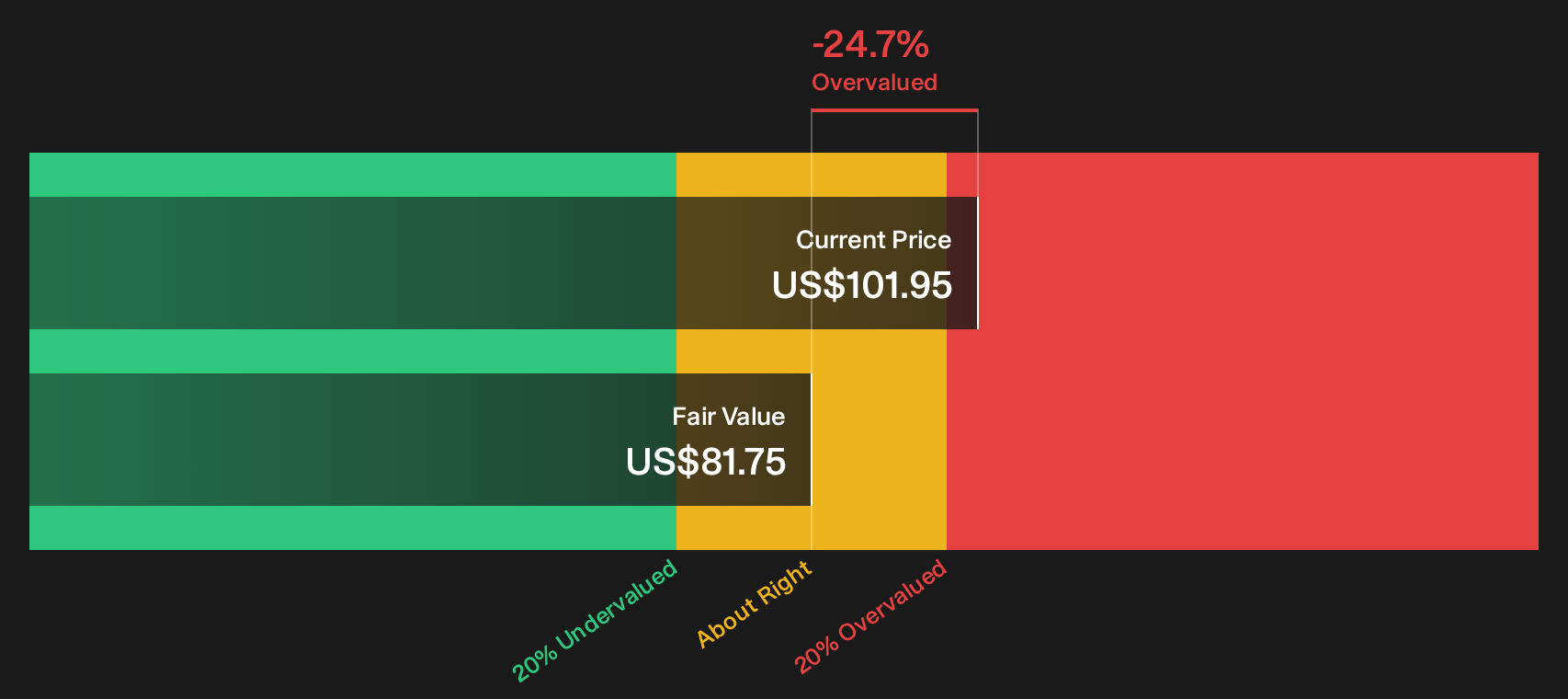
The Discounted Cash Flow (DCF) model here values Abbott Laboratories by projecting its future free cash generation and then discounting those dollars back to today. Abbott Laboratories produced about $7.6b of free cash flow over the last twelve months, and the 2 Stage Free Cash Flow to Equity model assumes that cash flows grow for a period before settling into a slower phase. Based on those inputs, the DCF indicates an intrinsic value of about $81.75 per share.
Compared with the current market price, that estimate implies Abbott Laboratories screens as overvalued by roughly 24.7%. The recent FDA approval of the TactiFlex Duo ablation catheter adds a concrete growth angle in cardiac devices, yet the market price already reflects more value than this cash flow model supports. On this cash flow view, Abbott Laboratories stock appears overvalued at today’s share price.
Our Discounted Cash Flow (DCF) analysis suggests Abbott Laboratories may be overvalued by 24.7%. Discover 31 high quality undervalued stocks or create your own screener to find better value opportunities.
Does Abbott Laboratories Look Undervalued on Earnings?
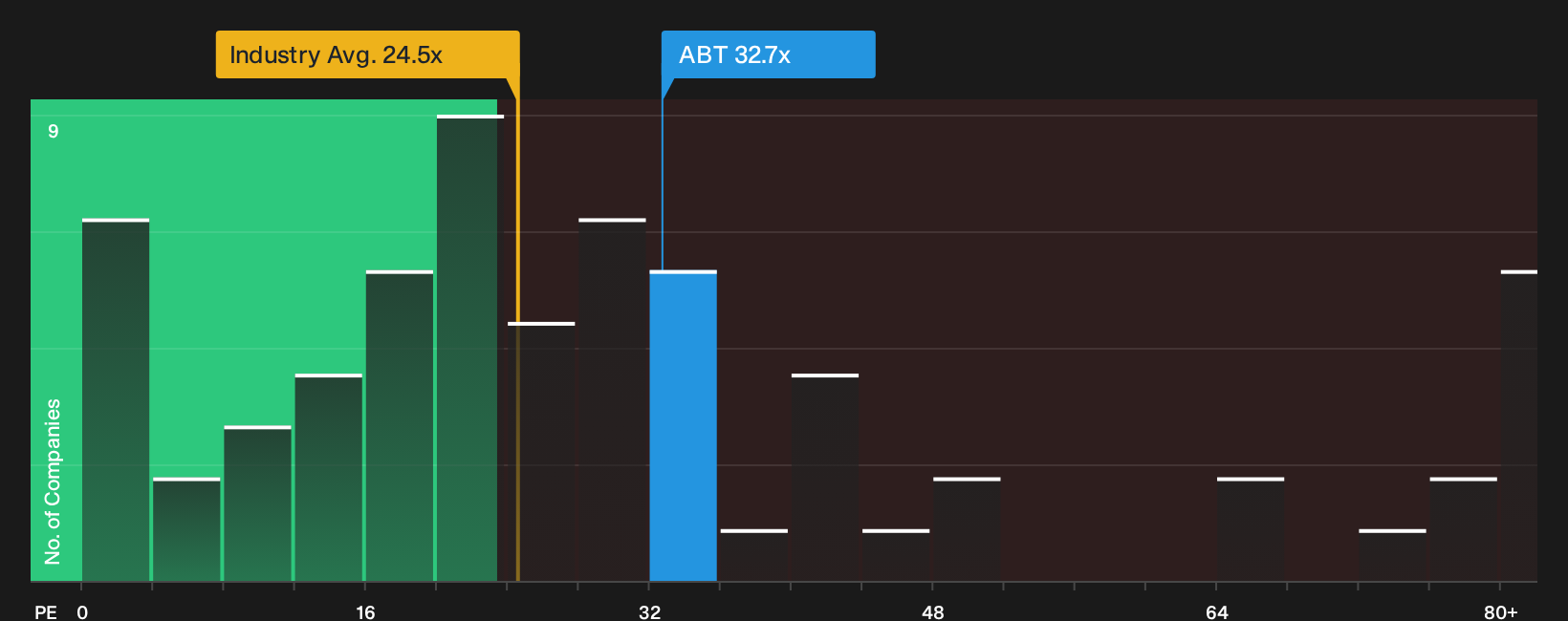
The P/E ratio suits Abbott Laboratories because earnings remain a key lens for large, diversified healthcare groups. The stock trades on a P/E of about 32.7x, which is higher than the medical equipment industry average of roughly 24.5x and also above the peer group average of about 27.3x. On simple comparisons, you are paying a richer headline multiple for Abbott than for many sector peers.
The valuation model that blends factors such as size, margins and sector risk suggests a fair P/E closer to 37.1x for Abbott Laboratories. That is above the current 32.7x level, so the shares trade at a discount to what this framework flags as a reasonable earnings multiple, even if they look expensive against broad industry averages.
Taken together, Abbott Laboratories appears undervalued on the P/E lens relative to the fair multiple implied by its fundamentals.
See what the numbers say about this price — find out in our valuation breakdown.
The Abbott Laboratories Narrative: What Would Justify Today's Price?
Simply Wall St Narratives pick up where the valuation split for Abbott Laboratories' cash flows and earnings leaves you. They spell out which paths for growth, margins and profits would need to play out for the stock to be worth materially more or materially less than today’s price on the Community page. Each scenario links a clear fair value to a particular mix of potential catalysts and risks, which helps you track over time which storyline lines up with how Abbott Laboratories' business actually develops.
Share a narrative on Abbott Laboratories' stock to put your numbers-driven view on the TactiFlex Duo catheter approval or its Alzheimer’s blood test ambitions into the Simply Wall St community conversation.
Set out a clear case today and track how that thesis holds up as Abbott Laboratories' results and clinical milestones come through over time.
Do you think there's more to the story for Abbott Laboratories? Head over to our Community to see what others are saying!
The Bottom Line
Abbott Laboratories throws off mixed signals. The Discounted Cash Flow (DCF) view points to an overvalued stock, since the current price sits above the intrinsic value estimate. The earnings based lens instead suggests the shares look undervalued relative to a fair P/E for a business with Abbott’s profile, even though wider checks flag a weak overall value case. The real swing factor is whether future cash generation eventually matches the growth and margin expectations that the P/E implies, or whether execution risk in areas like new diagnostics keeps the intrinsic value closer to the DCF line.
This article by Simply Wall St is general in nature. We provide commentary based on historical data and analyst forecasts only using an unbiased methodology and our articles are not intended to be financial advice. It does not constitute a recommendation to buy or sell any stock, and does not take account of your objectives, or your financial situation. We aim to bring you long-term focused analysis driven by fundamental data. Note that our analysis may not factor in the latest price-sensitive company announcements or qualitative material. Simply Wall St has no position in any stocks mentioned.
Have feedback on this article? Concerned about the content? Get in touch with us directly. Alternatively, email editorial-team@simplywallst.com