
Has Block (XYZ) Fallen Far Enough to Offset Crypto Risk?
Block stock brings a tricky valuation debate into focus right now, with a long term share price decline over 5 years set against mixed signals from different valuation frameworks and fresh moves deeper into crypto and data driven lending.
- Over the past 5 years, Block shares have declined about 69%, which puts fresh attention on whether today’s price better reflects the business than it did during earlier enthusiasm.
- Block’s push into bitcoin and stablecoin custody through a proposed national trust bank charter, alongside efforts to monetize Cash App Score data with external lenders, can support the thesis that future cash flows become more diversified. At the same time, heavier exposure to digital assets and consumer credit may increase regulatory and credit risk.
- The Excess Returns intrinsic value estimate points to roughly 22% upside from the current market price, yet earnings based multiples screen as expensive. The broader checks therefore give a mixed picture rather than a clear bargain, with its 3.0 value score sitting in the middle of the range.
The issue now is whether Block’s share price near recent levels already reflects the potential from these newer initiatives or still leaves a reasonable margin between market value and intrinsic value estimates.
Seize this moment around Block’s mixed valuation signals to review 31 high quality undervalued stocks, which combine stronger balance sheets with cleaner upside potential.Is Block a Bargain on Excess Returns?
Excess Returns looks at what a business like Block can earn on its equity after covering the shareholder cost of capital, then adds that economic profit to today’s book value. For Block, the model uses a Book Value of $36.70 per share and a Stable EPS of $5.60 per share, with that earnings figure sourced from weighted future Return on Equity estimates from 8 analysts. The implied Cost of Equity is $3.44 per share, leaving an Excess Return of $2.16 per share and an Average Return on Equity of 12.28%, which is then applied to a Stable Book Value forecast of $45.63 per share.
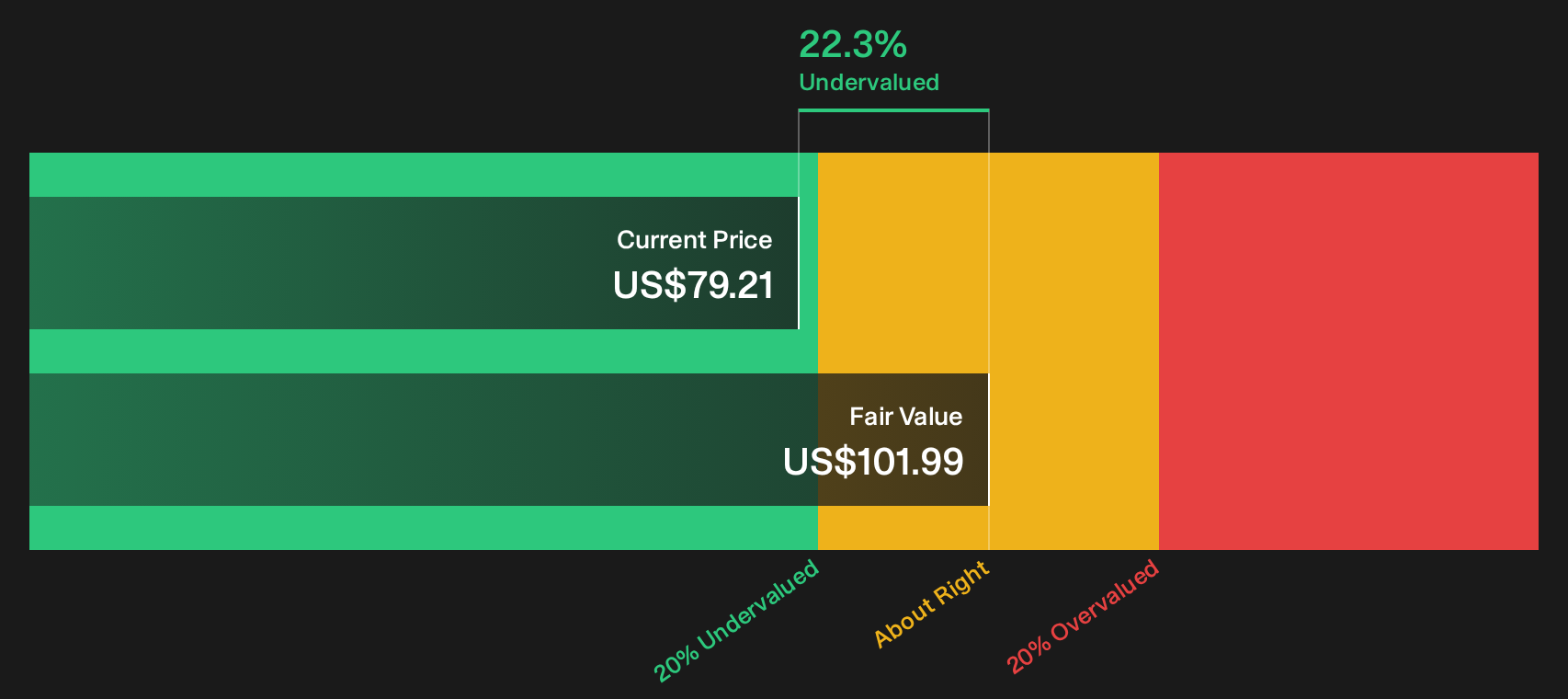
Plugging those inputs into Excess Returns gives an intrinsic value estimate of $101.99 per share, above the current share price and implying the stock is undervalued by about 22.3%. News around Block applying for a national trust bank charter to custody bitcoin and stablecoins helps explain why investors are debating risk, even as the model still assigns material value to the equity returns that underpin those projects.
On this Excess Returns view, Block stock currently screens as undervalued relative to the cash it is expected to earn on its equity base.
Our Excess Returns analysis suggests Block is undervalued by 22.3%. Track this in your watchlist or portfolio, or discover 31 more high quality undervalued stocks.
Has Block Run Too Far on Earnings?
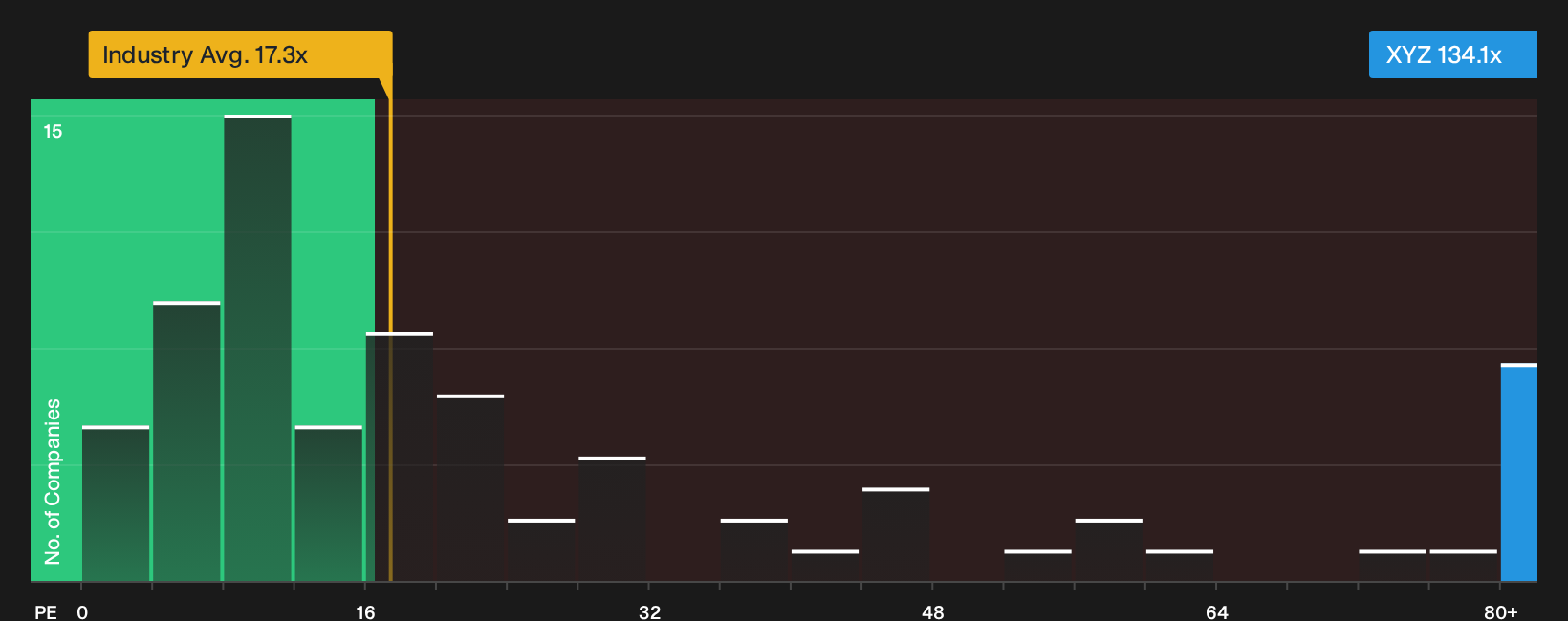
P/E is the cleanest way to line up Block with other financial stocks because it ties the share price directly to the earnings power underpinning both Cash App and the merchant business. On this metric, Block trades on a P/E of about 134.1x, versus a Diversified Financial industry average of 17.3x and a peer average of 12.2x. That is a very wide premium to what investors are currently paying for similar earnings streams elsewhere in the sector.
The tailored fair P/E ratio from the model is 36.1x, which already incorporates the company-specific profile, including its risk mix and growth expectations, yet still sits far below the present multiple. Because the gap is so large, the signal is less an exact target and more a warning that the stock reflects a lot of optimism relative to its recent earnings base. Put simply, on this framework Block appears expensive even after allowing for its differentiated product set and data-driven opportunities.
On the P/E multiple, Block screens as clearly overvalued compared with both its tailored fair ratio and broader Diversified Financial peers.
See what the numbers say about this price — find out in our valuation breakdown.
The Block Narrative: What Would Justify Today's Price?
Simply Wall St Narratives for Block sit between the valuation models above and the real world path the business could follow. These short scenarios spell out what mix of growth, profitability and earnings power would need to play out for Block to be worth materially more or materially less than today’s market value. Where a single ratio or model outputs one number, Narratives unpack the future that number assumes so you can watch how it unfolds on the Community page.
Block inspires very different stories right now, depending on whether you focus on product momentum or on rising structural risks.
Bull case: 19% undervalued
"Accelerated product launches, embedded banking, and cryptocurrency integration are driving user growth, deeper engagement, and expansion into higher-margin revenue streams..."
Read the full Bull Case to see why Block could be undervalued
Bear case: 11% overvalued
"Expanding regulatory pressures, cyber threats, and dependence on cryptocurrency inflows add cost burdens and amplify earnings volatility for Block..."
Read the full Bear Case to see why Block could be overvalued
Do you think there's more to the story for Block? Head over to our Community to see what others are saying!
The Bottom Line
Block’s intrinsic value estimate from the Excess Returns model points to meaningful upside, while the P/E view flags the stock as expensive compared with peers and its own tailored fair ratio. The clash stems from one framework leaning on future cash generation on the existing equity base and the other reflecting how much optimism is already embedded in the earnings multiple. With such an extreme gap between current P/E and the fair ratio, the key question is whether Block’s push into crypto custody and data driven lending ultimately delivers the returns implied by the intrinsic value view or whether the rich multiple is the market correctly pricing those risks.
This article by Simply Wall St is general in nature. We provide commentary based on historical data and analyst forecasts only using an unbiased methodology and our articles are not intended to be financial advice. It does not constitute a recommendation to buy or sell any stock, and does not take account of your objectives, or your financial situation. We aim to bring you long-term focused analysis driven by fundamental data. Note that our analysis may not factor in the latest price-sensitive company announcements or qualitative material. Simply Wall St has no position in any stocks mentioned.
Have feedback on this article? Concerned about the content? Get in touch with us directly. Alternatively, email editorial-team@simplywallst.com