
Will Rate Hike Expectations Change JPMorgan Stock Narrative
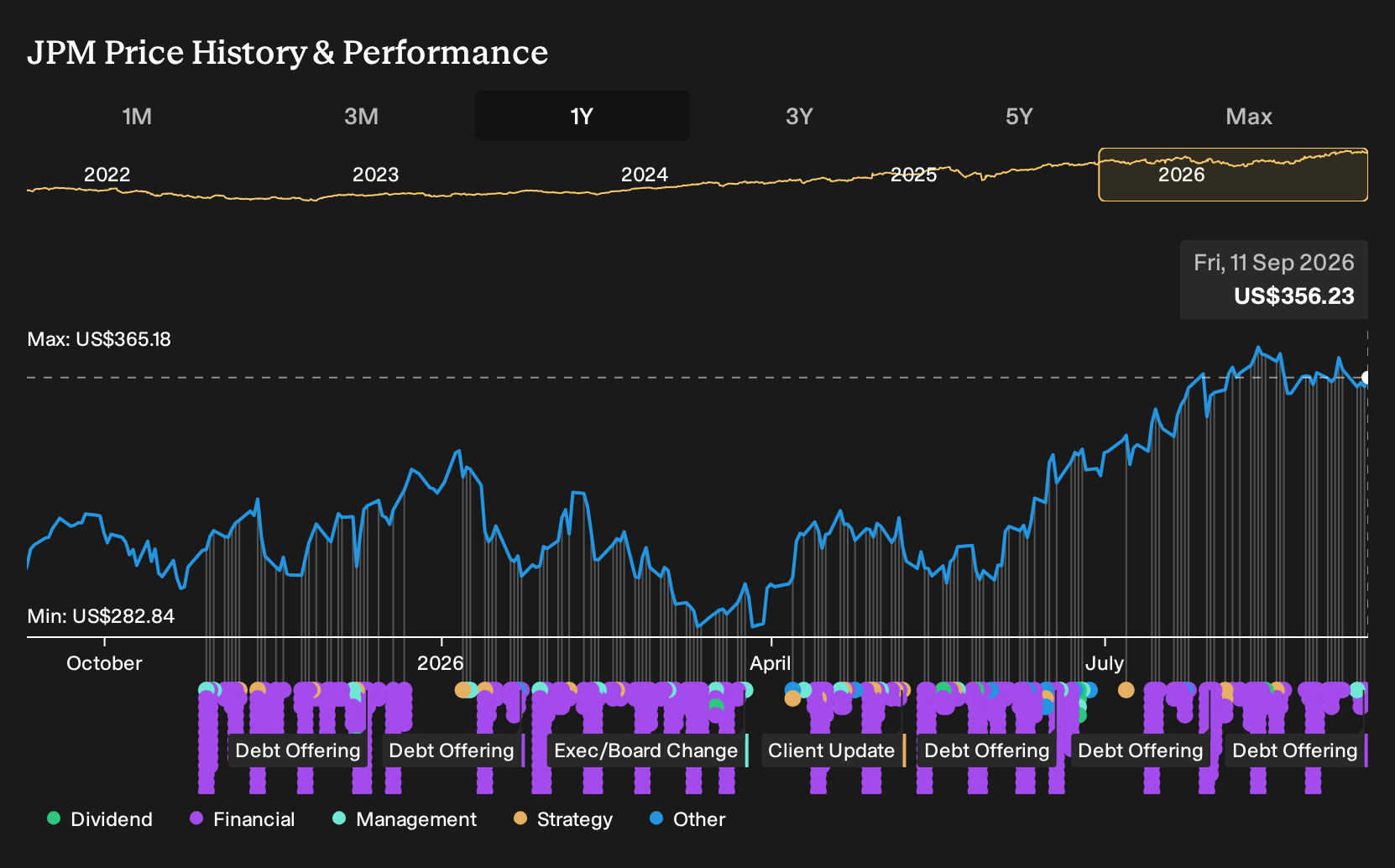
- In early September 2026, JPMorgan Chase announced a series of fixed rate, unsecured and unsubordinated callable notes across multiple maturities, alongside fresh leadership appointments in its international and U.S. private banking franchises and new benefits on its co-branded Air Canada Aeroplan credit card.
- The cluster of new bond offerings and ETF distribution updates points to JPMorgan Chase actively tuning its funding mix and fee driven businesses at the same time that prime brokerage risk appetite is being reassessed after losses linked to an AI focused hedge fund.
- We will now examine how JPMorgan Chase's investment narrative intersects with this renewed market focus on banks that may benefit from potential rate hikes.
JPMorgan Chase Investment Narrative Recap
To own JPMorgan Chase, you need to be comfortable with a large, diversified bank that leans heavily on fee businesses, digital payments, and wealth management alongside traditional lending. The big swing factor over the next few quarters is how net interest income and loan demand react if rate hikes materialize, while fee lines tied to cards, asset management, and payments stay resilient.
The prime near term risk sits in market sensitive activities and regulation. Recent prime brokerage losses linked to an AI focused hedge fund highlight how quickly risk can surface in markets businesses. By contrast, the flurry of new fixed rate callable notes mainly fine tunes funding and does not materially change the core operating story on its own.
The recent wave of fixed income offerings, including multiple callable unsecured notes out to 2056, is the cleanest link between JPMorgan Chase and the current focus on potential rate hikes. These bonds lock in fixed coupons like 5.75%, 6.1% and 6.3% on different maturities, which shapes the bank's funding profile across the curve.
For you as a shareholder, the relevance sits in execution. Funding decisions affect interest expense, flexibility to support loan growth, and capacity to keep investing in digital payments, wealth management and tokenization projects. The catalyst is whether the bank keeps translating its scale and funding access into steady fee growth while containing market, regulatory, and funding risks.
JPMorgan Chase's current analyst narrative points to forecast revenue of US$224.5b and earnings of US$67.8b by 2029. That profile implies 6.4% yearly revenue growth and an earnings increase of about US$4.2b from current earnings of US$63.6b.
Uncover why JPMorgan Chase's fair value indicates a 5% potential upside to its current price, which could narrow quickly as sentiment shifts.
Exploring Other Perspectives
One bullish twist you might explore is the idea that JPMorgan Chase could turn its heavy tech spending and blockchain work into much higher earnings power than consensus assumes. The most optimistic analysts were already penciling in revenue of US$237.1b and earnings of US$75.9b by 2029, before this funding flurry. Their view is far more upbeat on digital banking and tokenization than the baseline narrative, and fresh fixed income moves plus leadership changes may nudge those stories in new directions. It is worth comparing these different outlooks yourself and deciding which feels closer to how you see the bank’s future.
Explore 12 other JPMorgan Chase fair value estimates, including one that suggests as much as 38% upside from the current price.
Form Your Own Verdict
Don't just follow the ticker. Dig into the data and build a conviction that's truly your own.
- A great starting point for your JPMorgan Chase research is our analysis highlighting 3 key rewards and 1 important warning sign that could impact your investment decision.
- See our latest analysis for JPMorgan Chase. The report includes a comprehensive fundamental analysis summarized in a single visual, the Snowflake, making it easy to evaluate JPMorgan Chase's overall financial health at a glance.
Looking for more investment ideas beyond JPMorgan Chase?
Once you have a view on JPMorgan Chase, it can help to line it up against other opportunities that share similar themes on income, quality, and risk. The Simply Wall St Screener lets you quickly filter for different profiles so you can build a watchlist that matches how you like to invest.
- If you want resilient balance sheets and solid fundamentals to compare with large banks, start with this list of solid balance sheet and fundamentals (23 results) and see which businesses meet your quality threshold.
- For investors who prefer keeping risk in check while still hunting for returns, consider scanning a group of 11 resilient stocks with low risk scores that may offer a smoother ride through rate moves.
- If you are hunting for underfollowed opportunities rather than household names, broaden your watchlist with 16 high quality undiscovered gems that have strong underlying metrics but limited market attention so far.
This article by Simply Wall St is general in nature. We provide commentary based on historical data and analyst forecasts only using an unbiased methodology and our articles are not intended to be financial advice. It does not constitute a recommendation to buy or sell any stock, and does not take account of your objectives, or your financial situation. We aim to bring you long-term focused analysis driven by fundamental data. Note that our analysis may not factor in the latest price-sensitive company announcements or qualitative material. Simply Wall St has no position in any stocks mentioned.
Have feedback on this article? Concerned about the content? Get in touch with us directly. Alternatively, email editorial-team@simplywallst.com