
Under Armour (UAA) Shelf Filing Puts Its Fair Value Debate Back In Focus
Why Under Armour’s Shelf Registration Matters Now
Under Armour (UAA) has filed an omnibus shelf registration covering debt, preferred shares, Class A and Class C common stock, and warrants. This filing signals potential future funding flexibility across multiple security types.
A separate shelf registration for up to US$101.6 million of Class C stock tied to an employee stock ownership plan points to possible equity issuance. This could affect dilution, trading liquidity, and investor perception of capital discipline.
Recent moves show a mixed picture for Under Armour. The 1-day share price return of 2.82% contrasts with a 90-day share price decline of 15.54%. The 1-year total shareholder return of 5.36% sits against a 5-year total shareholder loss of 75.75%, suggesting that short-term momentum is improving even as the longer record remains weak.
Scan beyond Under Armour and compare how other consumer names handle capital raising and dilution risk with our curated list of list of solid balance sheet and fundamentals (23 results)
Under Armour shares have bounced in the very short term, but still carry a long track record of shareholder losses and fresh dilution risk from new shelf capacity. Does that balance of risk and potential upside still favour buyers at this price?
Most Popular Narrative: 18.7% Undervalued
Under Armour last closed at $5.11, while the most followed narrative pegs fair value at $6.28, implying meaningful upside built into that framework.
The ongoing transformation to a brand-first strategy, with a focus on premiumization, tighter SKU assortments, and greater brand storytelling, positions Under Armour to increase average selling prices, improve full-price sell-through, and reduce reliance on discounting, which should positively impact net margins and long-term earnings growth.
Want to see what that brand reset really assumes for Under Armour's revenue mix, profit turnaround, and future earnings multiple? The core levers may surprise you.
Result: Fair Value of $6.28 (UNDERVALUED)
Have a read of the narrative in full and understand what's behind the forecasts.
Still, Under Armour’s narrative leans heavily on successful premium pricing and a cleaner product lineup, and both could misfire if shoppers resist higher price points.
Find out about the key risks to this Under Armour narrative.
Another View On Under Armour’s Valuation
While the most followed narrative frames Under Armour as undervalued versus a $6.28 fair value, the SWS DCF model points the other way. On that cash flow view, the shares around $5.11 sit above an estimated value of $4.39, which implies a premium rather than a discount. Which lens do you trust more when the stories conflict?
Look into how the SWS DCF model arrives at its fair value.
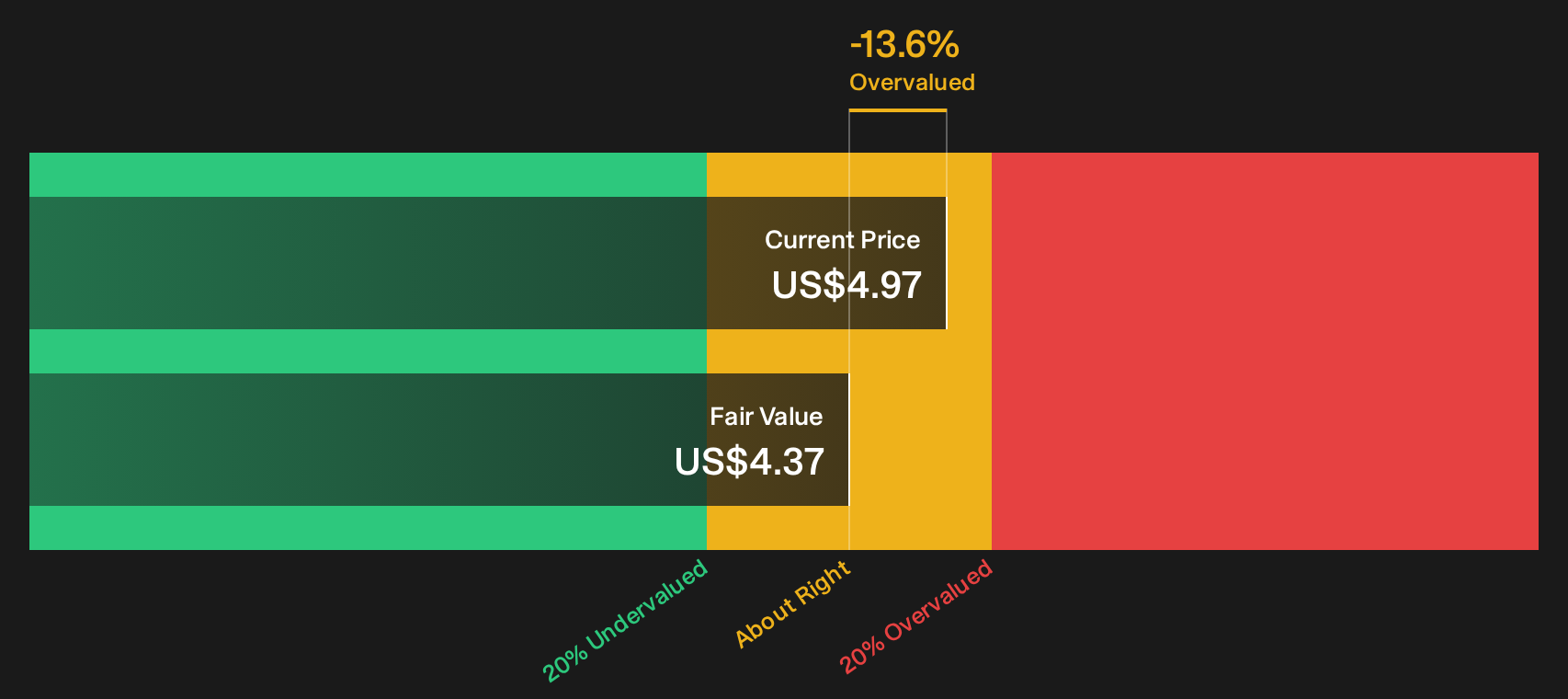
Simply Wall St performs a discounted cash flow (DCF) on every stock in the world every day (check out Under Armour for example). We show the entire calculation in full. You can track the result in your watchlist or portfolio and be alerted when this changes, or use our stock screener to discover 31 high quality undervalued stocks. If you save a screener we even alert you when new companies match - so you never miss a potential opportunity.
Next Steps
Mixed signals around Under Armour’s valuation and dilution risk make this a judgment call rather than a clear verdict. Check the data now and pressure test your own thesis using the 2 key rewards.
Ready For More Investment Ideas Beyond Under Armour?
If Under Armour has you thinking harder about risk, value, and dilution, it is worth lining up a few fresh contenders to compare side by side.
- Spot potential mispricings early by scanning a focused set of 16 high quality undiscovered gems that pair strong fundamentals with limited market attention.
- Zero in on resilience by screening 11 resilient stocks with low risk scores that aim for steadier performance through cleaner balance sheets and lower risk profiles.
- Target value opportunities by reviewing 31 high quality undervalued stocks where quality metrics and price still look out of sync.
This article by Simply Wall St is general in nature. We provide commentary based on historical data and analyst forecasts only using an unbiased methodology and our articles are not intended to be financial advice. It does not constitute a recommendation to buy or sell any stock, and does not take account of your objectives, or your financial situation. We aim to bring you long-term focused analysis driven by fundamental data. Note that our analysis may not factor in the latest price-sensitive company announcements or qualitative material. Simply Wall St has no position in any stocks mentioned.
Have feedback on this article? Concerned about the content? Get in touch with us directly. Alternatively, email editorial-team@simplywallst.com