
S&P 500 impact 8,000 point card case! US stock bulls are struggling to find a “mysterious catalyst”
The Zhitong Finance App learned that for several weeks, US stock bulls have been eyeing the 8,000 point mark of the S&P 500 index. But actually reaching this hurdle is much more difficult than you might think. On August 13, when this benchmark stock index once rose to 7816.7 points, a record intraday high, the 8,000 point integer mark seemed within reach. Since then, however, the market has moved in the opposite direction — soaring US bond yields, stubborn inflation, hawkish interest rate prospects, and weak consumer confidence have weighed on the stock market.
At a time when the market is about to enter a busy phase — including the Federal Reserve's interest rate decision next week, the question of what conditions are needed to push the S&P 500 to break through 8,000 points has once again surfaced. Breaking through 8,000 points would mean an increase of about 4.8% from Friday's closing price.
Sam Stovall, chief investment strategist at CFRA, raised the S&P 500 target from 7,400 points to 8050 points last month after performing better than expected in the earnings season. Although he is still adhering to this year-end target, he also said that it is currently impossible to clearly determine what factors will drive the market to start the next round of growth.
Sam Stovall said, “We are in an unresolved phase, and everyone is sitting back and waiting for that elusive catalyst to see if it can actually push the stock market further up from its current position.” “As to what exactly this catalyst is, no one can say for sure. Maybe inflation is cooling, or AI is making a breakthrough; it may be the risk posed by interest rate hikes, or it may be a further rise in oil prices and bond yields.”
Since reaching a record high in the previous round on August 13, the S&P 500 index has been fluctuating sideways. The trading range is only 2%, and the room for growth and decline is limited. As of Thursday, the S&P 500 index had not seen a 1% decline for 30 consecutive trading days, the longest period of calm since mid-May. The index closed up 0.86% to 7656.98 points on Friday after falling continuously for the first four trading days of the week.
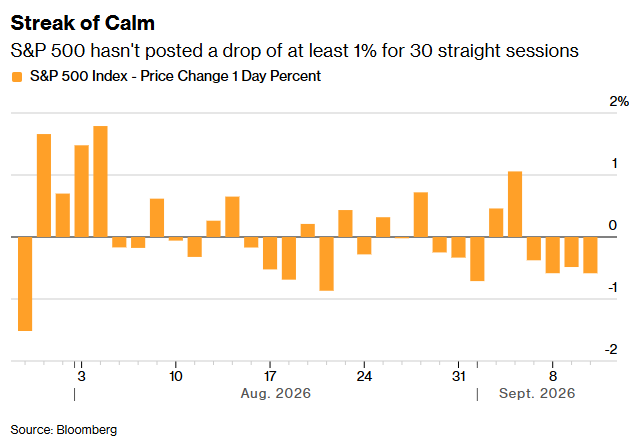
The quiet period continues - the S&P 500 index has not declined by at least 1% for 30 consecutive trading days
At a time when the stock market is once again experiencing fluctuations that usually coincide with this phase of the US midterm election cycle, traders are weighing an extremely cautious and hawkish interest rate outlook. As the much-publicized month-on-month increase in the US core CPI in August exceeded expectations, traders' current pricing shows that the probability that the Fed will raise interest rates in September has reached 90%, and the market fully anticipates that the Fed will raise interest rates twice before the end of the year.
50 Park Investments founder Adam Sarhan said, therefore, market performance over the next few weeks will be critical to determine the direction of the stock market from now to the end of 2026. He said, “There are enough reasons for the stock market to fall sharply in view of increasing macro risks, but it has remained resilient.” He has been increasing his holdings in various stocks, from large technology stocks to energy companies. “The market is a mirror of the economy. The economy remains strong, and corporate profits are growing. There are currently no concerns about a recession”.
For Sam Stovall, the S&P 500 index fell 5% to 10% from its current level, which is not abnormal. Since World War II, the benchmark index has experienced an average peak-to-trough decline of 18% in midterm election years. In his view, this means that even if the S&P 500 index fell by a maximum of 9.1% earlier this year and bottomed out at the end of March, the index will still be prone to some market turbulence in the future.
History shows that it may take some time to reach the 8,000 mark. According to data compiled by CFRA, since the index first broke through 1,000 points in 1998, the median number of trading days required for the S&P 500 index to climb to each subsequent 1000 point integer mark is 578. This means that according to the historical rhythm, the S&P 500 may not break through 8,000 points until around mid-2028.
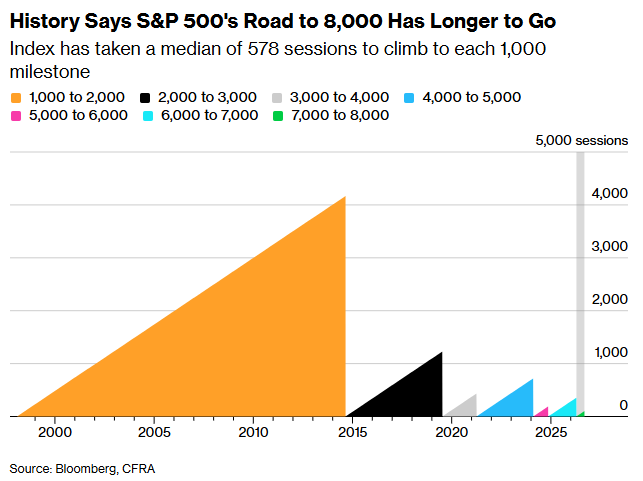
History shows that the S&P 500 is still a long way from 8,000 points — the median number of trading days required for the index to climb to each 1000 point integer mark is 578
Of course, the process of the S&P 500 moving towards every integer mark is far from linear. The S&P 500 index first closed above 1,000 points in February 1998, but it took more than 16 years to reach 2,000 points. The middle was dragged down by the bursting of the internet bubble and the global financial crisis. In 2019, during a cycle of interest rate cuts, the index broke through 3,000 points. A few months later, the COVID-19 pandemic brought the longest bull market in history to an abrupt end.
It took nearly three years for the S&P 500 to rise from 4,000 points to 5,000 points, mainly due to a 25% retracement between January and October 2022. However, after the index finally regained its all-time high in January 2024, it broke through the 5,000 point mark just a few weeks later. It only took 9 months for the index to rise from 5,000 points to 6,000 points, setting a record for the fastest increase of 1,000 points in history. It took about 14 months to climb from 6,000 points to 7,000 points.
Although the S&P 500 index has remained unchanged since mid-August, Wall Street has shown few signs of anxiety. According to data compiled by Deutsche Bank, regular investors and active investors are still oversubscribing to stocks, but this level is only at the 65th percentile of the past 10 years, which is clearly lower than the level suggested by current profit growth. This means that traders will still have enough money to buy stocks in the next few weeks.
The Chicago Board Options Exchange Volatility Index (VIX) closed at 15.84 points on Friday. The index has remained below 20, a level which usually means that market pressure is increasing. Maxwell Grinacoff, a stock derivatives strategist at UBS Group, said in a telephone interview: “The reason why stock market volatility has not changed is because this round of growth is supported by strong corporate profits.” “Macro risk isn't a stock market story. Instead, these risks stem from problems in other asset classes, such as the bond market, which may spill further into the stock market. It's just that we haven't seen this happen until now.”