
Record Legal Leasing Could Be A Big Moment For Cushman And Wakefield Stock
- Cushman & Wakefield reported that U.S. legal sector tenants leased a record 7.3 million square feet in Q2 2026, with first half activity reaching about 12.2 million square feet and driven by larger deals and law firm expansions.
- The surge in legal office leasing points to robust demand for larger, higher quality workspaces, which feeds directly into Cushman & Wakefield's fee pool and underlines how sector specific strength can support broader office leasing recovery.
- We will look at how Cushman & Wakefield's investment narrative lines up with surging legal sector office demand and larger law firm leases.
Scan Cushman & Wakefield's office demand backdrop against a curated set of landlords and REITs with resilient cash flows using the list of solid balance sheet and fundamentals (23 results) as your comparison universe.
Cushman & Wakefield Investment Narrative Recap
For an investor to back Cushman & Wakefield, the core belief is that global commercial property services remain in demand even as office usage evolves. The record legal sector leasing and stronger Lower Manhattan volumes point to pockets of healthy activity that can support fee income, but the key near term catalyst still rests on broader leasing and capital markets conditions, not one segment.
The main operational risk right now is that Cushman & Wakefield remains tied to cyclical transaction revenue while profit margins sit at 0.6% and interest costs are not comfortably covered. If recent leasing strength proves narrow or short lived, pressure on earnings quality, leverage and valuation could persist without much offset.
The most relevant recent data point is Cushman & Wakefield’s report that U.S. legal tenants leased a record 7.3 million square feet in Q2 2026 and 12.2 million square feet in the first half. This sits alongside stronger Lower Manhattan leasing and higher asking rents, suggesting that higher quality urban offices can still attract tenants willing to transact.
For the stock, that matters because the near term upside case leans on sustained activity in leasing and advisory rather than on aggressive cost cutting alone. Strong legal and tech tenant demand offers a clearer revenue path but does not remove core risks such as low margins, high P/E, meaningful leverage and exposure to any renewed slowdown in office decisions.
Cushman & Wakefield's current earnings of US$73.7 million are set against analyst expectations for US$12.4b in revenue and US$416.8 million in earnings by 2029. That outlook assumes revenue growth of 5.6% per year and an earnings increase of about US$343 million from today to the 2029 consensus forecast.
Uncover why Cushman & Wakefield's fair value indicates a 36% potential upside to its current price, which could narrow quickly if Cushman & Wakefield's narrative gains wider attention.
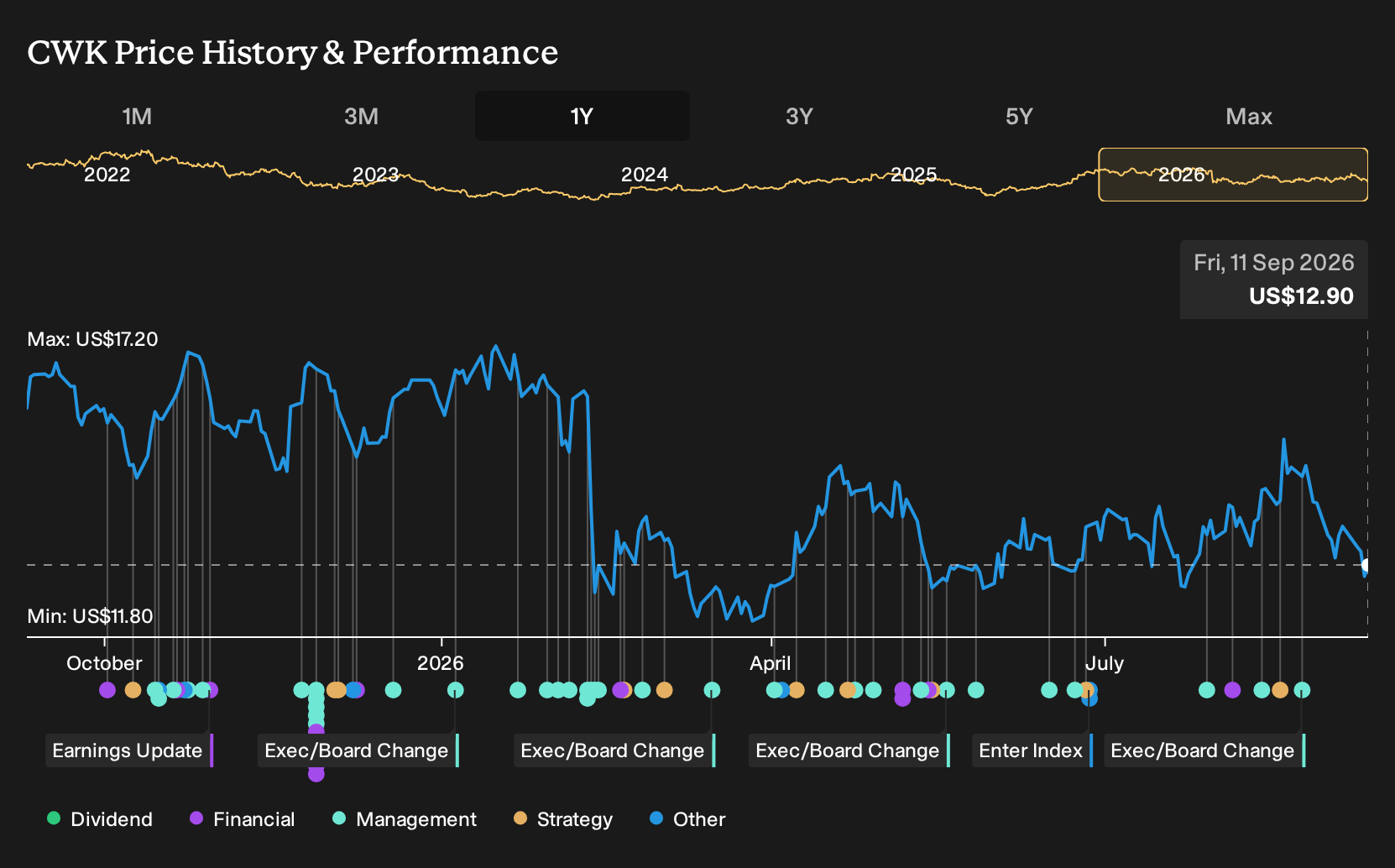
Exploring Other Perspectives
One alternate angle on Cushman & Wakefield focuses on a much stronger revenue ramp if services keep gaining traction. The most optimistic analysts were already modeling about US$12.9b of sales and US$502.9 million of earnings by 2029 before this legal leasing surge. That is far above the bearish US$387.1 million view, so treat today’s news as a prompt to compare those very different paths, and decide which assumptions feel closer to your own.
Explore another Cushman & Wakefield fair value estimate, including one that suggests potential upside of up to 146% from the current price.
Reach Your Own Conclusion
Don't just follow the ticker; dig into the data and build a conviction that's truly your own.
- A great starting point for your Cushman & Wakefield research is our analysis highlighting 3 key rewards and 3 important warning signs that could impact your investment decision.
- See our latest analysis for Cushman & Wakefield. The report includes a comprehensive fundamental analysis summarized in a single visual, the Snowflake, making it easy to evaluate Cushman & Wakefield's overall financial health at a glance.
Looking For More Ideas Beyond Cushman & Wakefield?
Once the Cushman & Wakefield story is clear in your mind, it can help to set it alongside other opportunities that match your risk tolerance and income goals. The Simply Wall St Screener lets you do that in a structured way so you can compare quality, valuation and balance sheet strength across a wide field of listed businesses.
- If capital preservation is high on your list, start with companies that pair sturdy finances with measured volatility by scanning a 11 resilient stocks with low risk scores tailored to that profile.
- If you want potential mispricing on your radar, focus on businesses with solid fundamentals that trade below estimated value by filtering through a 31 high quality undervalued stocks that highlights where the numbers may not match the price.
- If you are hunting for future leaders before they are widely followed, widen your research across a 16 high quality undiscovered gems that surfaces quality operators the market may not be paying close attention to yet.
This article by Simply Wall St is general in nature. We provide commentary based on historical data and analyst forecasts only using an unbiased methodology and our articles are not intended to be financial advice. It does not constitute a recommendation to buy or sell any stock, and does not take account of your objectives, or your financial situation. We aim to bring you long-term focused analysis driven by fundamental data. Note that our analysis may not factor in the latest price-sensitive company announcements or qualitative material. Simply Wall St has no position in any stocks mentioned.
Have feedback on this article? Concerned about the content? Get in touch with us directly. Alternatively, email editorial-team@simplywallst.com