
Charles Schwab (SCHW) Stock Looks Reasonable Even With 15% Upside估
Charles Schwab has delivered a powerful 3 year share-price run, yet its current valuation checks send a mixed signal, with the Excess Returns intrinsic value estimate pointing to some undervaluation while market multiples look closer to fair.
- The stock is up about 92% over three years, which puts fresh pressure on buyers to judge whether that past strength already reflects the business outlook.
- Schwab's move to raise minimums on certain tax-aware long short accounts can support perceived quality of client assets, while tighter access to margin and complex strategies may limit fee upside if investor appetite cools.
- The value score of 4 out of 6 points to a mixed picture rather than a clear bargain or clear overvaluation.
The issue now is whether Charles Schwab's current share price already captures the intrinsic value implied by the Excess Returns model or still leaves some room for upside based on fundamentals.
Capitalize on the re-rating in Charles Schwab by scanning a curated set of quality financials with solid balance sheet and fundamentals stocks screener (23 results).Does Charles Schwab Look Undervalued on Excess Returns?
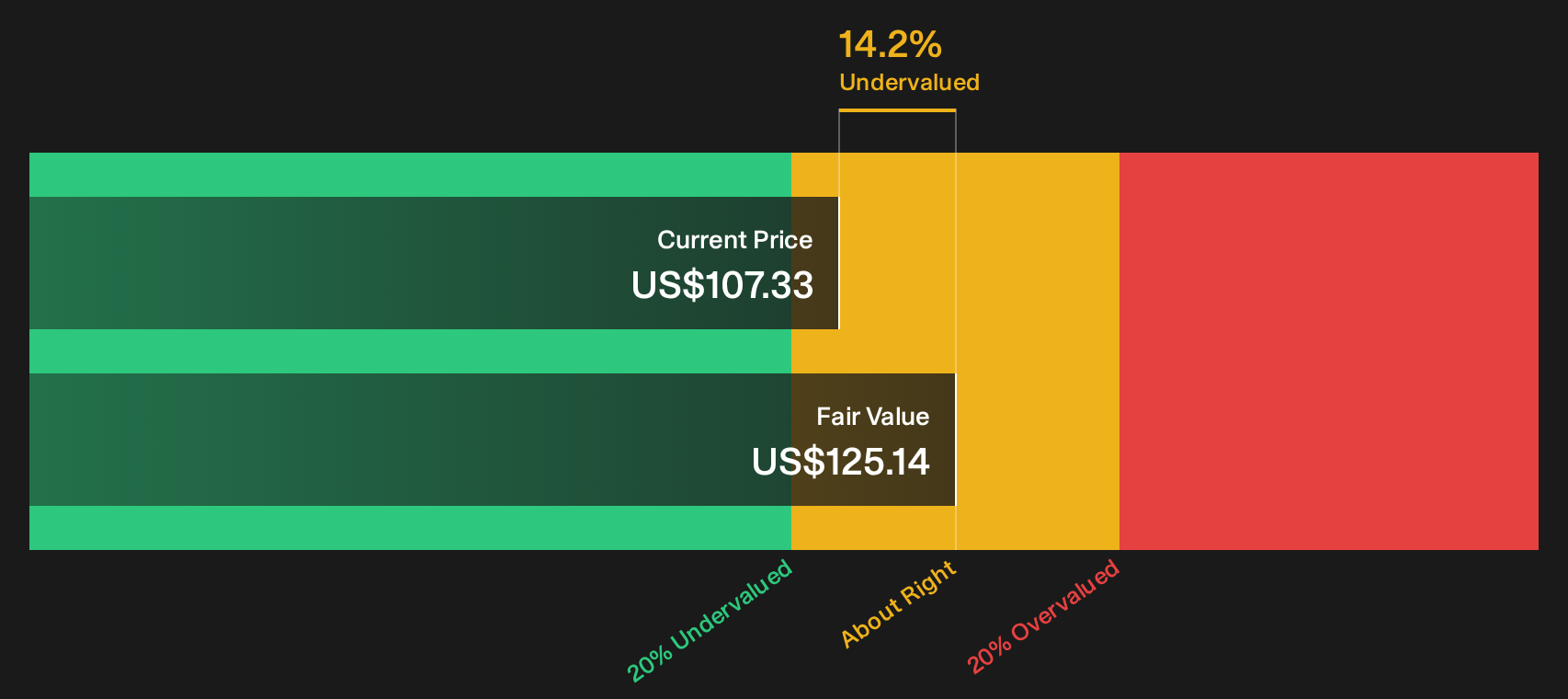
The Excess Returns model examines how much profit Charles Schwab can earn on its equity above the return investors require. On this framework, the stock appears undervalued.
Schwab is modeled with Book Value of $25.42 per share and Stable EPS of $7.45 per share, based on forward return on equity estimates from 5 analysts. With an Average Return on Equity of 23.32% and a Cost of Equity of $2.78 per share, the Excess Return is $4.68 per share, in addition to a Stable Book Value of $31.96 per share from 4 analyst estimates. That stream of excess profits results in an intrinsic value estimate of $125.72 per share, which is above the current share price and implies the stock is 14.7% undervalued.
News that Charles Schwab is raising minimums on tax aware long short accounts and tightening portfolio margin access helps explain why some investors may still hesitate, even though the Excess Returns analysis indicates a higher value than where the market is currently pricing the shares.
On this model, Charles Schwab appears undervalued relative to the earnings power implied by its projected returns on equity.
Our Excess Returns analysis suggests Charles Schwab is undervalued by 14.7%. Track this in your watchlist or portfolio, or discover 31 more high quality undervalued stocks.
Where Does Charles Schwab Sit on Earnings?
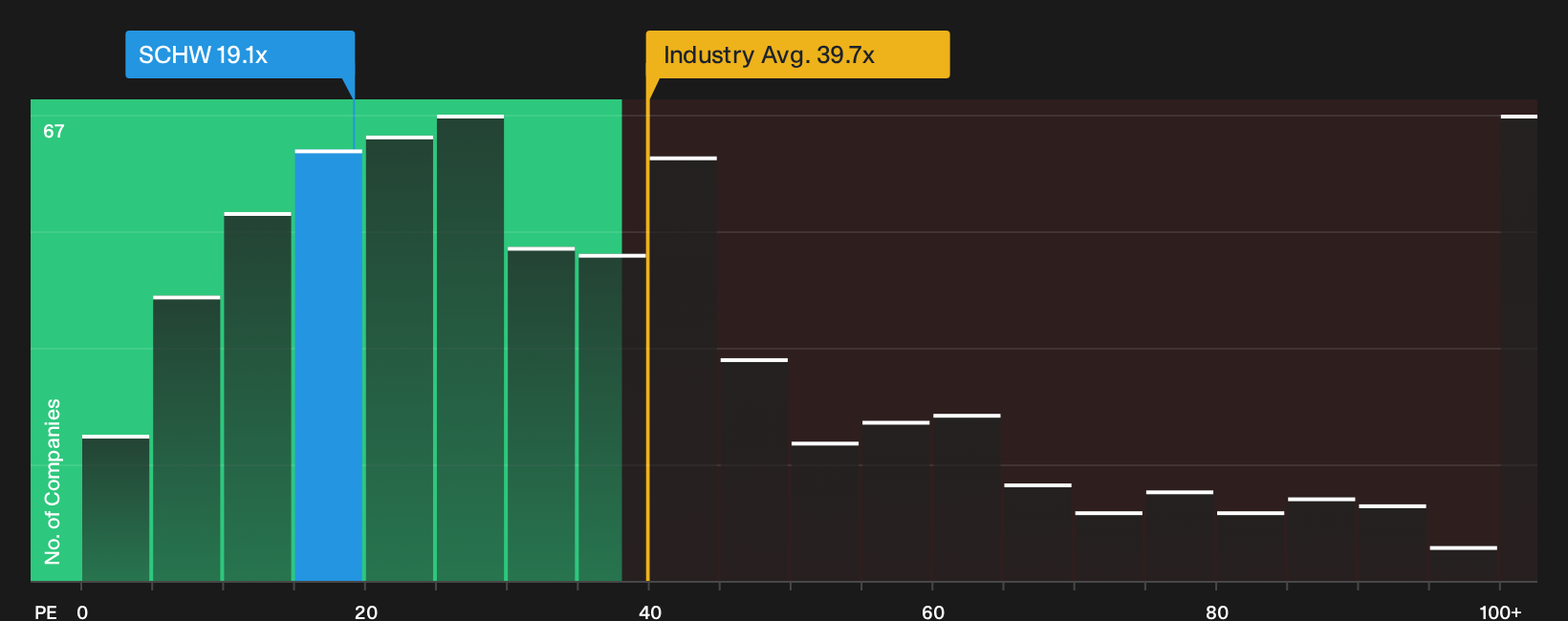
P/E suits Charles Schwab because earnings power is still the main anchor investors use for large brokerage and platform businesses. On this metric, the stock trades at about 19.1x earnings. That sits well below the capital markets industry average of roughly 39.7x and also under the peer group reference point of about 29.6x, so the market is not assigning Schwab a premium label here.
The Fair P/E Ratio for Charles Schwab is estimated at about 19.5x. That is only a small step above the current 19.1x and points to a tight range between what investors are paying and what the model suggests would be reasonable once growth, profitability, size and risk are blended together. The gap is not large enough to argue for a clear discount or a stretched valuation on this earnings yardstick.
On the P/E multiple, Charles Schwab stock looks roughly in line with what the tailored fair value framework would suggest.
See what the numbers say about this price — find out in our valuation breakdown.
The Charles Schwab Narrative: What Would Justify Today's Price?
Simply Wall St Narratives for Charles Schwab pick up where the valuation puzzle leaves off. They spell out which paths for Charles Schwab's growth, profitability and earnings would need to play through for the shares to be worth meaningfully more or less than today, and each narrative ties a specific fair value to a clear mix of potential drivers and risks so you can track over time which version of the story is actually unfolding.
Community views on Charles Schwab could hardly be further apart, which gives you two very different stories to stress-test.
Bull case: 13% undervalued
"Its model blends brokerage, asset management, advisory services, and banking in a way that creates multiple, overlapping revenue streams."
Read the full Bull Case to see why Charles Schwab could be undervalued
Bear case: 6% overvalued
"Heavy investment in AI, technology and new platforms such as spot crypto could overshoot sustainable demand."
Read the full Bear Case to see why Charles Schwab could be overvalued
Do you think there's more to the story for Charles Schwab? Head over to our Community to see what others are saying!
The Bottom Line
For Charles Schwab, the Excess Returns intrinsic value estimate points to undervaluation, while the tailored P/E workup says the current multiple is about right. That split largely comes down to what you trust more: the long run earnings power implied by projected returns on equity, or the market’s current expectations for growth and comparable re-rating. With a mixed valuation score sitting between those two signals, the key question from here is whether Schwab’s profitability and capital efficiency actually track the stronger intrinsic story, or whether recent product and access changes limit potential upside and keep the shares closer to a fully priced range.
This article by Simply Wall St is general in nature. We provide commentary based on historical data and analyst forecasts only using an unbiased methodology and our articles are not intended to be financial advice. It does not constitute a recommendation to buy or sell any stock, and does not take account of your objectives, or your financial situation. We aim to bring you long-term focused analysis driven by fundamental data. Note that our analysis may not factor in the latest price-sensitive company announcements or qualitative material. Simply Wall St has no position in any stocks mentioned.
Have feedback on this article? Concerned about the content? Get in touch with us directly. Alternatively, email editorial-team@simplywallst.com