
Bank of America (BAC) Stock Still Looks Like A Bargain After A 130% Run
Bank of America stock has delivered a very strong 3 year run, yet current valuation checks suggest the shares may still be pricing in less than the full intrinsic value implied by cash flow and earnings based models. For investors watching a large U.S. bank after a big move, the question is whether recent optimism and new initiatives are already fully reflected in today’s US$62.56 share price.
- Bank of America has returned 130.2% over the past 3 years, which puts recent short term pullbacks in a very different light for anyone thinking in multi year terms.
- Management’s push into areas such as AI related financing and a planned USD stablecoin project can support long run fee and interest income. At the same time, shifts in regulation and interest rate policy remain a meaningful risk for what those future cash flows are worth today.
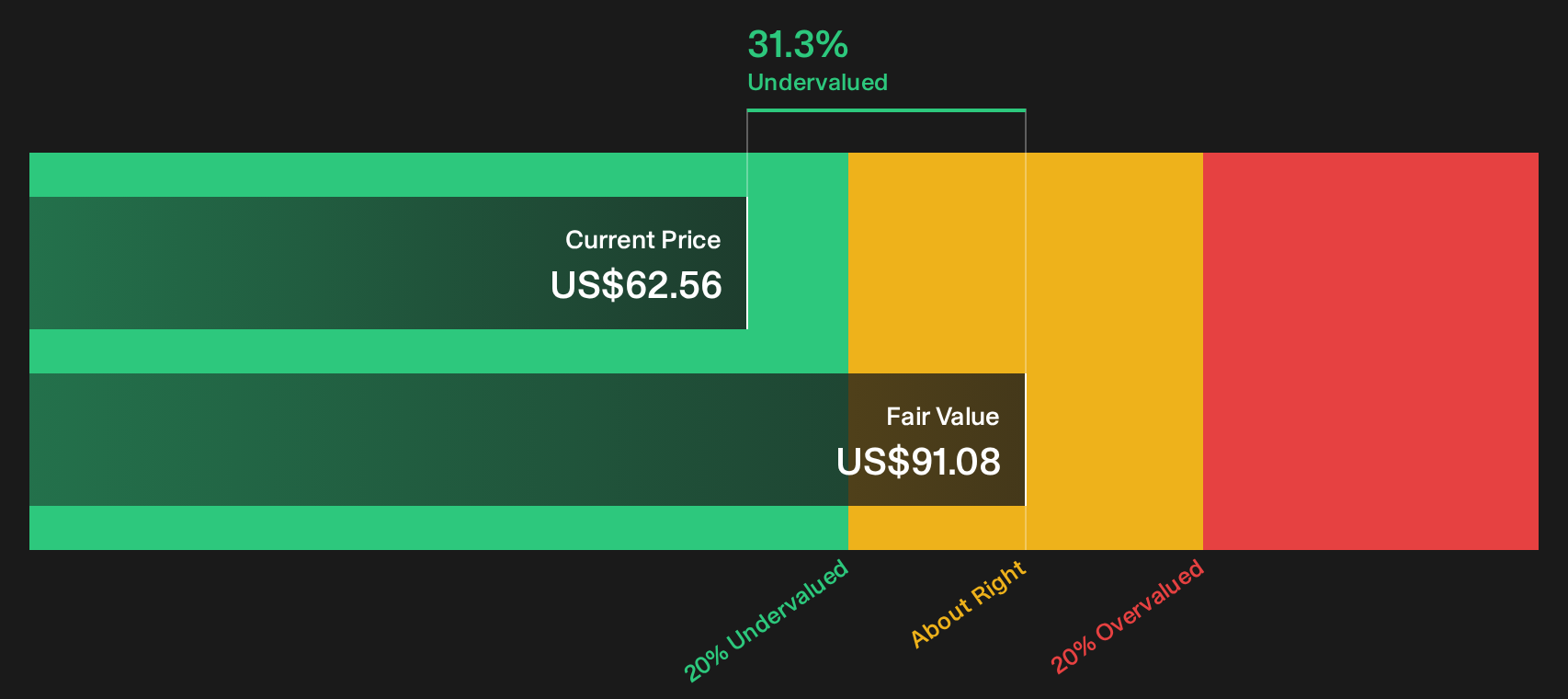
- The Excess Returns based intrinsic value estimate points to the stock trading about 31.3% below that model’s fair value, and the broader checks, including earnings multiples, lean toward undervalued. Taken together, these factors present a mixed picture rather than a clear-cut bargain.
The issue now is whether Bank of America’s current market price already reflects a reasonable margin for the potential rewards and the evident risks in the next few years.
Capitalize on the AI and digital finance themes driving Bank of America by scanning 74 profitable AI stocks that aren't just burning cash, which already blend real earnings power with expanding technology demand.Does Bank of America Look Undervalued on Excess Returns?
The Excess Returns model looks at what Bank of America can earn on its equity above the cost of that equity, then capitalises those surplus profits into a per share value. For this bank, the inputs point to a franchise that is expected to earn more on shareholder capital than investors are charging it.
Book value sits at $39.34 per share and is projected to trend toward a stable $43.45, while stable EPS of $5.52 is set against a cost of equity of $3.48 per share. That leaves an estimated excess return of $2.05 per share on an average return on equity of 12.71%, which feeds into an intrinsic value estimate of $91.08 per share compared with a current price of $62.56. Because the planned USD stablecoin rollout targets fee rich payment flows, the market discount likely reflects regulatory and execution questions rather than a lack of earnings power.
On these Excess Returns assumptions, Bank of America stock appears undervalued relative to what its projected profitability on equity would justify.
Our Excess Returns analysis suggests Bank of America is undervalued by 31.3%. Track this in your watchlist or portfolio, or discover 33 more high quality undervalued stocks.
Does Bank of America Look Undervalued on Earnings?
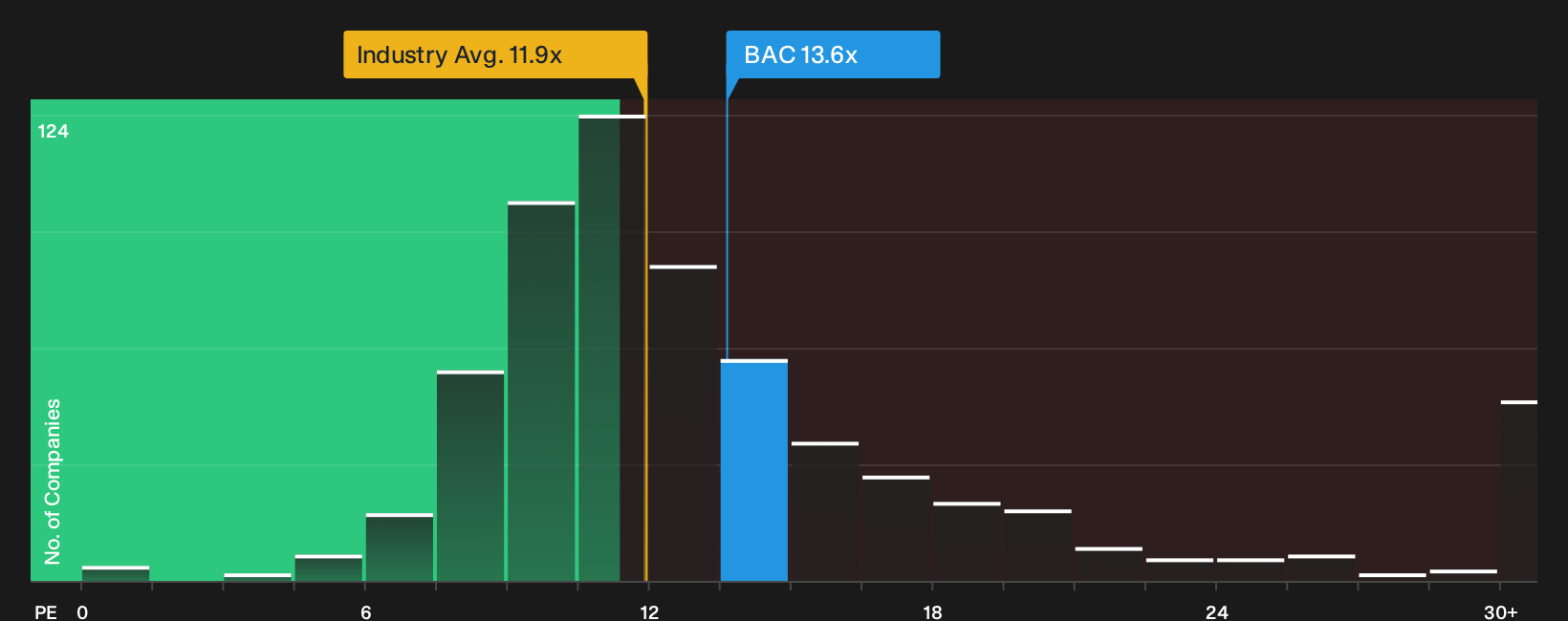
The P/E ratio fits Bank of America because earnings remain the main yardstick for a large, mature lender. On this metric, the stock trades on a P/E of 13.6x, which is almost in line with the peer average of 13.7x and modestly above the broader banks sector on 11.9x. That small premium to the wider industry suggests investors are willing to pay slightly more than for a typical bank but not a big step up compared with close peers.
The Fair Ratio for Bank of America is 15.3x, which is higher than both its current P/E and the peer group. This gap implies the shares change hands at a discount to what the model suggests for a bank with this size, profitability profile and risk mix. Despite the recent focus on AI related lending and the planned USD stablecoin project, the valuation multiple has not stretched far beyond the sector.
Taken together, the P/E comparison indicates Bank of America stock appears undervalued on earnings relative to both peers and its modelled fair multiple.
See what the numbers say about this price — find out in our valuation breakdown.
The Bank of America Narrative: What Would Justify Today's Price?
Simply Wall St Narratives for Bank of America pick up where the valuation puzzle leaves off and explain which paths for growth, margins and earnings would need to occur for the stock to be worth materially more or less than today’s price. Each scenario presents fair value as a thesis about Bank of America’s business that can be revisited over time. These scenarios are available on Simply Wall St’s Community page for investors to track as the story develops.
Share a narrative on Bank of America in the Simply Wall St community and present a number-driven case on whether the planned USD stablecoin project and AI-focused financing really justify the valuation the market is offering today. Add your view now and track how your thesis holds up as new results and news roll in.
Do you think there's more to the story for Bank of America? Head over to our Community to see what others are saying!
The Bottom Line
On the numbers, Bank of America screens as undervalued, with both the intrinsic value work from the Excess Returns model and the earnings multiple checks pointing in the same direction rather than clashing. The gap between the intrinsic value estimate and the current share price only matters if the bank can convert its AI focused lending push and planned USD stablecoin project into durable returns on equity without regulatory setbacks eroding those economics. The real fork in the road is simple: either that discount reflects a mispricing of a solid franchise, or it is fair compensation for execution and policy risk that could cap how much of the projected profitability actually reaches shareholders.
This article by Simply Wall St is general in nature. We provide commentary based on historical data and analyst forecasts only using an unbiased methodology and our articles are not intended to be financial advice. It does not constitute a recommendation to buy or sell any stock, and does not take account of your objectives, or your financial situation. We aim to bring you long-term focused analysis driven by fundamental data. Note that our analysis may not factor in the latest price-sensitive company announcements or qualitative material. Simply Wall St has no position in any stocks mentioned.
Have feedback on this article? Concerned about the content? Get in touch with us directly. Alternatively, email editorial-team@simplywallst.com