
Capri Holdings (CPRI) Stock Looks Undervalued On Earnings While Returns Stay Weak
Capri Holdings stock has had a rough run over the past few years, yet some valuation checks now flag the shares as potentially cheaper than the market is pricing in. The gap between a long stretch of weak returns and an undervalued reading on traditional multiples is what investors are trying to make sense of.
- Capri Holdings has declined 75.6% over the past 5 years, which suggests many investors have already moved away from the stock and expectations are muted.
- Future cash generation and margin resilience in its luxury brands can support the current share price, while any further pressure on profitability or balance sheet flexibility may keep the market cautious.
- The valuation checks give Capri Holdings a mixed score of 3 out of 6, which points to a stock that screens as somewhat cheap on some measures but not a straightforward bargain overall.
The issue now is whether Capri Holdings' depressed share price already reflects the bad news, or if the current discount on multiples still leaves investors paying up for more risk than they might like.
Spot fresh ideas by comparing Capri Holdings with 33 high quality undervalued stocks that also screen as potentially cheap on fundamentals.Does Capri Holdings Look Undervalued on Earnings?
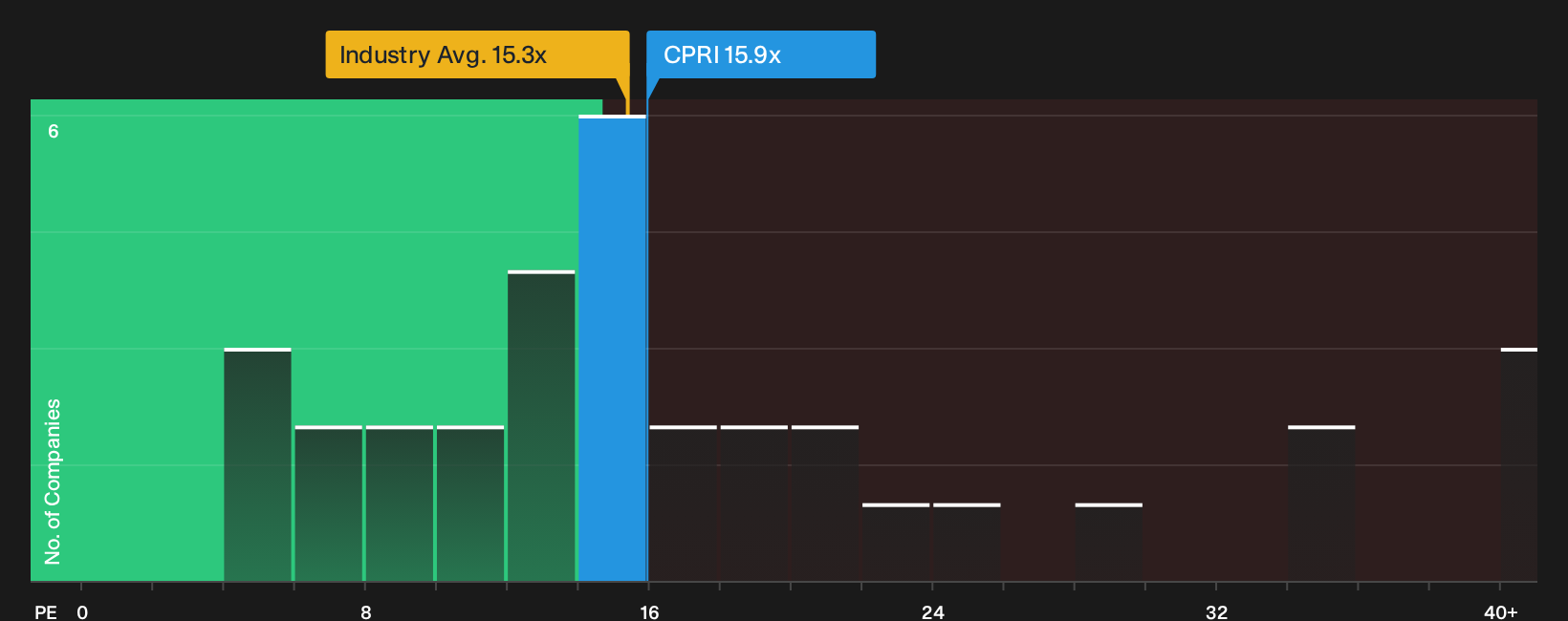
The P/E ratio suits Capri Holdings because earnings remain a key anchor for how investors judge its luxury brands. On this metric, the stock trades at about 15.9x earnings, which is close to both the Luxury industry average of around 15.3x and the peer group on roughly 15.8x. So the headline multiple makes Capri look broadly in line with sector and peer benchmarks rather than wildly cheap or expensive at first glance.
The fair P/E ratio model points to a higher level of about 22.1x for Capri Holdings, based on the company’s profile and risks. That is a sizeable gap to the current 15.9x, which implies the shares change hands at a discount compared with what this framework suggests might be reasonable if the business can support its current earnings power.
On the P/E multiple, Capri Holdings stock screens as undervalued relative to the fair ratio implied by its fundamentals.
See what the numbers say about this price — find out in our valuation breakdown.
The Capri Holdings Narrative: What Would Justify Today's Price?
Simply Wall St Narratives for Capri Holdings pick up where the valuation puzzle leaves off and explain which paths for growth, margins and earnings would need to materialise for Capri Holdings' share price to justify a meaningfully higher or lower level than today, all housed on the Community page. Each scenario ties a fair value to a specific mix of potential catalysts and pressure points so you can track over time which version of Capri Holdings' story is taking shape.
One of the top community narratives on Capri Holdings: 43% undervalued
"Sequential improvement in full-price store traffic, reduced discounting, and growing success of new product launches, supported by data-driven marketing and influencer engagement, signal effective brand revitalization..."
Read one of the top narratives on Capri Holdings
Do you think there's more to the story for Capri Holdings? Head over to our Community to see what others are saying!
The Bottom Line
Capri Holdings screens as undervalued on its P/E compared with a tailored fair multiple, yet the broader checks only give a mixed signal rather than a clear green light. The market is effectively asking whether earnings from its luxury labels can stay resilient enough to justify a higher valuation or if the current discount is still the right cushion for brand, margin and balance sheet risks. That tug of war rests on one central question for investors from here: Does Capri Holdings show enough proof of durable profitability to turn a statistical discount into a justified re-rating rather than a value trap?
This article by Simply Wall St is general in nature. We provide commentary based on historical data and analyst forecasts only using an unbiased methodology and our articles are not intended to be financial advice. It does not constitute a recommendation to buy or sell any stock, and does not take account of your objectives, or your financial situation. We aim to bring you long-term focused analysis driven by fundamental data. Note that our analysis may not factor in the latest price-sensitive company announcements or qualitative material. Simply Wall St has no position in any stocks mentioned.
Have feedback on this article? Concerned about the content? Get in touch with us directly. Alternatively, email editorial-team@simplywallst.com