
Has Patria Investments (PAX) Fallen Far Enough To Look Cheap?
Patria Investments has had a difficult run so far this year, with the share price down 32.5% year to date. The valuation workup suggests the stock is roughly in line with its estimated intrinsic value, but it still screens as expensive on standard market multiples. That mix of a weak recent share price and a low broader value score raises the question of whether the current level offers compensation for the risks in the business model.
- The year to date decline of 32.5% leaves Patria Investments trading well below where it started the year. This may change how investors weigh future return potential against near term uncertainty.
- The long term appeal for this asset manager can rest on consistent fee generation and cash flow from its investment platforms. However, any pressure on fundraising or performance fees may weigh on profitability and perceived value.
- The broader valuation checks rate Patria Investments as expensive, with a low value score of 1 out of 6. This points to more premium style pricing than obvious bargain territory.
The issue now is whether that combination of a roughly aligned intrinsic value estimate, richer market multiples and a weak share price track record leaves Patria Investments offering enough upside for the risk you are taking.
Broaden your watchlist by comparing Patria Investments with 33 high quality undervalued stocks, which pair stronger value checks with more supportive recent share price trends.
Is Patria Investments Fairly Priced on Excess Returns?
The Excess Returns model starts by asking how efficiently Patria Investments turns its equity base into earnings over time. For this stock, the inputs point to a fairly compact equity engine. Book Value sits at $3.49 per share, with Stable EPS at $0.62 per share based on the median return on equity from the past 5 years. That compares with an Average Return on Equity of 16.88%, which is solid but not extreme for a capital markets business.
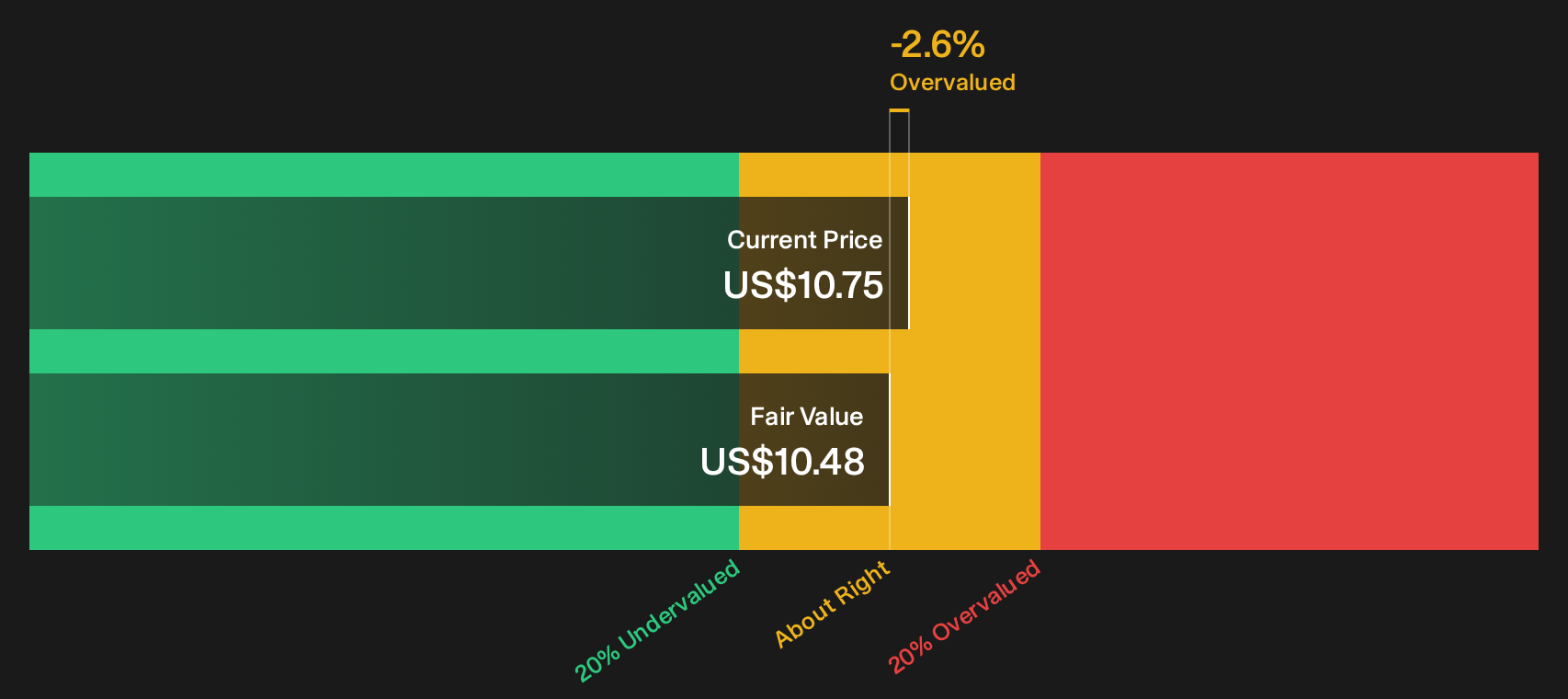
The key output is the relationship between what shareholders require and what the company is modeled to earn on that equity. Cost of Equity is set at $0.30 per share, while Excess Return is estimated at $0.31 per share on a Stable Book Value of $3.64 per share, informed by three analyst forecasts. Plugging those into Excess Returns gives an intrinsic value of $10.48 per share. With the current NasdaqGS:PAX price implying a 2.6% premium to that estimate, Patria Investments screens as only slightly rich rather than obviously mispriced.
On this Excess Returns view, Patria Investments appears to be roughly fairly valued, with only a small amount of optimism reflected in the price.
Patria Investments is fairly valued according to our Excess Returns, but this can change at a moment's notice. Track the value in your watchlist or portfolio and be alerted on when to act.
Does Patria Investments Look Pricey on Earnings?
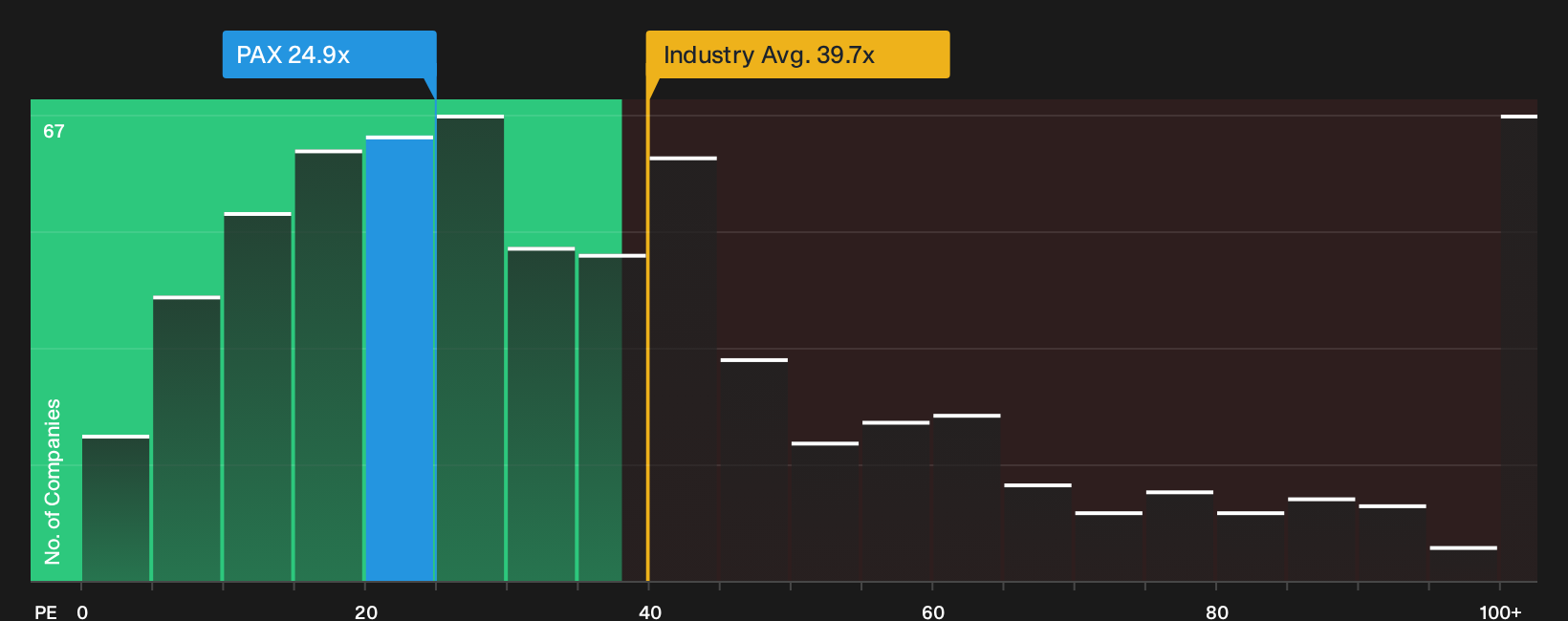
P/E fits Patria Investments because earnings are a central gauge for asset managers that rely on fee income. On this lens, the stock trades on a P/E of 24.9x, which is above the peer average of 11.9x but below the broader Capital Markets industry average of 39.7x. That places the valuation between specialist peers and the wider sector, suggesting investors are paying up somewhat for the current earnings profile, but not at the very top of industry levels.
The tailored fair P/E for Patria Investments is estimated at 19.2x, based on factors such as margins, size and risk. The current multiple therefore sits several turns higher than that fair ratio, which points to a meaningful premium in how the market prices each dollar of earnings compared with what the model suggests as justified.
On the P/E test, Patria Investments appears overvalued, with the market assigning a richer earnings multiple than the model’s fair range.
See what the numbers say about this price — find out in our valuation breakdown.
The Patria Investments Narrative: What Would Justify Today's Price?
Patria Investments' valuation picture raises more questions than it answers, and Simply Wall St Narratives are built to spell out what would need to happen on growth, margins and earnings for the stock to be worth materially more or less than today’s price on the Community page. Rather than focusing on a single multiple or model output, each view lays out the underlying assumptions for its fair value so you can compare them with actual results as they come through.
The community is split on Patria Investments, with one camp leaning into the alternative assets growth story and another fixating on Brazil specific risks and tighter assumptions.
Bull case: 31% undervalued
"The accelerating global shift of institutional capital towards alternative assets, particularly private equity, infrastructure, and credit, is directly driving robust organic fundraising growth, reflected in Patria's repeated upward revision to annual fundraising guidance and rate of net new fee-earning AUM inflows…"
Read the full Bull Case to see why Patria Investments could be undervalued
Bear case: 8% overvalued
"While the build out of private credit in Brazil is expanding Patria's fee earning AUM through Solis and related CLO structures, heavy reliance on a single country credit cycle means any tightening of regulation or a slowdown in securitization could limit future management fee growth and temper fee related earnings…"
Read the full Bear Case to see why Patria Investments could be overvalued
Do you think there's more to the story for Patria Investments? Head over to our Community to see what others are saying!
The Bottom Line
Patria Investments looks close to its intrinsic value on the Excess Returns model, yet screens as overvalued on P/E against both peers and a tailored fair ratio. That split comes from the intrinsic view focusing on what the balance sheet can earn over time, while the market multiple leans on expectations for higher growth and sentiment toward alternative assets. Broader valuation checks remain weak, so the burden of proof sits with future earnings delivery rather than multiple expansion. The key question is whether fee growth and performance revenues can support today’s richer earnings multiple without a material stumble in fundraising or Brazil focused exposure.
This article by Simply Wall St is general in nature. We provide commentary based on historical data and analyst forecasts only using an unbiased methodology and our articles are not intended to be financial advice. It does not constitute a recommendation to buy or sell any stock, and does not take account of your objectives, or your financial situation. We aim to bring you long-term focused analysis driven by fundamental data. Note that our analysis may not factor in the latest price-sensitive company announcements or qualitative material. Simply Wall St has no position in any stocks mentioned.
Have feedback on this article? Concerned about the content? Get in touch with us directly. Alternatively, email editorial-team@simplywallst.com