
MSCI (MSCI) Stock May Be 17% Below Fair Value Despite Bond Yield Pressure
MSCI stock has lagged over the past five years, yet the current share price sits below an intrinsic value estimate from a Discounted Cash Flow (DCF) approach, while traditional market multiples suggest the shares are expensive. That split leaves MSCI looking neither clearly cheap nor clearly stretched on a broad valuation read.
- Over the past 5 years, MSCI has declined 11.1%, which raises questions about how much of the company’s cash flow potential is already reflected in the current market value.
- Expected demand for index and analytics benchmarks that can support recurring fee income is a key support for MSCI’s valuation. However, any sustained pressure on institutional investment activity, such as from weaker commercial real estate exposure highlighted in recent bond yield news, may weigh on future fee growth assumptions.
- On a broad scoring framework, MSCI shows a mixed picture, with a value score of 3 out of 6, so it screens as neither a clear bargain nor a clear overvaluation.
The issue now is whether the current discount implied by the DCF-style intrinsic value is strong enough to offset the richer message from market multiples for MSCI.
Compare MSCI's mixed valuation signal with a curated list of other companies that pair solid balance sheets with durable fundamentals using the solid balance sheet and fundamentals stocks screener (23 results).
Is MSCI a Bargain on Cash Flow?
The Discounted Cash Flow (DCF) approach here is built on projected free cash flows rather than short term earnings swings. For MSCI, the latest twelve month free cash flow sits around $1.5b, which presents a picture of an established, cash generative business rather than a turnaround story. The model assumes those cash flows grow over time, which lifts the estimated intrinsic value to about $661 per share.
Compared with the current market price, that DCF output suggests MSCI is trading at roughly a 17.2% discount, so the stock appears undervalued on this cash generation metric. Rising bond yields pressuring commercial real estate and institutional flows help explain why the market may be hesitant, even though the cash flow model points to a higher figure.
On this DCF view, MSCI stock appears undervalued relative to the cash flows analysts expect it to produce.
Our Discounted Cash Flow (DCF) analysis suggests MSCI is undervalued by 17.2%. Track this in your watchlist or portfolio, or discover 33 more high quality undervalued stocks.

Is MSCI Getting Expensive on Earnings?
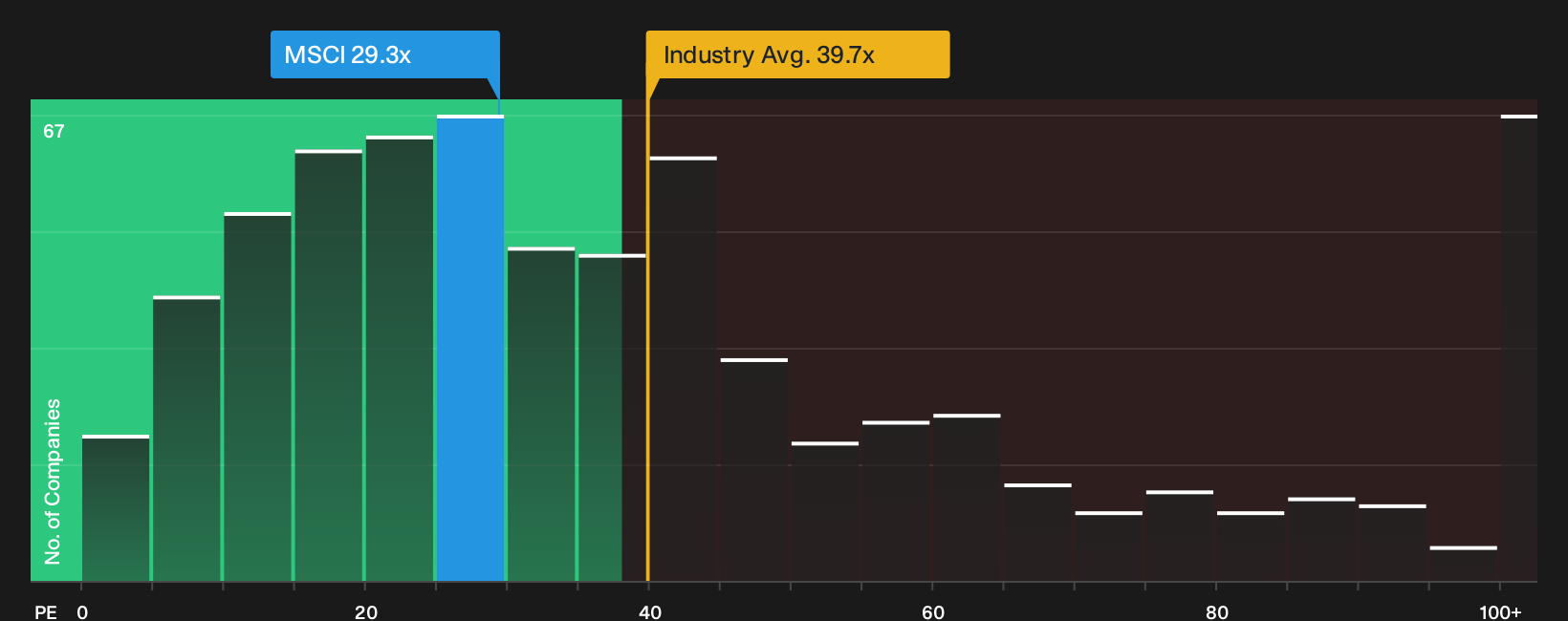
The P/E ratio is a useful lens for MSCI because earnings tend to be relatively steady for a mature data and index provider. On that metric, the stock trades on roughly 29.3x earnings, which is below the broader Capital Markets industry average of about 39.7x. Against more direct peers, though, MSCI sits above a peer group average of roughly 25.4x.
A tailored fair P/E ratio for MSCI is estimated at about 16.4x, so the current multiple represents a clear premium to what this framework suggests would be reasonable for its earnings power and risk mix. That spread implies investors are paying up heavily for the quality and predictability of MSCI’s earnings stream rather than getting it at a discount.
On this earnings yardstick, MSCI stock screens as overvalued relative to the fair P/E level implied by its fundamentals.
See what the numbers say about this price — find out in our valuation breakdown.
The MSCI Narrative: What Would Justify Today's Price?
Simply Wall St Narratives pick up where MSCI's valuation puzzle leaves off. They spell out which paths for MSCI's future growth, profitability and earnings would need to play out for the share price to end up meaningfully higher or lower than today. Each one anchors its number to a clear view on how growth, margins and risk could evolve. You can revisit these views as fresh results and macro data arrive on the Community page.
Community views on MSCI are sharply split, with one camp seeing a high quality compounder on sale and the other flagging a premium story already priced in.
Bull case: 28% undervalued
"That creates a very attractive economic model: MSCI can participate in the growth of assets invested against its indexes without having to supply the capital itself..."
Read the full Bull Case to see why MSCI could be undervalued
Bear case: 32% overvalued
"The investment thesis rests on three durable pillars: (1) permanent switching costs in the Index segment, where fund mandate rewrites, LP notifications, and derivative contract renegotiations make benchmark migration prohibitively costly for all but the most determined sponsors..."
Read the full Bear Case to see why MSCI could be overvalued
Do you think there's more to the story for MSCI? Head over to our Community to see what others are saying!
The Bottom Line
MSCI’s Discounted Cash Flow (DCF) intrinsic value points to a meaningful 17.2% discount, yet the P/E work suggests the shares trade on an overvalued earnings multiple. That clash reflects a simple split. Cash flow modelling focuses on the durability of MSCI’s fee stream, while the market multiple view leans on what investors are willing to pay for that growth profile today. With broader checks sending a mixed signal, the key question is whether recurring demand for indexes and analytics can stay strong enough to validate the intrinsic value argument rather than the more cautious earnings-based read.
This article by Simply Wall St is general in nature. We provide commentary based on historical data and analyst forecasts only using an unbiased methodology and our articles are not intended to be financial advice. It does not constitute a recommendation to buy or sell any stock, and does not take account of your objectives, or your financial situation. We aim to bring you long-term focused analysis driven by fundamental data. Note that our analysis may not factor in the latest price-sensitive company announcements or qualitative material. Simply Wall St has no position in any stocks mentioned.
Have feedback on this article? Concerned about the content? Get in touch with us directly. Alternatively, email editorial-team@simplywallst.com