
Is Jacobs Solutions (J) Reasonably Priced Or Stretched By Earnings?
Jacobs Solutions comes into focus with a split verdict on value, as a Discounted Cash Flow (DCF) estimate points to a sizeable gap to intrinsic value, while market multiples lean the other way.
- Over the past 5 years, Jacobs Solutions has returned 32.8%, which suggests long term holders have seen moderate compound gains even with recent share price softness.
- New work on large infrastructure and energy projects, such as the MetroLink partnership and the MESH Energy Storage Project, can support long duration cash flows. At the same time, execution risk on complex programs may affect how quickly those cash flows show up.
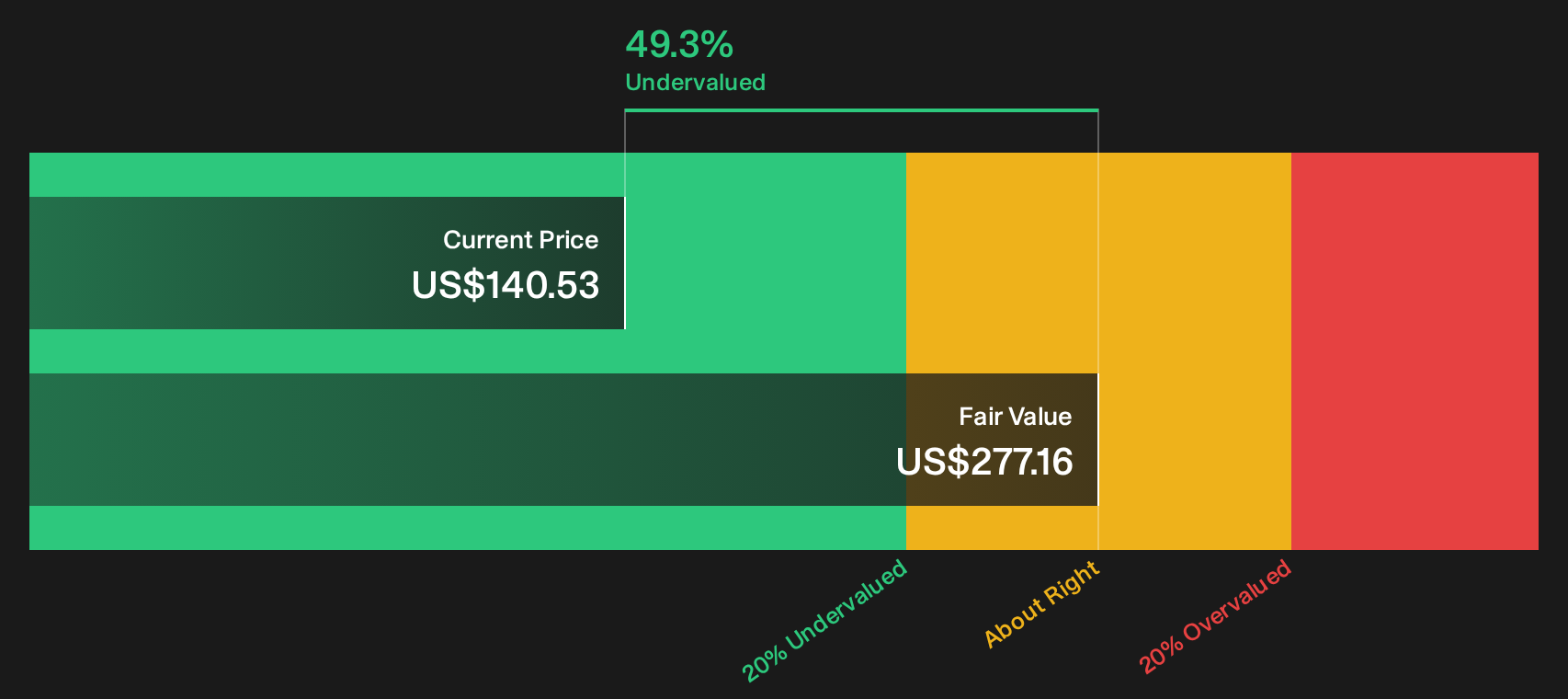
- The broader valuation checks are cautious, with a low value score that leans expensive, even as the DCF view indicates the stock may trade at a 49.3% discount to intrinsic value.
For investors, the debate is whether Jacobs Solutions should be treated as a rare discount on future cash flows or as a stock that already prices in a full set of expectations when judged by market ratios.
Spot opportunities that rhyme with Jacobs Solutions’ story by scanning 33 high quality undervalued stocks, which highlights companies that pair healthy fundamentals with prices the market may be misjudging.Is Jacobs Solutions a Bargain on Cash Flow?
The Discounted Cash Flow (DCF) approach looks at what Jacobs Solutions’ future cash generation could be worth in today’s dollars. The model starts from latest twelve month free cash flow of about $608 million and assumes that cash generation keeps growing rather than shrinking, consistent with a business focused on long duration infrastructure and energy programs.
On those inputs, the DCF points to an estimated intrinsic value of about $277 per share, which sits well above the current market price and presents the stock as potentially undervalued based on this cash flow view. News that Jacobs’ backlog reached $28.9 billion with guidance raised again helps explain why projected cash flows in the model are relatively firm, even if execution on large projects always carries some risk.
In summary, the DCF estimate suggests that Jacobs Solutions may be trading below its calculated intrinsic value on these assumptions.
Our Discounted Cash Flow (DCF) analysis suggests Jacobs Solutions is undervalued by 49.3%. Track this in your watchlist or portfolio, or discover 33 more high quality undervalued stocks.
Has Jacobs Solutions Run Too Far on Earnings?
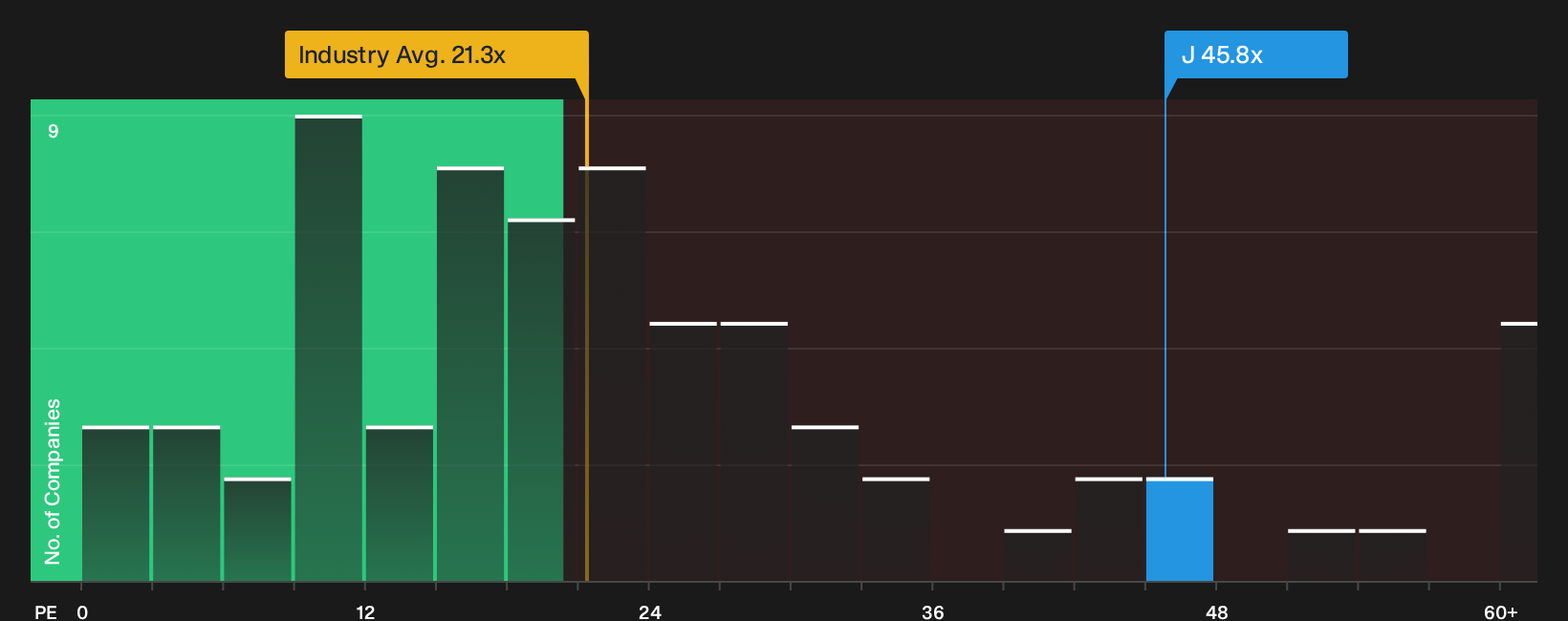
P/E fits Jacobs Solutions well because earnings remain a central yardstick for a mature professional services group with long contracts and recurring work. On that metric, the stock trades at about 45.8x earnings, more than double the wider Professional Services sector, which sits near 21.3x.
The fair P/E ratio for Jacobs Solutions, based on its profile and risk mix, is estimated at about 34.6x. That leaves a wide gap between what the model suggests and where the market currently prices the shares, even when compared with a peer average of roughly 22.2x. This spread indicates that investors today are paying a premium multiple.
On the market multiple view, Jacobs Solutions appears overvalued, with its P/E ratio sitting well above both tailored and industry benchmarks.
See what the numbers say about this price — find out in our valuation breakdown.
The Jacobs Solutions Narrative: What Would Justify Today's Price?
Simply Wall St Narratives pick up where the valuation split on Jacobs Solutions leaves off. They spell out which paths for growth, profitability and earnings would need to play out for the stock to justify a meaningfully higher or lower price than today. Each narrative links its number to a concrete view on how Jacobs Solutions' growth, margins and risks might evolve, which you can return to over time on the Community page as fresh information comes through.
Share a narrative on Jacobs Solutions' stock to add a number-driven view on whether projects like MetroLink and the MESH Energy Storage Project ultimately deliver the kind of cash generation implied by today's price. Be one of the first voices in the Simply Wall St community to set out a clear thesis and track how it holds up as new results and contract news emerge.
Do you think there's more to the story for Jacobs Solutions? Head over to our Community to see what others are saying!
The Bottom Line
Jacobs Solutions screens as undervalued on the Discounted Cash Flow (DCF) view, with the intrinsic value estimate sitting well above the current share price. The market multiple view points the other way and signals an overvalued stock on earnings, which keeps the broader valuation score weak despite the discounted cash flow signal. That split mainly reflects a tension between long term cash flow potential and a rich P/E that already bakes in strong expectations. The real swing factor from here is whether large, complex projects translate into dependable free cash flow rather than execution setbacks that justify the current premium.
This article by Simply Wall St is general in nature. We provide commentary based on historical data and analyst forecasts only using an unbiased methodology and our articles are not intended to be financial advice. It does not constitute a recommendation to buy or sell any stock, and does not take account of your objectives, or your financial situation. We aim to bring you long-term focused analysis driven by fundamental data. Note that our analysis may not factor in the latest price-sensitive company announcements or qualitative material. Simply Wall St has no position in any stocks mentioned.
Have feedback on this article? Concerned about the content? Get in touch with us directly. Alternatively, email editorial-team@simplywallst.com