
Asana (ASAN) Stock May Be Undervalued After Soft Q3 Outlook
Asana stock is trading after a very steep multi year decline, yet on broad valuation checks it now screens as cheap rather than expensive. The share price reset sits against a business still investing in AI driven products and absorbing the impact of that shift on revenue mix and margins.
- Over the past 5 years, Asana shares have fallen about 93%, which means the market has already priced in a lot of disappointment and execution risk.
- The push into AI based work management can support long term demand for Asana’s platform. At the same time, higher AI infrastructure costs and a softer near term revenue run rate may restrain how much investors are willing to pay.
- On Simply Wall St’s broader checks, Asana scores a high 5 out of 6 on value, which points to a stock that currently leans cheap rather than richly priced.
The issue now is whether Asana’s current valuation already reflects the near term growing pains around AI, or if the market is still over discounting the company’s longer run earnings power.
Scan the reset in Asana against other beaten down opportunities by sizing up 33 high quality undervalued stocks that currently screen as cheap on Simply Wall St’s valuation checks.
Does Asana Look Undervalued on Sales?
P/S is a useful yardstick for Asana because the business is still leaning on revenue rather than consistent earnings to tell its story.
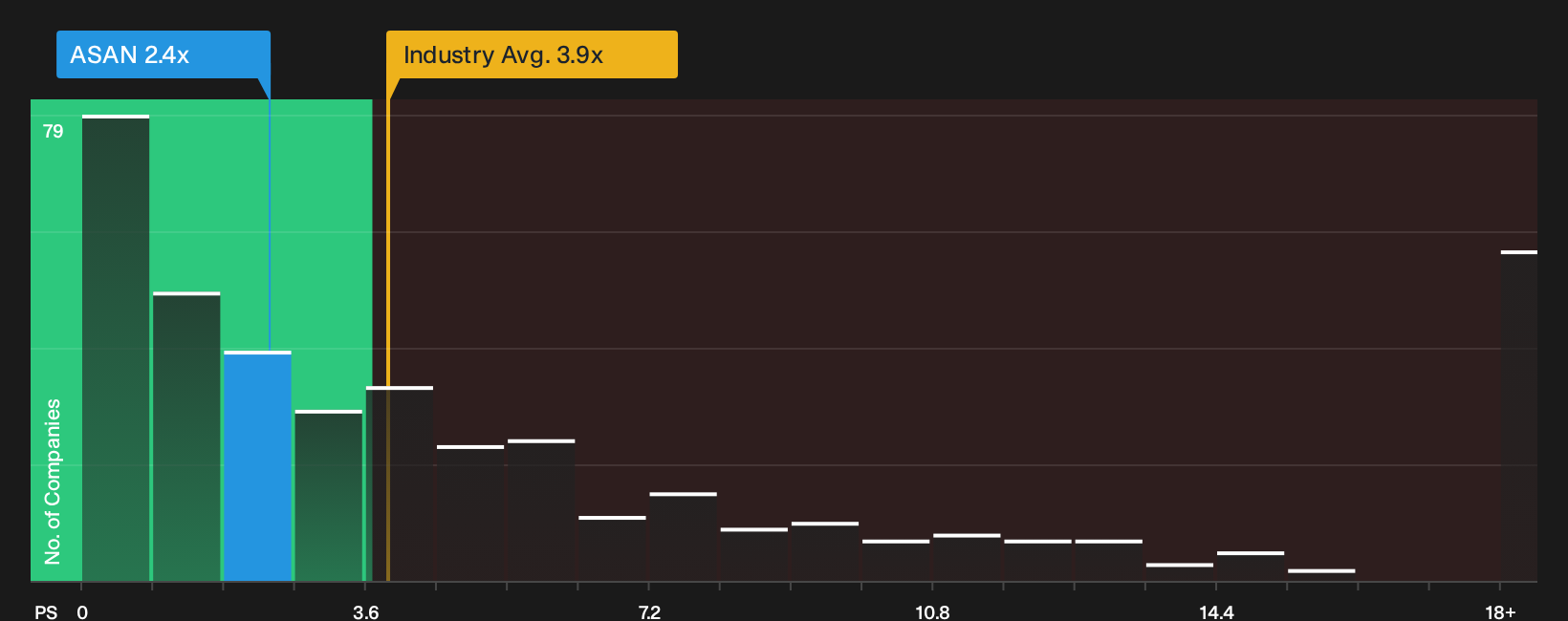
On this metric, Asana trades on a P/S of about 2.4x, which sits below both the broader software group at roughly 3.9x and the peer pack around 2.7x. The valuation framework that blends factors such as growth profile, margins, size and risk points to a fair P/S closer to 4.1x for this stock. That is a sizable gap between where the shares change hands and what this model suggests investors might usually pay for a software platform with similar characteristics.
Despite the recent share pullback after softer Q3 guidance and AI infrastructure cost pressure, Asana’s current sales multiple still lines up at a discount to these benchmarks.
On the P/S multiple alone, Asana stock currently appears undervalued relative to both its tailored fair ratio and the wider software sector.
See what the numbers say about this price — find out in our valuation breakdown.
The Asana Narrative: What Would Justify Today's Price?
Asana’s P/S gap raises a simple question for investors: what kind of future growth, profitability and earnings profile would need to play out for the current share price to look either too low or too optimistic. Simply Wall St Narratives on the Community page turn that broad question into concrete paths for Asana by spelling out the revenue, margin and cash flow paths that sit behind any single valuation output so you can watch in real time whether the story is tracking to that script or breaking away from it.
Community views on Asana are sharply split, with one camp arguing the reset has gone too far while another sees more downside risk.
Bull case: 8% undervalued
"Asana's integration of AI into structured workflow automation (AI Studio, smart workflows, and upcoming AI Teammates) is unlocking new, highly valued enterprise use cases that increase platform stickiness, boost customer expansion and drive higher ARPU..."
Read the full Bull Case to see why Asana could be undervalued
Bear case: 49% overvalued
"Intensifying competition from established larger software providers and the mounting customer preference for integrated, all in one solutions threaten Asana's market share, increasing customer churn and putting downward pressure on pricing, likely eroding gross margins and compressing long term earnings potential..."
Read the full Bear Case to see why Asana could be overvalued
Do you think there's more to the story for Asana? Head over to our Community to see what others are saying!
The Bottom Line
Asana looks undervalued on market multiples, yet that gap only matters if the company can translate its AI push into durable revenue growth and better margins. The discount reflects real execution questions around competitive pressure, infrastructure costs and the path to stronger profitability. For now, the crux is simple: either the current price reflects a cautious read on those risks, or the market is underestimating Asana’s ability to improve its earnings power over time.
This article by Simply Wall St is general in nature. We provide commentary based on historical data and analyst forecasts only using an unbiased methodology and our articles are not intended to be financial advice. It does not constitute a recommendation to buy or sell any stock, and does not take account of your objectives, or your financial situation. We aim to bring you long-term focused analysis driven by fundamental data. Note that our analysis may not factor in the latest price-sensitive company announcements or qualitative material. Simply Wall St has no position in any stocks mentioned.
Have feedback on this article? Concerned about the content? Get in touch with us directly. Alternatively, email editorial-team@simplywallst.com