
eBay (EBAY) Stock Looks Reasonable On Earnings But Cheap On Cash Flow
eBay stock has posted a very strong 3 year run, yet the current US$105.03 share price lines up with an intrinsic value estimate that screens as undervalued, while broader valuation checks point to a more mixed picture.
- The share price has gained 148.8% over the past 3 years, which puts extra weight on whether recent momentum can be supported by underlying cash flows.
- Recent moves to go fee free for private sellers in France and Italy, and to expand fashion authentication, may support future activity on the platform. At the same time, the shift in fee structure and seller tools could introduce execution risk if user behavior or profitability change in unexpected ways.
- The company carries a mixed value profile, with a 3 out of 6 value score that suggests neither a clear bargain nor a clearly expensive stock on the combined checks.
The issue now is whether eBay’s current price already reflects the intrinsic value suggested by the Discounted Cash Flow estimate or still leaves a margin between market and fundamentals.
Scan beyond eBay and weigh it up against 33 high quality undervalued stocks that also combine strong cash flows with balance sheet strength and a valuation that still screens as attractive.
Does eBay Look Undervalued on Cash Flow?
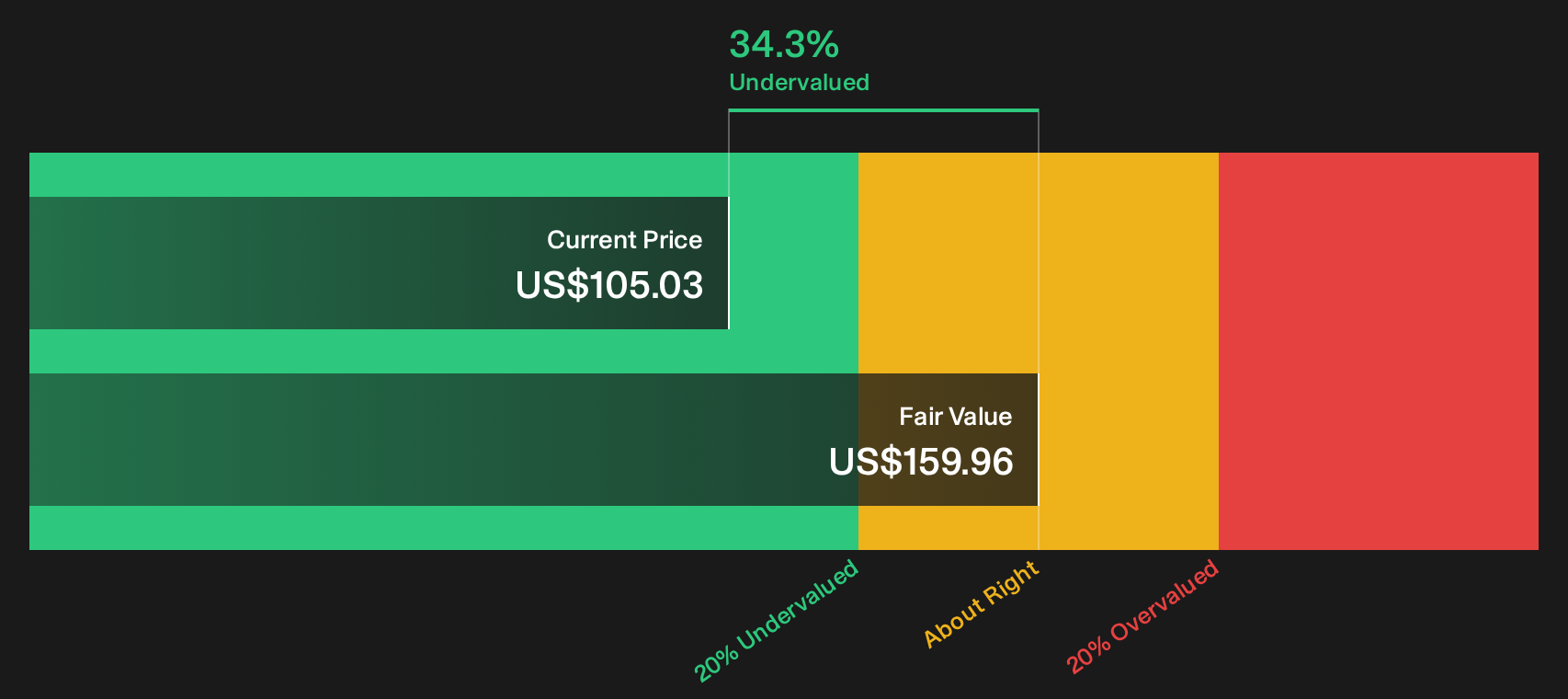
The Discounted Cash Flow (DCF) model used here projects what eBay’s future cash generation could be worth in today’s dollars. On the latest twelve month numbers, the platform produced about US$2.49b in free cash flow, and the DCF framework assumes that these cash flows keep growing rather than shrinking. Rolling those projections forward and discounting them back leads to an estimated intrinsic value of about $160 per share.
That compares with the current $105.03 share price and implies the stock trades at roughly a 34.3% discount to the cash flow based estimate. Recent moves to go fee free for private sellers in France and Italy, while adding some execution risk, help explain why the market may be hesitating even as the DCF outcome suggests the underlying cash generation supports a higher valuation.
On this cash flow view, eBay stock currently screens as undervalued relative to its estimated intrinsic value.
Our Discounted Cash Flow (DCF) analysis suggests eBay is undervalued by 34.3%. Track this in your watchlist or portfolio, or discover 33 more high quality undervalued stocks.
Where Does eBay Sit on Earnings?
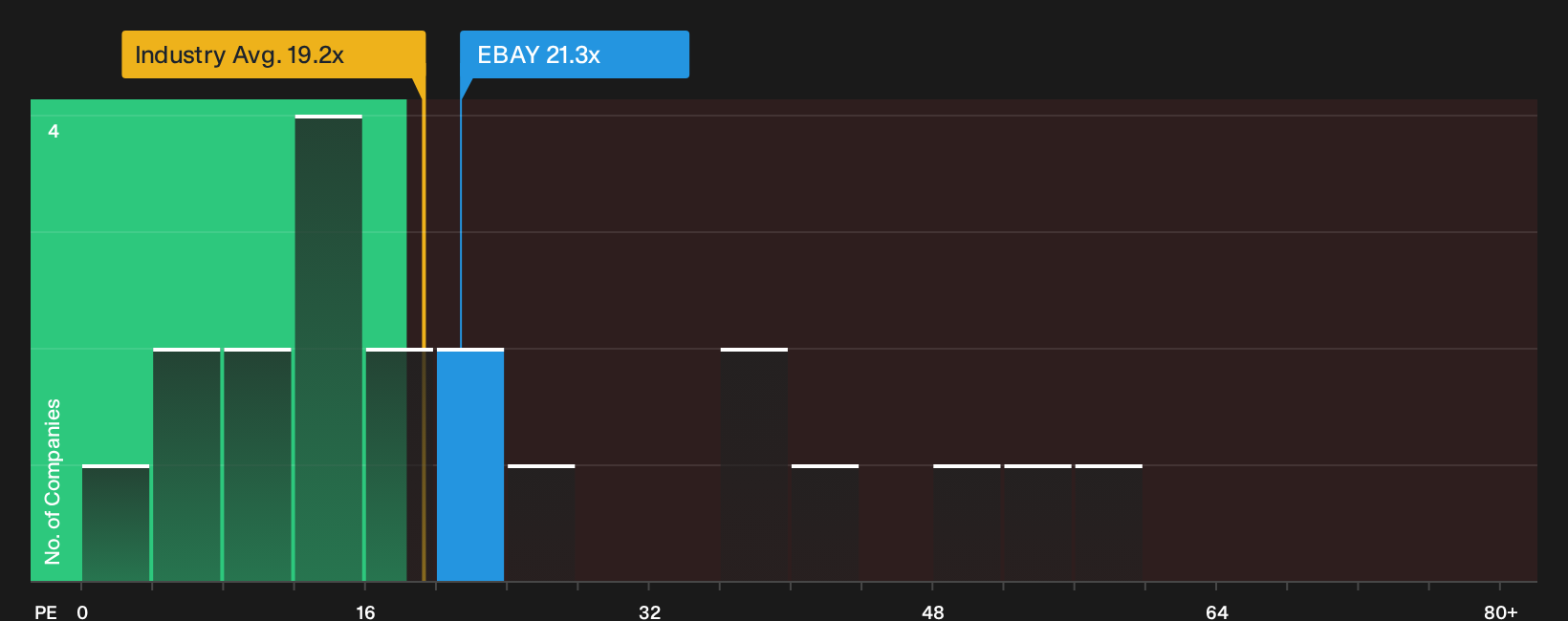
The P/E ratio is a useful way to gauge what you are paying for each dollar of eBay earnings. On this yardstick, the stock trades on about 21.3x earnings, compared with an industry average of roughly 19.2x for Multiline Retail and a peer group around 29.2x.
The tailored fair P/E for eBay, which factors in its profitability profile, size and risk, is estimated at about 20.4x. That sits very close to the current multiple, suggesting the market is pricing the shares in line with what the model sees as a reasonable earnings based valuation, even as sentiment swings around new fee policies and product changes.
On the P/E measure, eBay looks roughly fairly valued, with the share price tracking close to the earnings multiple the model flags as reasonable.
See what the numbers say about this price — find out in our valuation breakdown.
The eBay Narrative: What Would Justify Today's Price?
eBay’s valuation puzzle only really comes into focus once the assumptions behind it are made explicit. This is what Simply Wall St Narratives aim to do on the Community page by spelling out what kind of growth, margins and earnings path would need to play out for the stock to be worth significantly more or less than today’s price. Rather than relying on a single multiple or DCF output, each scenario sets out its own drivers so you can weigh those inputs against actual results as eBay reports them.
Community views on eBay pull in opposite directions, with one camp focused on AI and category depth and the other fixated on deal risk and capital structure.
Bull case: 9% undervalued
"Expansion of mobile access and innovative app experiences, including new AI-powered listing tools, personalized communications, streamlined C2C managed shipping, and eBay Live social shopping, are driving higher seller and buyer engagement, which is likely to lift active user growth, listing volume, and ultimately top-line revenue…"
Read the full Bull Case to see why eBay could be undervalued
Bear case: roughly fairly valued
"The eBay bid is not a standalone acquisition. It is the second-to-last move in a multi-year, traceable strategic architecture connecting GameStop, PSA/Collectors Holdings, eBay's existing vaulting integration, and (implied) tZERO settlement infrastructure…"
Read the full Bear Case to see why eBay could be overvalued
Do you think there's more to the story for eBay? Head over to our Community to see what others are saying!
The Bottom Line
eBay’s Discounted Cash Flow (DCF) view points to intrinsic value above the current share price, while the P/E framework suggests the stock trades close to what peers and earnings would justify. That split comes from the DCF leaning heavily on the durability and timing of cash flows, whereas the multiple reflects how much growth and re rating investors are currently willing to pay for. With broader valuation checks painting a mixed picture, the key issue is whether eBay can execute on fee and product changes without denting user behavior or profitability. The central question is whether the discount reflects opportunity or a fair pricing of that execution risk.
This article by Simply Wall St is general in nature. We provide commentary based on historical data and analyst forecasts only using an unbiased methodology and our articles are not intended to be financial advice. It does not constitute a recommendation to buy or sell any stock, and does not take account of your objectives, or your financial situation. We aim to bring you long-term focused analysis driven by fundamental data. Note that our analysis may not factor in the latest price-sensitive company announcements or qualitative material. Simply Wall St has no position in any stocks mentioned.
Have feedback on this article? Concerned about the content? Get in touch with us directly. Alternatively, email editorial-team@simplywallst.com